Band 5.5 IELTS Writing Task 1 Model Answer
Overall Band Score: 5.5 · IELTS Summit Mastery · 2026-11-26
IELTS Writing Task 1 question
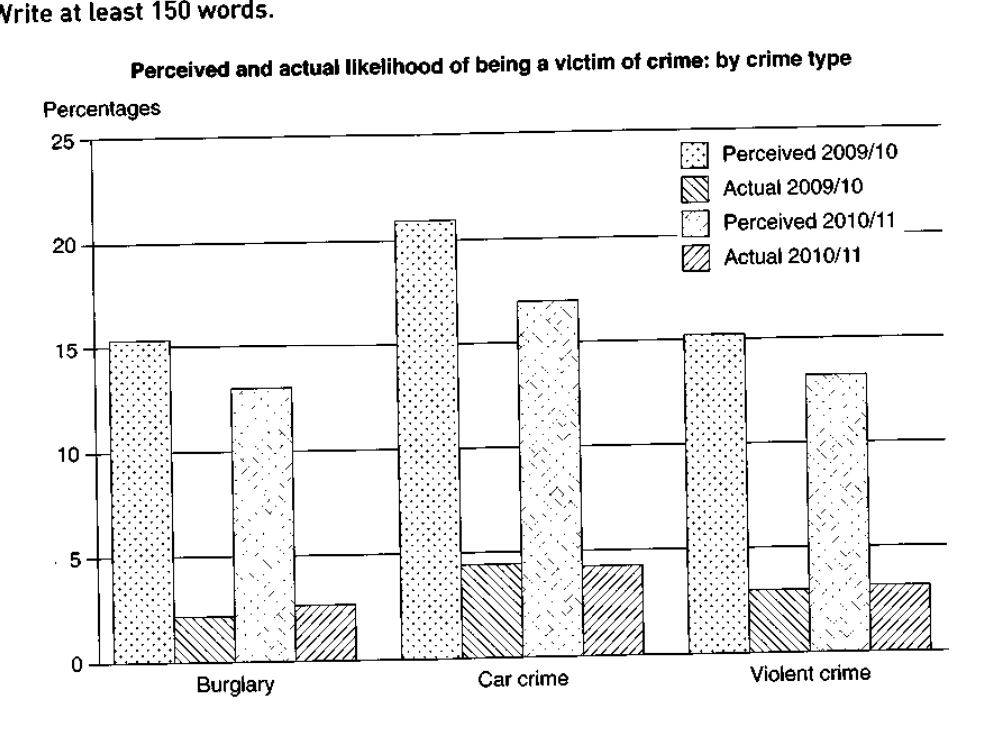
The graph below shows the perceived danger and actual likelihood of being a victim of crime.
Summarise the information by selecting and reporting the main features, and make comparisons where relevant.
Perceived and actual likelihood of being a victim of crime: by crime type
Student answer (Band 5.5)
The graph below illustrates the perceived danger and actual likelihood of being a victim of crime.
The perceived crime is higher than in actual likelihood in any type of crime the graph shows. The perceived car crime is on top and burglary and violent crime are on the same level.
In 2009/10 the car crime perceived is about 21% and in actual likelihood it is about 4%.
And in 2010/11 the perceived car crime dropped from 21% to 17% but the percentage of actual likelihood car crimes remain the same which is about 4%.
Perceived burglary and violent crimes are 15% in 2009/10 and they dropped to 13% in 2010/11. But, in actual likelihood the percentage of both crimes are very low and both remain on the same 2% percnetgae from 2009 to 2011. In actual likelihood burglary just had a small rise of 0.5% in a year but actual likelihood violent crimes remains on same percentage.
AI examiner evaluation
| Criterion | Band |
|---|---|
| Task Achievement / Task Response | 5.5 |
| Coherence and Cohesion | 5.0 |
| Lexical Resource | 5.5 |
| Grammatical Range and Accuracy | 5.5 |
| Overall | 5.5 |
Task Achievement / Task Response: Band 5.5
You identify the main contrast accurately: perceived risk is much higher than actual victimisation for all three crimes, and car crime has the highest perceived figure. You also report the broad decline in perceived figures between the two years. However, some details are inaccurate or incomplete: perceived burglary and violent crime were not both exactly 15% in 2009/10, and actual violent crime rose from about 3% to 3.5%, rather than remaining unchanged. The overview could also compare the overall pattern more clearly across all categories. The response is five words below the 150-word minimum, which further limits how fully the key features are reported.
Coherence and Cohesion: Band 5.0
The response has a basic, relevant structure: it begins with a general comparison, then discusses car crime, followed by burglary and violent crime. This gives the reader some organisation, and time markers such as “In 2009/10” help locate the data. However, progression is limited because the comparisons are presented as separate observations rather than developed into a clear overview and grouped comparisons. Linking is also repetitive, particularly the repeated use of “And” and “But,” and some references are unclear, as in “both remain on the same 2% percentage.” Use a distinct overview paragraph, then organise the details by perceived versus actual figures, with precise links between the years and crime types.
Lexical Resource: Band 5.5
You use relevant chart vocabulary, including “perceived,” “actual likelihood,” “dropped,” “rise,” and “percentage,” so the topic is generally clear. However, the range is limited and several phrases are awkward or imprecise, such as “The perceived crime is higher than in actual likelihood” and “The perceived car crime is on top.” “Remain the same” is repeated, and “percnetgae” contains a spelling error. These choices sometimes make the comparisons less natural, even though the intended meaning can usually be understood. Aim for accurate collocations such as “perceived risk,” “actual rate,” “was highest,” and “remained stable,” and vary the language used to describe increases and decreases.
Grammatical Range and Accuracy: Band 5.5
You attempt both simple and longer sentences, and the reader can usually follow the main comparisons. However, control is uneven, especially in sentence structure and subject–verb agreement. For example, “The perceived crime is higher than in actual likelihood” lacks a clear grammatical comparison, while “the percentage of actual likelihood car crimes remain the same” has an agreement error and an awkwardly formed clause. “Perceived burglary and violent crimes are 15%” also uses an unsuitable tense for past data, and the final sentence contains several clauses joined without clear punctuation. Practise forming direct comparison sentences with consistent past-tense verbs, for example, “Perceived risk of burglary and violent crime fell…” This would make the data easier to interpret.
See this exact question answered at other band scores. The same prompt compared across bands.
Browse more IELTS Writing model answers or get your own writing scored by the same AI examiner.