Band 6.0 IELTS Writing Task 1 Model Answer
Overall Band Score: 6.0 · IELTS Summit Mastery · 2026-11-27
IELTS Writing Task 1 question
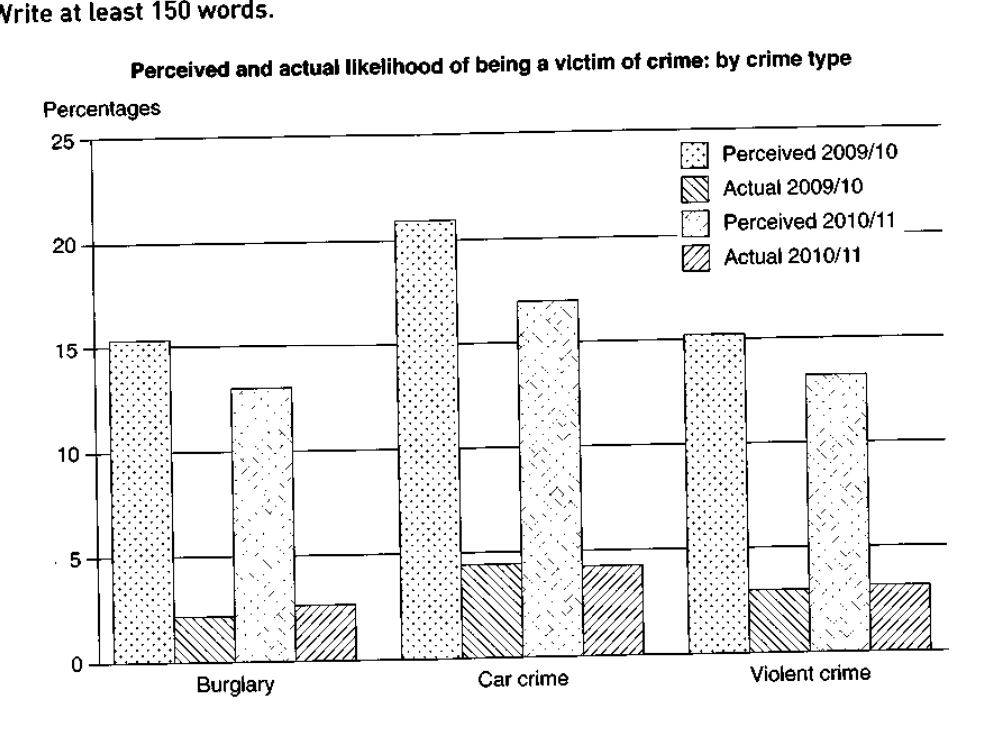
The graph below shows the perceived danger and actual likelihood of being a victim of crime.
Summarise the information by selecting and reporting the main features, and make comparisons where relevant.
Perceived and actual likelihood of being a victim of crime: by crime type
Student answer (Band 6.0)
The bar graph illustrates the percentage difference of predicted and actual likelihood of being a victim of crime in the year 2009/10 and 2010/11, divided into 3 different types.
Overall, the most noticeable feature was the significant gap between the perceived percentages and actual percentages of victim of crimes. the predicted percentages were much higher than the actual percentage of crime victims.
Firstly, the percentage of car crime victims in 2009/10 was the highest predicted percentage 21%, followed by the same type of crime's victim percentage at 17% for the year 2010/11. However, the actual percentages of victim of this type of crime was almost same in both given years 4%.
On the other hand, the prediction of burglary victims was slightly above than 15% in 2009/10, and around 13% in 2010/11. By contrast, the actual percentage of the victims accounted 5 fold lower at roughly 3% in the both years. Similarly, the predected percentage in both years of violent crime victims was the same as burglary victims, also the actual percentage were almost similar to the percentage of burglary victims for both years.
AI examiner evaluation
| Criterion | Band |
|---|---|
| Task Achievement / Task Response | 6.5 |
| Coherence and Cohesion | 6.5 |
| Lexical Resource | 5.5 |
| Grammatical Range and Accuracy | 5.5 |
| Overall | 6.0 |
Task Achievement / Task Response: Band 6.5
You identify the chart’s central contrast accurately: perceived risk is much higher than actual victimisation, and car crime has the highest perceived figures. You also compare both years for burglary and car crime. Some details are less fully reported, however. The actual car-crime figures are about 4.5% in both years, rather than simply 4%, and the actual rates for all three crimes rise slightly or remain similar; this overall pattern is not clearly stated. The claim that violent-crime perceptions were “the same as burglary” is imprecise: they are close, but differ slightly in each year. A more complete overview and precise comparisons across all categories would strengthen the response.
Coherence and Cohesion: Band 6.5
The response has a clear overall arrangement: an introduction, an overview, and two paragraphs comparing crime categories. Sequencing phrases such as “Firstly” and “By contrast” help readers follow the comparisons, and the main contrast between perceived and actual risk is easy to locate. However, the final paragraph combines burglary and violent crime without giving the latter’s figures, so its comparison is less clear and developed. Some linking is also mechanical, particularly the repeated contrast markers. Improve progression by grouping perceived figures together and actual figures together, or by treating each crime type consistently, and use explicit references such as “these rates” only when their referent is unmistakable.
Lexical Resource: Band 5.5
You use relevant chart vocabulary, including “percentage,” “predicted,” “actual,” “significant gap,” and “accounted,” so the topic is generally clear. However, several word choices and collocations are inaccurate or awkward: “percentage difference” does not describe the chart as naturally as “percentages”; “victim percentage” is unclear; and “the actual percentage of the victims accounted 5 fold lower” is not idiomatic. There is also a spelling error in “predected.” Use precise terms such as “perceived likelihood,” “actual victimisation rate,” and “was approximately one-fifth of.” Varying “percentage” with “rate” where appropriate would also make the description more fluent and precise.
Grammatical Range and Accuracy: Band 5.5
You attempt a mix of simple and complex forms, including the contrast structure “However, the actual percentages…” and the longer sentence beginning “By contrast.” The meaning is usually recoverable, but some grammatical errors remain. For example, “the most noticeable feature was…” is followed by a sentence beginning “the predicted,” which needs a capital letter; “the actual percentages … was” has subject–verb disagreement; and “the same type of crime’s victim percentage” uses an awkward possessive construction. In “the actual percentage of the victims accounted 5 fold lower,” the sentence pattern is also faulty. Check agreement, sentence boundaries, and article/plural choices, and use simpler, controlled comparison structures when unsure.
See this exact question answered at other band scores. The same prompt compared across bands.
Browse more IELTS Writing model answers or get your own writing scored by the same AI examiner.