Band 5.5 IELTS Writing Task 1 Model Answer
Overall Band Score: 5.5 · IELTS Summit Mastery · 2026-11-27
IELTS Writing Task 1 question
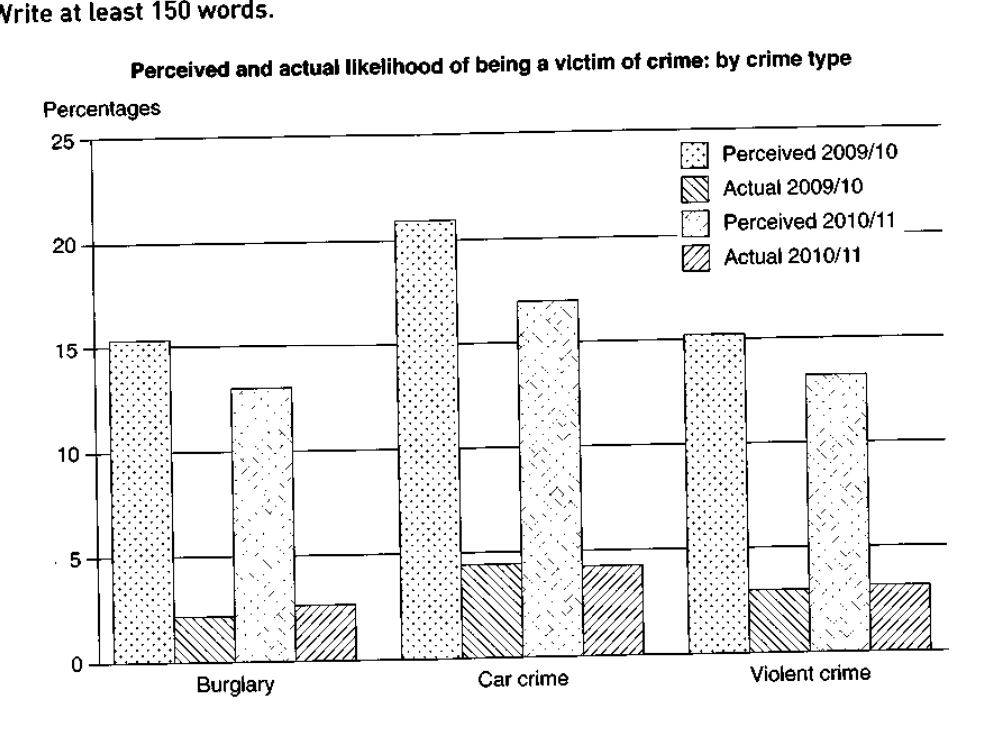
The graph below shows the perceived danger and actual likelihood of being a victim of crime.
Summarise the information by selecting and reporting the main features, and make comparisons where relevant.
Perceived and actual likelihood of being a victim of crime: by crime type
Student answer (Band 5.5)
Here's a graphical representation of the crimes that were perceived and actually take place in two thousand nine and two thousand ten. For the burglary rate the perceived amount of crime was greater and but in reality it drops to a lower level and for the car crime the similar way the perceived amount was greater and it wasn't that much crime the actual crime ratio was smaller and for the violent crime the perceived was also greater but it wasn't that much bad.
The burglary crime dropped from fifteen to two or three percent and then car crime dropped was perceived twentieth and in actyal it was three or four and violent crime was perceived fifteen but in reality it was four or five.
The main reasons of the difference in both the rates were because some people exaggerate the negativity and negativity is generally more highlighted. so people were unable to understand the actyal crime rates or ot might be possible that in the last yeras rates were bery high and then the police control the crime rate but people wre unable to assess that.
AI examiner evaluation
| Criterion | Band |
|---|---|
| Task Achievement / Task Response | 5.5 |
| Coherence and Cohesion | 5.5 |
| Lexical Resource | 5.0 |
| Grammatical Range and Accuracy | 5.0 |
| Overall | 5.5 |
Task Achievement / Task Response: Band 5.5
You identify the central contrast accurately: perceived risk is much higher than actual victimisation for burglary, car crime and violent crime. You also include several approximate figures, such as perceived burglary at about 15% and actual car crime at around 3–4%. However, the account is only partial and some details are inaccurate: the chart covers 2009/10 and 2010/11, not simply “two thousand nine and two thousand ten,” and the figures for violent crime are not consistently reported. Most importantly, you do not describe the year-to-year pattern: perceived figures fell for all three crimes, while actual figures rose slightly or stayed similar. The explanation about exaggeration and police control is speculative and not shown by the chart; focus instead on a clear overview and supported comparisons.
Coherence and Cohesion: Band 5.5
The response has some organisation: it begins by introducing the chart, then compares the three crime types, and ends with a possible explanation. This gives the reader a basic sense of the topic. However, progression is not consistently clear because several comparisons are packed into one long opening sentence, with repeated links such as “and” and “for.” The second paragraph repeats information from the first rather than developing a clear comparison between the two years. The final paragraph shifts from describing data to speculating about causes, which weakens the report’s focus. Use separate paragraphs for an overview and key details, and organise the details by year or by perceived versus actual rates. Clearer linking and less repetition would make the sequence easier to follow.
Lexical Resource: Band 5.0
You use relevant basic terms, including “perceived,” “actual,” “crime rate” and “percentage,” so the topic is generally understandable. However, the vocabulary is limited and repetitive, particularly the repeated use of “greater,” “was,” and “crime.” Some expressions are imprecise or unnatural, such as “it wasn't that much bad” and “the perceived amount was greater”; these make the comparisons less clear. There are also noticeable spelling errors, including “actyal,” “ot,” “yeras,” and “wre.” Aim for precise chart language and accurate spelling. For example, describe a figure as “higher than” another, or say that the actual rate “remained low,” rather than using vague wording about how much crime there was.
Grammatical Range and Accuracy: Band 5.0
You attempt to connect ideas in longer sentences, but the range of structures is limited and these sentences are often faulty. For example, “the perceived amount of crime was greater and but in reality it drops” combines conflicting connectors and shifts tense; “the car crime dropped was perceived twentieth” is difficult to interpret because the sentence structure is incomplete. The response also has problems with articles, verb forms and sentence boundaries, as in “the police control the crime rate” and the run-on sequence in the opening paragraph. These errors sometimes make comparisons hard to follow. Use straightforward, complete sentences first, keep past-tense reporting consistent, and check that each sentence has a clear subject and verb. Then add a few controlled comparison clauses, such as “whereas” or “while.”
See this exact question answered at other band scores. The same prompt compared across bands.
Browse more IELTS Writing model answers or get your own writing scored by the same AI examiner.