Band 5.5 IELTS Writing Task 1 Model Answer
Overall Band Score: 5.5 · IELTS Summit Mastery · 2026-11-28
IELTS Writing Task 1 question
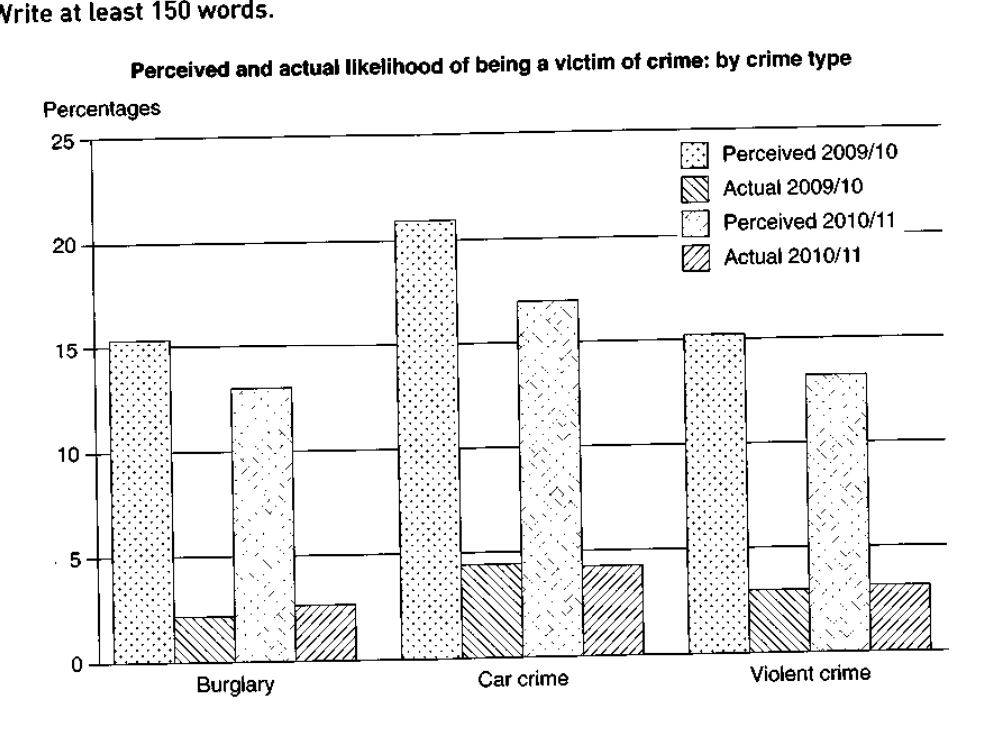
The graph below shows the perceived danger and actual likelihood of being a victim of crime.
Summarise the information by selecting and reporting the main features, and make comparisons where relevant.
Perceived and actual likelihood of being a victim of crime: by crime type
Student answer (Band 5.5)
The graph below illustrates the perceived danger and actual likelihood of being a victim of crime.
Overall, it is evident that perceived danger of experiencing crime was higher than the actual danger in both years. Car crime had the maximum perceived and actual danger, whereas burglary had the lowest actual crime rate.
For burglary in the year 2009, people assumed about 16 percent of the total crime, whereas only 2 percent occured. In 2010, the perceived crime was around 13 percent and the occurence was of approximately 2 percent crime. In 2009, the perceived crime for car crime was about 21 percent, however in real 4 percent happened. On the contrary, the assumption for actual crime was rougly 17 percent and in real 4 percent took place.
In case of violent crime in the year 2009, people assumed that 15 percent of it will take place but actually approximately 3 percent occurred. Finally, in 2010, people perceived about 16 percent for voilent crime, however in actual, it accounted for roughly 3 percent.
AI examiner evaluation
| Criterion | Band |
|---|---|
| Task Achievement / Task Response | 6.0 |
| Coherence and Cohesion | 5.5 |
| Lexical Resource | 5.5 |
| Grammatical Range and Accuracy | 5.5 |
| Overall | 5.5 |
Task Achievement / Task Response: Band 6.0
You provide a relevant overview, noting that perceived risk was higher than actual victimisation in both years, and you identify car crime as the highest perceived category and burglary as the lowest actual one. Several comparisons are supported with figures, including the 2009 perceived estimates for car crime and burglary. However, some details are inaccurate or unclear: the 2010 car-crime perceived figure is described as an “assumption for actual crime” of 17%, confusing perceived and actual data, and the 2010 violent-crime estimate is given as about 16% rather than approximately 13.5%. The actual car-crime figure is also reported as 4% rather than about 4.5%. More accurate distinction between the four series and fuller coverage of the small year-to-year changes would make the summary more complete.
Coherence and Cohesion: Band 5.5
The response has a recognisable structure: an introduction, an overview, and paragraphs describing the crime categories. This gives the reader a basic route through the information, and phrases such as “Overall” and “Finally” help signal progression. However, the body is organised mainly as a sequence of separate categories rather than making the key comparisons between years and between perceived and actual figures consistently clear. The transition “On the contrary” is confusing because the 17% figure is another perceived estimate, not a contrast with the actual figure. Some references, such as “the assumption for actual crime,” are also difficult to follow. Grouping perceived figures together and actual figures together, with clearer linking, would improve progression and cohesion.
Lexical Resource: Band 5.5
You use a reasonable range of task-related vocabulary, including “perceived,” “actual,” “occurred,” and “approximately,” and the main topic remains understandable. However, several word choices and collocations are imprecise or repetitive. “People assumed about 16 percent of the total crime” does not clearly express the proportion who thought they might be victims, while “in real 4 percent happened” is unnatural and vague. “Perceived crime” is also used where “perceived likelihood” or “perceived risk” would be more accurate. Spelling slips such as “occured,” “occurence,” “rougly,” and “voilent” reduce control. Aim for precise chart language and check spelling, while varying repeated uses of “crime” and “assumed.”
Grammatical Range and Accuracy: Band 5.5
You attempt a mix of simple and more complex sentence forms, including clauses introduced by “whereas” and “however,” and the overall meaning is generally recoverable. Some grammatical problems remain, particularly in sentence construction and punctuation. For example, “In 2009, the perceived crime for car crime was about 21 percent, however in real 4 percent happened” joins contrasting clauses awkwardly; use a full stop or a suitable conjunction and construct the second clause clearly. “The assumption for actual crime was roughly 17 percent” also creates an unclear grammatical relationship between the subject and the figure. In “people assumed … but actually approximately 3 percent occurred,” the comparison is understandable but not expressed precisely. More consistently controlled clauses and punctuation would strengthen accuracy.
See this exact question answered at other band scores. The same prompt compared across bands.
Browse more IELTS Writing model answers or get your own writing scored by the same AI examiner.