Band 7.0 IELTS Writing Task 1 Model Answer
Overall Band Score: 7.0 · IELTS Summit Mastery · 2026-11-28
IELTS Writing Task 1 question
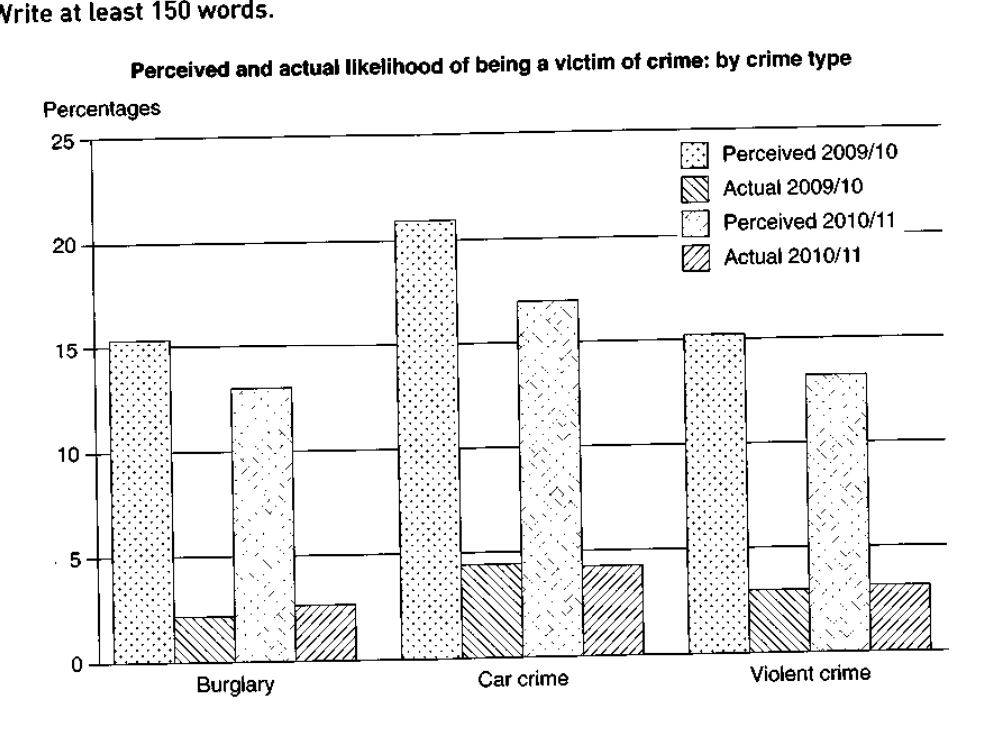
The graph below shows the perceived danger and actual likelihood of being a victim of crime.
Summarise the information by selecting and reporting the main features, and make comparisons where relevant.
Perceived and actual likelihood of being a victim of crime: by crime type
Student answer (Band 7.0)
The bar chart compares the preceived and actual chances of burglary, car crime and violent crime in the years 2009/10 and 2010/11.
Overall, it is clear that, the likelihood of being victim of actual crime is less than the perceived danger and the car crime had the highest actual chances among other crimes.
Looking at the chart in detail, there was over 15% likelihood of perceived crime through burglary in 2009/10 and its share declined below 15% in 2010/11. Car crime accounted for the highest share of perceived danger with over 20% in 2009/10 but had a drop to around 17% in 2010/11. Violent crime also experienced a decrease from about 15% to almost 13% in 2010/11 for perceived danger.
On the other hand, there was less than 5% chances of actual burglary in both 2009/10 and 2010/11. While car crime had almost 4% actual crime, violent crime made up only 3% in 2009/10. Both crimes had unchanged number in the following year.
AI examiner evaluation
| Criterion | Band |
|---|---|
| Task Achievement / Task Response | 7.0 |
| Coherence and Cohesion | 7.0 |
| Lexical Resource | 6.5 |
| Grammatical Range and Accuracy | 6.5 |
| Overall | 7.0 |
Task Achievement / Task Response: Band 7.0
You address the task with a clear overview: actual crime likelihood is much lower than perceived danger, and car crime is highest among the actual categories. The detail paragraphs cover all three crime types and both years, with broadly accurate comparisons, including the fall in perceived car crime from just over 20% to about 17%. Some figures are imprecise or over-generalised: actual car crime is described as “almost 4%” and unchanged, although it is about 4.5% in both years; actual burglary and violent crime rise slightly in 2010/11 rather than remaining unchanged. The overview could also capture the overall decline in perceived figures and slight increases in actual figures more explicitly. More precise reporting of these changes would strengthen an otherwise well-focused summary.
Coherence and Cohesion: Band 7.0
The response is organised clearly into an introduction, an overview and two detail paragraphs, and the progression from perceived to actual likelihood is easy to follow. Linking phrases such as “Overall,” “Looking at the chart in detail,” and “On the other hand” help signal the stages of the summary. The comparisons within the perceived-crime paragraph are also logically ordered by crime type. Cohesion is generally effective, though the final sentence, “Both crimes had unchanged number,” is unclear about which categories it refers to and overlooks the slight changes shown. You could improve precision by naming the categories and using a more explicit contrast between the two years. Overall, the structure supports the reader well, with only minor lapses in reference and phrasing.
Lexical Resource: Band 6.5
You use a suitable range of chart vocabulary, including “compares,” “declined,” “accounted for,” and “experienced a decrease,” and the meaning remains clear throughout. There is some flexibility in describing proportions and trends, but several choices are imprecise or unnatural for this task. “Chances of actual crime” is less accurate than a phrase describing the likelihood of being a victim, while “share” suggests a proportion of a whole rather than a percentage likelihood. “Actual chances” is also repeated, and “preceived” is misspelled. These issues do not prevent understanding, but more consistent, precise collocations would improve control. Aim to distinguish perceived risk from recorded likelihood and use standard terms such as “percentage” or “rate” where appropriate.
Grammatical Range and Accuracy: Band 6.5
You use a mix of simple and complex structures, including the contrastive sentence beginning “While car crime…” and clauses describing changes across the two years. Most sentences communicate the intended comparisons, but some grammatical errors remain. In the overview, “the likelihood of being victim” needs an article, and the comma after “clear that” is unnecessary. The phrase “there was less than 5% chances” has a number-agreement problem, and “Both crimes had unchanged number” lacks a natural grammatical construction. The sentence about violent crime also needs a clearer structure for the change from one year to the next. These are generally understandable, but checking articles, singular/plural agreement and sentence punctuation would make the writing more accurate.
See this exact question answered at other band scores. The same prompt compared across bands.
Browse more IELTS Writing model answers or get your own writing scored by the same AI examiner.