Band 4.5 IELTS Writing Task 1 Model Answer
Overall Band Score: 4.5 · Cambridge IELTS 17 · 2026-11-09
IELTS Writing Task 1 question
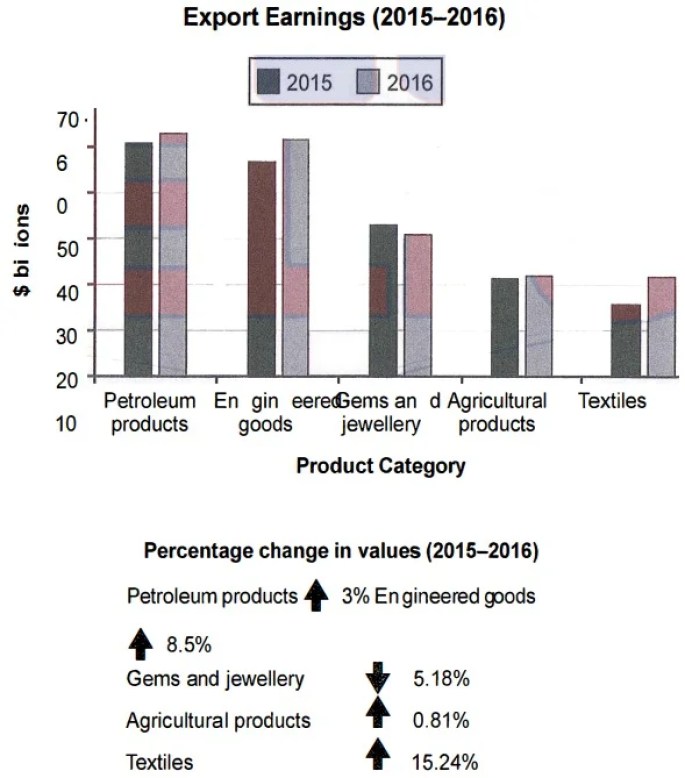
below shows the value of one country’s exports in various categories during 2015 and 2016. The table shows the percentage change in each category of exports in 2016 compared with 2015.
Summarise the information by selecting and reporting the main features, and make comparisons where relevant.
Student answer (Band 4.5)
a country exports between 2015 and 2016, there is some category about the exports. there are petroleum product, engineered goods, germs and jewellery, agricultural products, and the last one textile.
as we can see from the table shows like from 2016 the highest percentage product is petroleum product almost 70 bilions, and if we compare to 2015 is not a huge different change. not only a petroleum product, also enginereed goods almost same with petroleum product exports.
and for the agricultural products also not a big different within 2015 and 2016. we can see for the textiles maybe a huge comperations between 2015 and 2016.
in conclusion, the highest export product was petroleum product for 2015 and 2016 and follow by engineered goods. and the lowest one was textiles.
AI examiner evaluation
| Criterion | Band |
|---|---|
| Task Achievement / Task Response | 4.0 |
| Coherence and Cohesion | 5.0 |
| Lexical Resource | 4.5 |
| Grammatical Range and Accuracy | 5.0 |
| Overall | 4.5 |
Task Achievement / Task Response: Band 4.0
You identify the export categories and give a basic overall comparison, noting that petroleum products were highest and that engineered goods were next. However, the response reports very few accurate details from the chart: petroleum exports were about $61–63 billion, not “almost 70,” and textiles were not the lowest in 2016; gems and jewellery were lower. The claim that textiles showed a “huge” difference is not explained with figures, while the substantial rise in engineered goods and the fall in gems and jewellery are missed. The overview is therefore incomplete and some comparisons are inaccurate. The response also contains 129 words, below the required 150. Add a fuller overview and support comparisons with the chart’s key values and directions of change.
Coherence and Cohesion: Band 5.0
The response has a recognisable sequence: it introduces the categories, comments on several comparisons, and ends with a conclusion. Paragraph breaks help separate these stages, and phrases such as “as we can see” and “in conclusion” signal the writer’s intentions. However, progression is limited because the middle paragraphs mention categories without systematically comparing the two years, and the conclusion repeats the opening observation rather than drawing together the main trends. Some linking is awkward or repetitive, including “not only a petroleum product, also engineered goods.” Organise the body around the clearest changes—for example, increases, stability, and decline—and use precise references such as “by contrast” to make relationships between figures clearer.
Lexical Resource: Band 4.5
You use basic task-related vocabulary, including “exports,” “percentage,” “highest,” and “compare,” so the general subject is understandable. However, the range is limited and several choices or spellings make the description imprecise: “germs” appears to mean “gems,” “huge comperations” does not express a clear comparison, and “not a huge different change” is awkward. The repeated use of “product” and “big” also limits precision. Use standard category names and vocabulary suited to describing data, such as “export value,” “rose,” “remained stable,” and “declined.” More accurate collocations would help you report trends clearly without relying on vague descriptions.
Grammatical Range and Accuracy: Band 5.0
You attempt some longer sentence forms, including “if we compare to 2015” and “we can see for the textiles,” and the reader can generally follow the intended topic. However, sentence structures are often incomplete or faulty. The opening, “a country exports between 2015 and 2016,” lacks a clear subject and main verb, while “as we can see from the table shows” combines two incompatible constructions. There are also errors in articles, plurals, and agreement, as in “there is some category” and “the highest percentage product is.” Most sentences rely on simple patterns, so the range remains limited. Practise complete subject–verb sentences and use a consistent past-tense frame, for example: “Petroleum exports rose from about $61 billion to $63 billion.”
See this exact question answered at other band scores. The same prompt compared across bands.
Browse more IELTS Writing model answers or get your own writing scored by the same AI examiner.