Band 5.0 IELTS Writing Task 1 Model Answer
Overall Band Score: 5.0 · Cambridge IELTS 17 · 2026-11-19
IELTS Writing Task 1 question
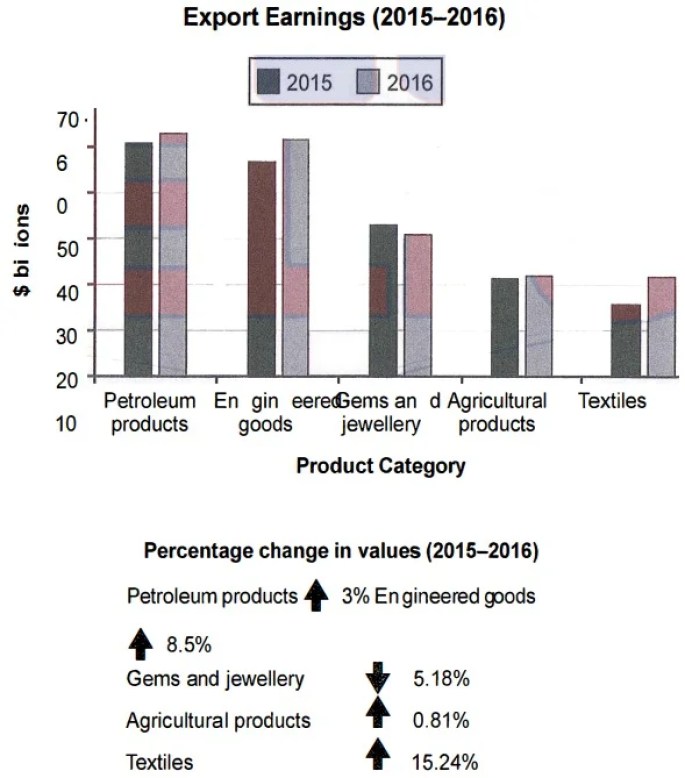
below shows the value of one country’s exports in various categories during 2015 and 2016. The table shows the percentage change in each category of exports in 2016 compared with 2015.
Summarise the information by selecting and reporting the main features, and make comparisons where relevant.
Student answer (Band 5.0)
First of all we will look at the comparison of petroleum products which have 60% earnings in 2015 while have 63% in 2016 that means in 2016 the earning value is increased by 3%.Then we see the earning percentage of En gineered goods which are 70% in 2016 and 61.5% in 2015.The earning value is increased by 8.5% in 2016 as compared to 2015.Gems and jewellery have to face 5.18% less earnings in 2016 as in 2015 the earning value is 52% but in 2016 it becomes to 46.82%.Agriculture products earnings have increased by 0.81% in 2016 as they have 40% earnings in 2015 but now they have increased to 40.81%.At the last we saw the earning values of textiles which are massively increased by 15.24% in 2016 as compared to 2015.In 2015 its value is 35% and then in 2016 it increased to 42% which have good impacts in the textiles market.
AI examiner evaluation
| Criterion | Band |
|---|---|
| Task Achievement / Task Response | 4.5 |
| Coherence and Cohesion | 5.0 |
| Lexical Resource | 5.5 |
| Grammatical Range and Accuracy | 5.5 |
| Overall | 5.0 |
Task Achievement / Task Response: Band 4.5
The response identifies the five export categories and reports several percentage changes, so it is relevant to the task. However, the figures are repeatedly misread: for example, engineered goods are described as 70% and 61.5%, whereas the chart shows about $57 billion and $62 billion; gems are given as 52% and 46.82%, rather than about $43 billion and $41 billion. The response also confuses dollar values with percentages and does not provide a clear overview of the main pattern, such as textiles having the strongest growth and gems being the only category to decline. To improve, distinguish export earnings in billions from the percentage-change figures and summarise the key trends before listing details.
Coherence and Cohesion: Band 5.0
The categories are presented in a generally understandable sequence, and phrases such as “First of all,” “Then,” and “At the last” signal movement through the data. However, the response is one continuous paragraph and reads mainly as a list, without a clear overview or grouping of related trends. Some transitions are repetitive, and the repeated pattern of naming a category, giving figures, and stating a change does not create a strong overall progression. Organise the response into an introduction and overview, followed by one or two detail paragraphs. Group categories that increased separately from the category that declined, and use linking expressions to show comparisons rather than simply moving from one item to the next.
Lexical Resource: Band 5.5
The response uses relevant topic vocabulary, including “earnings,” “increased,” “decreased,” and “percentage,” and the category names are mostly recognisable. However, the wording is repetitive, particularly the repeated use of “earning value” and “increased,” and some expressions are imprecise or unnatural, such as “have to face 5.18% less earnings” and “which have good impacts.” The repeated use of “%” for values that should be expressed in billions also makes the description less precise. Build a more varied range of accurate chart language, such as “stood at,” “rose to,” “recorded a decline,” and “export revenue,” while ensuring that the vocabulary matches the units shown.
Grammatical Range and Accuracy: Band 5.5
The response attempts some longer sentences using clauses such as “while” and “as compared to,” and the intended meaning is usually recoverable. However, sentence structures are repetitive, and errors in agreement, tense, articles, and punctuation occur throughout. For example, “which have 60% earnings” has faulty agreement, while “in 2016 it becomes to 46.82%” uses an incorrect verb form. Several sentences run together without spaces after full stops, as in “3%.Then,” which also affects readability. Practise forming accurate comparisons with a consistent past tense, and separate each sentence with correct punctuation. More controlled complex sentences would help express the data clearly.
See this exact question answered at other band scores. The same prompt compared across bands.
Browse more IELTS Writing model answers or get your own writing scored by the same AI examiner.