Band 6.0 IELTS Writing Task 1 Model Answer
Overall Band Score: 6.0 · Cambridge IELTS 17 · 2026-11-20
IELTS Writing Task 1 question
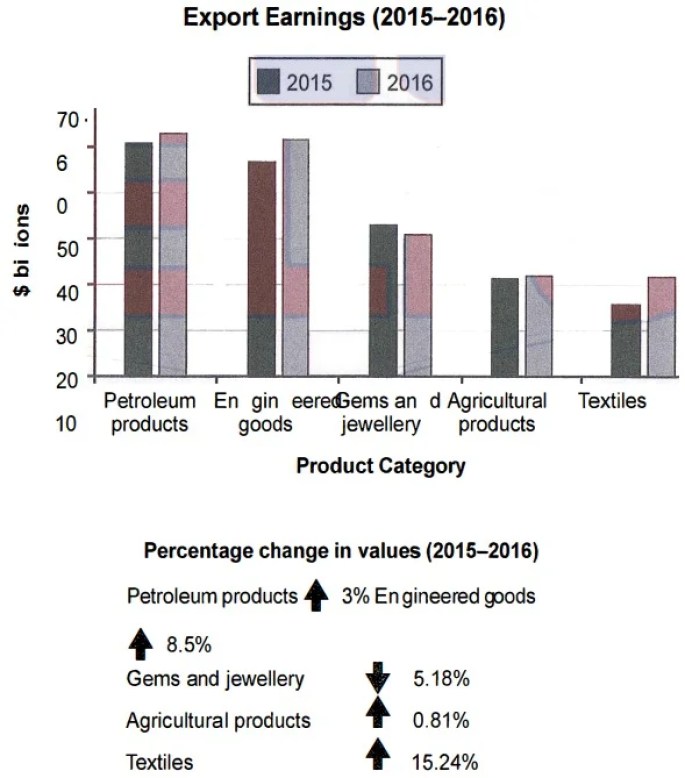
below shows the value of one country’s exports in various categories during 2015 and 2016. The table shows the percentage change in each category of exports in 2016 compared with 2015.
Summarise the information by selecting and reporting the main features, and make comparisons where relevant.
Student answer (Band 6.0)
The bar graph compares the percentages and prices of export of goods of a particular country in 2016 and 2015.
Overall, there are variety of goods that are exported by this country. For example petroleum, engineered, agricultural and textile products are exported to other countries in billions of dollars. Petroleum products are sold on the highest prices and scale, in contrast, textile products are sold on the lowest prices.
In 2015, At first petroleum product sales are 60 billion dollars, then the countries sales minimally raises by 3% in 2016. Secondly the engineered good sales are lower than petroleum products, in one year the figure of engineered goods increase by 8.5%. Thirdly gems products sales follow opposite trend by decrease in it's sales about 5.18%., while agricultural products sales remains stable with minimal change of only 0.81% in one year. At last, textile product sales are the lowest, but, a visible change is seen it's sale from ([redacted phone]). Textile enhanced it's sale by 15.24% in 2016.
AI examiner evaluation
| Criterion | Band |
|---|---|
| Task Achievement / Task Response | 6.0 |
| Coherence and Cohesion | 6.0 |
| Lexical Resource | 5.5 |
| Grammatical Range and Accuracy | 5.5 |
| Overall | 6.0 |
Task Achievement / Task Response: Band 6.0
You cover the main categories and report the key direction of change for each, including the rise in petroleum and engineered goods, the fall in gems and jewellery, and the near-stability of agricultural exports. Your overview also identifies petroleum as the highest-value category and textiles as the lowest in 2015. However, the overview is partly inaccurate: textiles were not the lowest in 2016, as agricultural products remained at about $31 billion while textiles rose to about $31 billion. The response also omits several useful comparisons, such as engineered goods reaching roughly $62 billion and overtaking petroleum in percentage growth only, not value. Develop the overview around the overall ranking and the contrast between the largest and fastest-growing categories, and report more actual values alongside the percentages.
Coherence and Cohesion: Band 6.0
The response has a recognisable structure: an introduction, an overview and a paragraph describing the categories. The sequence through the five product groups makes the information easy to follow, and transitions such as “Secondly” and “At last” signal progression. However, these numbered transitions feel mechanical, and the final paragraph reads more like a list than a comparison of the data. Some links between ideas are unclear, particularly “while agricultural products sales remains stable with minimal change,” which combines stability with a reported percentage change without explaining the relationship. Grouping categories by trend—for example, increases, the decline in gems, and near-stability—would create a clearer progression. Use referencing and linking phrases more naturally to connect comparisons.
Lexical Resource: Band 5.5
You use relevant topic vocabulary, including “export,” “petroleum products,” “engineered goods,” “agricultural products,” and “percentage,” so the reader can identify the categories and trends. There are also attempts at more descriptive language, such as “opposite trend” and “visible change.” However, several word choices and collocations are inaccurate or unnatural: “prices” is used where the chart shows export values, “sales minimally raises” is awkward, and “textile enhanced it's sale” does not express the increase clearly. Repetition of “sales” and “products” also limits flexibility. Choose precise terms such as “export earnings,” “value,” “rose,” and “declined,” and use standard forms such as “textiles” and “gems and jewellery” to describe the categories accurately.
Grammatical Range and Accuracy: Band 5.5
You attempt a mixture of simple and more complex sentences, including comparisons and clauses introduced by “while” and “but.” The main trends are generally understandable, but some grammatical errors recur. For example, “there are variety of goods” needs an article, and “the countries sales minimally raises” has problems with possession, agreement and verb form. In “agricultural products sales remains stable,” the subject and verb do not agree, while “it's sale” uses the wrong possessive form. Capitalisation after “In 2015,” and punctuation around “5.18%., while” also need attention. Aim for accurate, straightforward reporting structures first, then add complex clauses; check articles, subject–verb agreement, apostrophes and sentence punctuation.
See this exact question answered at other band scores. The same prompt compared across bands.
Browse more IELTS Writing model answers or get your own writing scored by the same AI examiner.