Band 5.5 IELTS Writing Task 1 Model Answer
Overall Band Score: 5.5 · Cambridge IELTS 17 · 2026-11-27
IELTS Writing Task 1 question
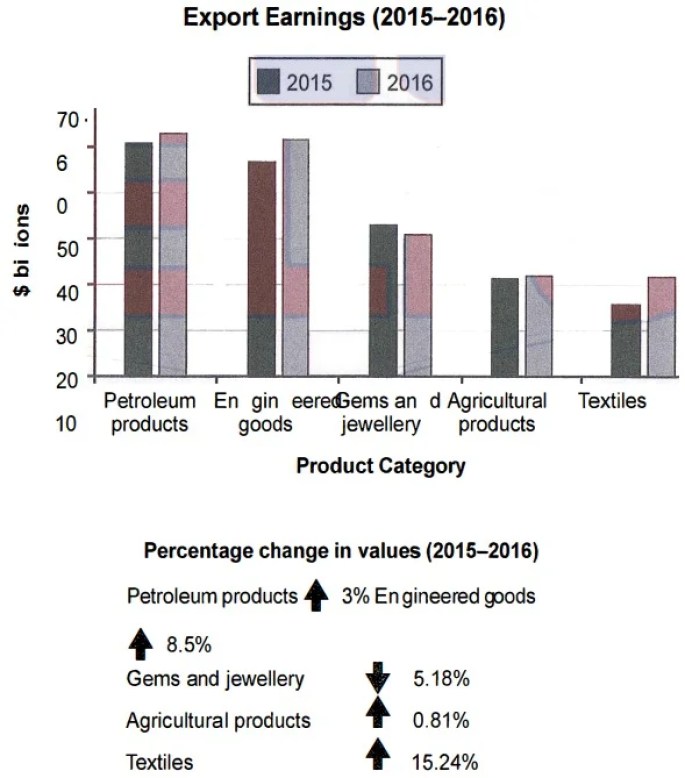
below shows the value of one country’s exports in various categories during 2015 and 2016. The table shows the percentage change in each category of exports in 2016 compared with 2015.
Summarise the information by selecting and reporting the main features, and make comparisons where relevant.
Student answer (Band 5.5)
The chart illustrates the export incomes of the product in the year 2015 to 2016. Overall, the earning through petroleum products and engineering goods were top of the tier and also increases the exports with the agricultural products and textiles. Whereas, gems and jewellery deline in the exportation.
The export increased to 3% for the petroleum products and then a huge increase is noticed in the sectors of engineering goods which was increased by 8.5% in one year. Another slight increase in agricultural products which is 0.81%. And a massive demand in a year in the textiles which was 15.24% leads the exportation sectors. But the product which faces decline is the sector of gems and jewellery.
In addition, the earning through petroleum goods lead the list where the revenue was more than 60 billion closed to the second lead which is engineering goods. Furthermore, gems and jewellery faced downward trend and its earning was around 50 billion. Finally, agricultural goods and textiles earn nearly 45 billion.
AI examiner evaluation
| Criterion | Band |
|---|---|
| Task Achievement / Task Response | 5.5 |
| Coherence and Cohesion | 5.5 |
| Lexical Resource | 5.5 |
| Grammatical Range and Accuracy | 5.5 |
| Overall | 5.5 |
Task Achievement / Task Response: Band 5.5
You identify the main broad pattern: petroleum and engineered goods are the highest-earning categories, while gems and jewellery decline and the other categories rise. You also include several percentage changes accurately, including 3%, 8.5%, 0.81% and 15.24%. However, some key comparisons are unclear or inaccurate. The final paragraph says gems and jewellery earned around $50 billion, although the chart shows about $43 billion in 2015 and $41 billion in 2016; it also groups agricultural products and textiles as earning nearly $45 billion, when both are closer to $26–31 billion. The overview would be stronger if it clearly stated that textiles had the largest percentage rise and agricultural products changed very little, while distinguishing the approximate values in each year.
Coherence and Cohesion: Band 5.5
The response has a recognisable structure, with an opening overview followed by paragraphs describing percentage changes and export values. This gives the reader a basic route through the information. However, progression is weakened by the way details are divided: the second paragraph lists changes, while the final paragraph returns to values without consistently comparing 2015 with 2016. Some linking is also awkward or repetitive, such as repeated uses of “Furthermore” and “Finally,” and the opening “Whereas” fragment is not smoothly connected to the preceding sentence. Organise the body around clear comparisons—for example, the highest-value categories first, then the lower-value categories—and use links that show contrast or change precisely.
Lexical Resource: Band 5.5
You use some relevant chart vocabulary, including “export,” “revenue,” “downward trend” and “decline,” and the category names are generally recognisable. However, several word choices and collocations are inaccurate or unnatural, which limits precision: “export incomes of the product,” “top of the tier,” “deline in the exportation,” and “massive demand” do not describe the chart clearly. The chart reports export values, not demand, so “massive demand” also introduces an unsupported interpretation. Spelling and word-form problems such as “deline” and “engineering” where “engineered goods” is intended further affect clarity. Prefer standard data-reporting phrases such as “export earnings,” “ranked highest,” and “recorded a decline.”
Grammatical Range and Accuracy: Band 5.5
You attempt both simple and more complex sentence forms, including a contrast with “Whereas” and clauses describing changes over time. However, control is inconsistent, and several sentences contain errors in agreement, tense, or sentence construction. For example, “the earning … were top” has a singular/plural mismatch, while “the sectors of engineering goods which was increased” has faulty agreement and an unnecessary passive construction. “Another slight increase in agricultural products which is 0.81%” is a fragment, and “Finally, agricultural goods and textiles earn” uses an unsuitable verb form for reporting past figures. Build complete sentences with a clear subject and verb, and use past-tense forms consistently when describing 2015–2016 data.
See this exact question answered at other band scores. The same prompt compared across bands.
Browse more IELTS Writing model answers or get your own writing scored by the same AI examiner.