Band 4.5 IELTS Writing Task 1 Model Answer
Overall Band Score: 4.5 · IELTS Momentum Workout · 2026-11-05
IELTS Writing Task 1 question
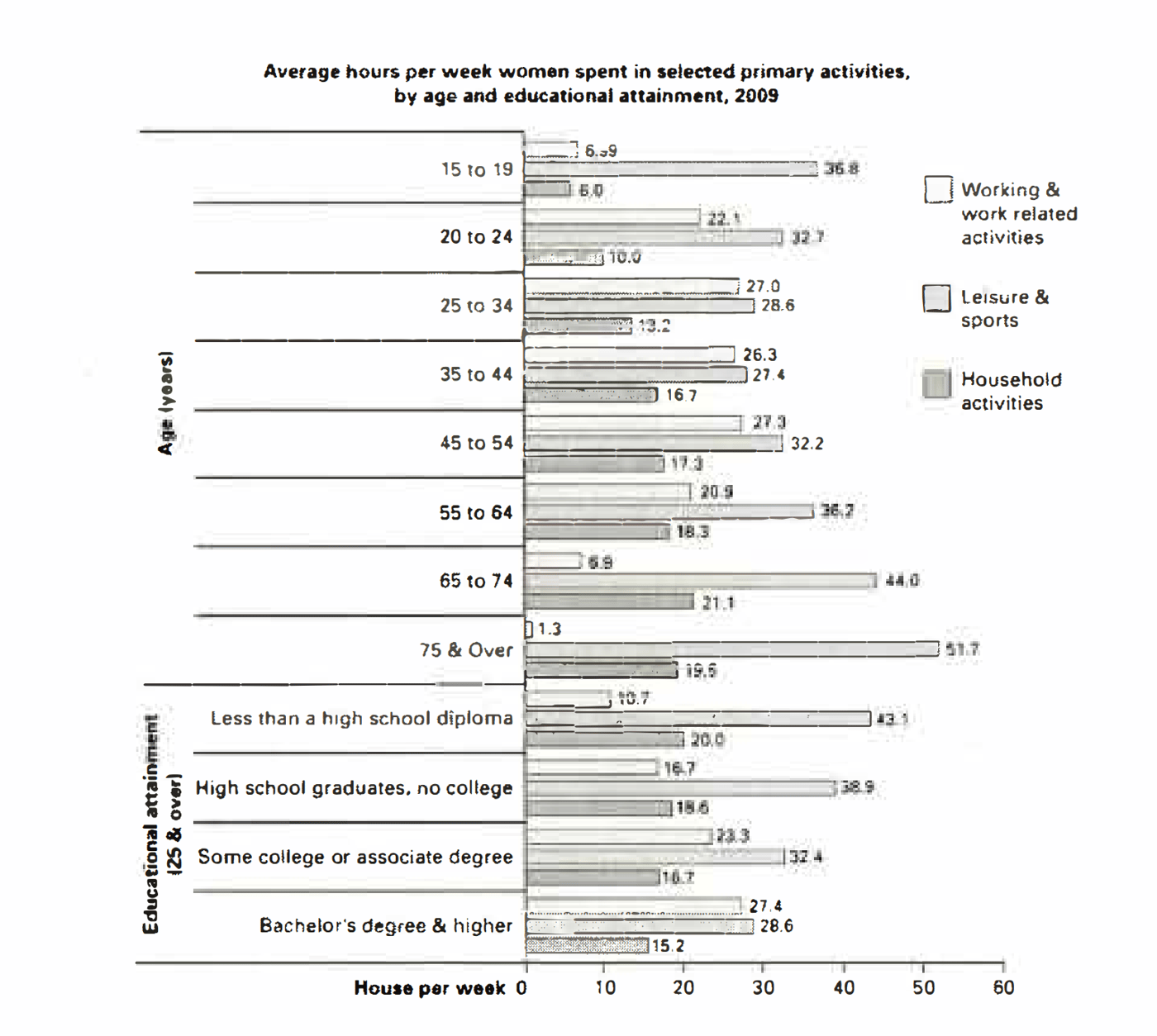
The bar chart below shows the average number of hours that women in various age groups and women with varying levels of education spend on primary activities each week.
Summarise the information by selecting and reporting the main features, and make comparisons where relevant.
Average hours per week women spent in selected primary activities, by age and educational attainment, 2009
Student answer (Band 4.5)
The bar chart shows the average number of hours that woman in various age groups and woman with varying levels of education spend on primary activities each week.
Overall, it will we clearly seen, that free & sports are the most activities in the every age.household activity lowest in 15 to 75 age.
To begin with, in 2009,15 to 44 age, favorit activity is the free time and sports because people like to more leisure time and games ratherthan other works. in the same age household activities more less than other activites in 15 to 19 only 6.0,20 to 24 only 4 ponit increse reached just 10.0, and 35 to 44 16.7.
Futhermore, others activities are same intreste like leisure time and games more like activites and household on more like however work related activities like but free time is he first one favrouit activity. 75 & over leisure time gruallyincresase they reached 51.7 other activity to more like in this years
AI examiner evaluation
| Criterion | Band |
|---|---|
| Task Achievement / Task Response | 4.0 |
| Coherence and Cohesion | 4.5 |
| Lexical Resource | 4.5 |
| Grammatical Range and Accuracy | 4.5 |
| Overall | 4.5 |
Task Achievement / Task Response: Band 4.0
The response identifies the chart’s general subject and attempts an overview, but it reports the main features only minimally, which is why the account remains limited. The claim that leisure and sports are the leading activity is broadly true for the age groups, and the figure of 51.7 hours for women aged 75 and over is accurate. However, the overview that household activity is lowest “in 15 to 75 age” is unclear and overlooks that work is also very low among the youngest and oldest groups. The education data are not discussed at all, and several age-group comparisons are incomplete or inaccurate: for example, household activity for ages 20–24 is 10.0, not “4 point increase” as presented. Select key trends across both categories and support them with accurate comparisons.
Coherence and Cohesion: Band 4.5
There is a basic attempt to organise the response with an introduction, an overview, and sequencing phrases such as “To begin with” and “Furthermore.” These provide some signposting, but the progression is difficult to follow because the body does not group the chart’s information clearly and the final paragraph repeats broad claims rather than developing a comparison. References such as “other activities” and “in the same age” are not always clear, while the discussion shifts between leisure, household tasks, and work without a consistent structure. A clearer plan would be to summarise the age trends in one paragraph and educational attainment in another, using comparisons to connect the figures. This would make the relationships between the data easier to understand.
Lexical Resource: Band 4.5
The response uses some relevant chart vocabulary, including “average number of hours,” “household activities,” “work related activities,” and “leisure time.” However, the range is basic and repetitive, with “activities” and “like” used repeatedly, and several word choices or collocations make the meaning difficult to interpret. For instance, “free & sports” is not a clear label for “leisure & sports,” and “favorit activity” does not accurately describe the chart category. Spelling errors such as “Futhermore,” “gruallyincresase,” and “favrouit” also reduce clarity. Use the chart’s category names consistently and choose precise verbs such as “rise,” “decline,” or “peak” to describe trends.
Grammatical Range and Accuracy: Band 4.5
The response attempts both simple statements and longer sentences, but control is uneven and errors frequently make relationships between ideas hard to follow. For example, “Overall, it will we clearly seen” has an incorrect verb construction, while “household activity lowest in 15 to 75 age” lacks a verb and has an unclear age reference. The sentence beginning “in the same age household activities…” also combines several figures without clear sentence boundaries, and punctuation is often missing after introductory phrases and numbers. There is little evidence of reliably controlled complex sentence structure. Practise forming complete subject–verb sentences, checking singular and plural agreement, and separating comparisons into shorter sentences before attempting longer structures.
See this exact question answered at other band scores. The same prompt compared across bands.
Browse more IELTS Writing model answers or get your own writing scored by the same AI examiner.