Band 5.5 IELTS Writing Task 1 Model Answer
Overall Band Score: 5.5 · IELTS Momentum Workout · 2026-11-08
IELTS Writing Task 1 question
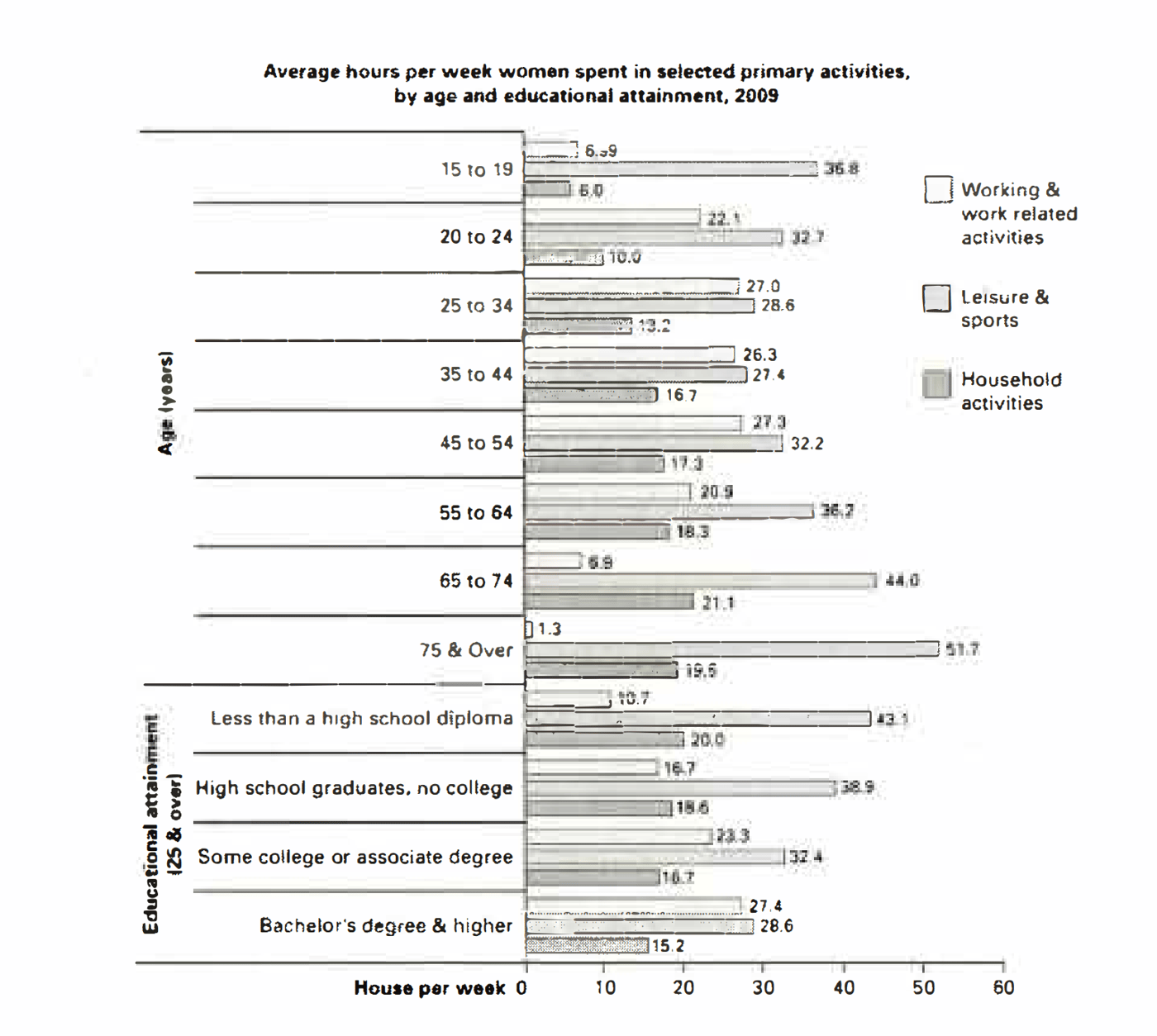
The bar chart below shows the average number of hours that women in various age groups and women with varying levels of education spend on primary activities each week.
Summarise the information by selecting and reporting the main features, and make comparisons where relevant.
Average hours per week women spent in selected primary activities, by age and educational attainment, 2009
Student answer (Band 5.5)
The chart illustrates the average number of hours per week that women in eight different age groups and four educational attainment groups spend on primary activities.
Overall, working hours generally increased until middle age before declining among older women. Time spent on household activities also rose with age, reaching a peak among women aged 65–74 before falling slightly in the oldest age group. Furthermore, working hours increased with educational attainment.
Women aged 45 to 54 spent about 30 hours per week on work. the figure slighlty declined as age increased. Considerably, older women , aged 65 and above spend most of their time on leisure. Household activities ,particularly were done by 65 to 74 years old females.
Regarding education , women with higher educatio spent most of their time working, such as about 27.4 women spent approximately 30 hours per week working.
AI examiner evaluation
| Criterion | Band |
|---|---|
| Task Achievement / Task Response | 5.0 |
| Coherence and Cohesion | 5.5 |
| Lexical Resource | 5.5 |
| Grammatical Range and Accuracy | 5.0 |
| Overall | 5.5 |
Task Achievement / Task Response: Band 5.0
You introduce the chart and provide an overview of several genuine patterns, including the rise and later fall in work among age groups and the increase in household activity into older age. However, the response only partially reports the data: it gives almost no specific comparisons across the age groups or education categories, and the final example is unclear (“about 27.4 women spent approximately 30 hours”). The claim that women aged 65 and above spend most of their time on leisure is broadly supported, but the household-activity peak is at 65–74, not simply a general feature of that group. Include accurate figures and compare leisure, work and household time across both sets of categories. The response is also 8 words below the required minimum.
Coherence and Cohesion: Band 5.5
The response has a recognisable structure: an introduction, an overview and two short sections addressing age and education. This gives the reader a basic route through the information. However, the body paragraphs are very brief and do not develop a clear sequence of comparisons; the education paragraph, in particular, ends with an incomplete or confusing comparison. Linking expressions such as “Overall,” “Furthermore” and “Regarding education” help signal shifts, but some connections are abrupt, and the comma use around phrases such as “particularly” interrupts the flow. Organise the details into fuller comparisons—for example, age trends first, then educational trends—and connect each figure explicitly to the point it supports.
Lexical Resource: Band 5.5
You use some relevant chart vocabulary, including “average number of hours,” “age groups,” “educational attainment,” “declined” and “peak.” This is enough to communicate the general subject and some trends. However, the range is limited, and several choices are imprecise or awkward: “working hours” can suggest paid working time rather than the chart’s work-related activities, while “Household activities particularly were done” is unnatural and unclear. There are also spelling errors in “slighlty” and “educatio,” which reduce accuracy. Use precise terms for the three categories and vary comparison language, such as “accounted for,” “spent on,” “exceeded” and “was highest among,” while checking spelling carefully.
Grammatical Range and Accuracy: Band 5.0
You produce some clear sentences, such as “The chart illustrates the average number of hours per week…” and the overview sentence describing household activity. There is also an attempt to use a subordinate clause in “before declining among older women.” However, the range is limited, and errors recur in the body. “the figure slighlty declined” begins with an uncapitalised word after a full stop and uses an unclear subject; “older women … spend” shifts tense from the past context; and “about 27.4 women spent” has a faulty sentence structure. Punctuation is also inconsistent, with spaces before commas. Build accurate comparisons using complete past-tense sentences, and proofread sentence boundaries, agreement and punctuation.
See this exact question answered at other band scores. The same prompt compared across bands.
Browse more IELTS Writing model answers or get your own writing scored by the same AI examiner.