Band 5.5 IELTS Writing Task 1 Model Answer
Overall Band Score: 5.5 · IELTS Momentum Workout · 2026-11-09
IELTS Writing Task 1 question
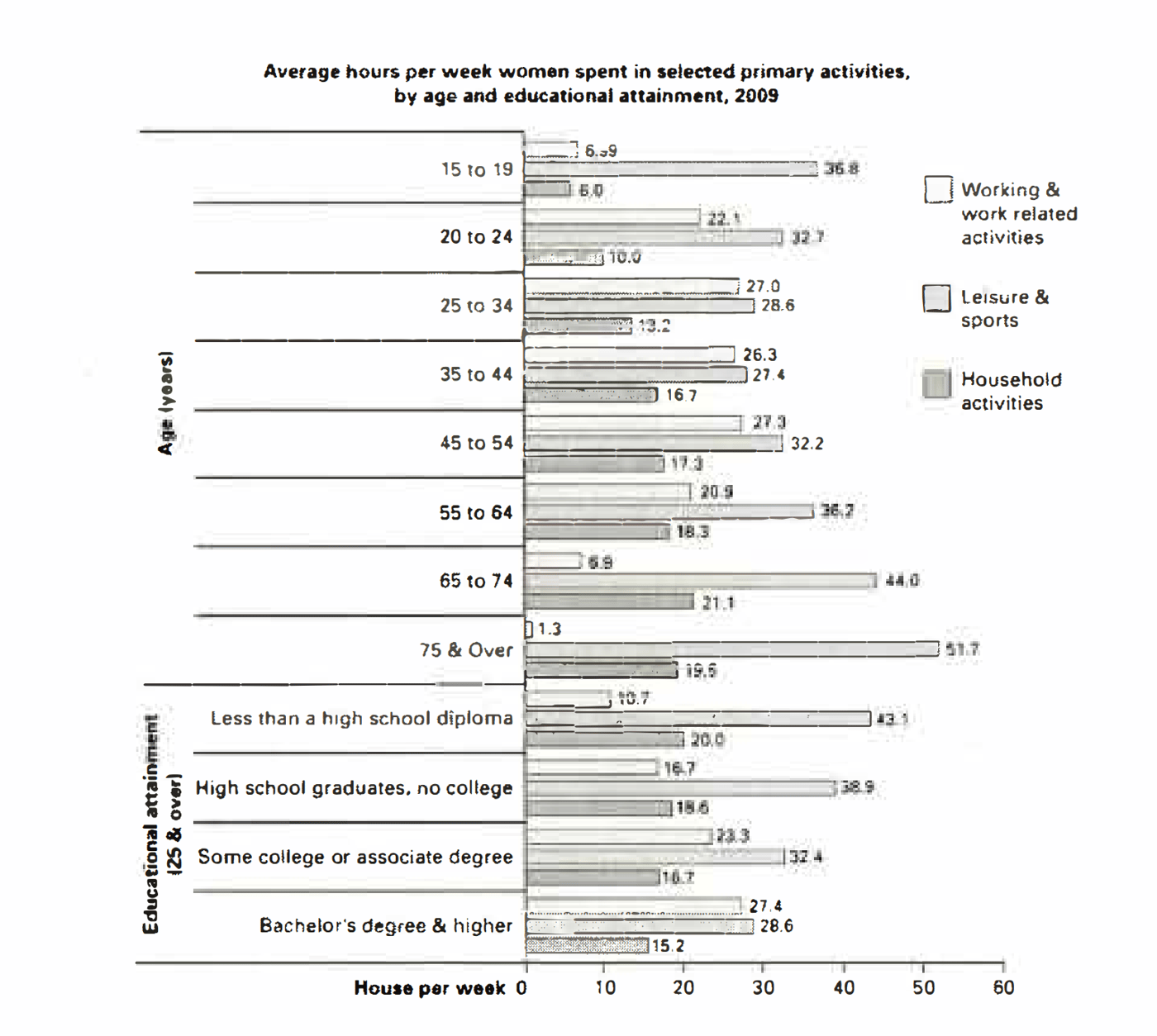
The bar chart below shows the average number of hours that women in various age groups and women with varying levels of education spend on primary activities each week.
Summarise the information by selecting and reporting the main features, and make comparisons where relevant.
Average hours per week women spent in selected primary activities, by age and educational attainment, 2009
Student answer (Band 5.5)
The bar chart demonstrate average number of hour that women of different age groups and women with higher or lower level of qualification spends on primary activities every week.
Overall, younger and middle-aged women spend most time working, while other women spend most time on leisure.
Looking at the age, women whose are older 75 years or more are play a significant role in leisure and sports activities approximately 51.7 hour. However the women who belong to age group of 65 to 74 are mostly engage in working and work related activities. On the other hand older than 25 years old who mostly hold the bachelor's degree or higher are actively participating in all type of activities.
Regarding to education, women with bachelor's degree or higher work 27.4 hours compared to only 10.7 hours for those with less than a high school diploma. However, the less educated group spends 43.1 hours on leisure and 20.0 hours household activities, both higher than the figure for graduates.
AI examiner evaluation
| Criterion | Band |
|---|---|
| Task Achievement / Task Response | 5.5 |
| Coherence and Cohesion | 6.0 |
| Lexical Resource | 5.5 |
| Grammatical Range and Accuracy | 5.5 |
| Overall | 5.5 |
Task Achievement / Task Response: Band 5.5
You provide an overview and include relevant comparisons, especially the contrast between degree holders’ working hours (27.4) and the least-educated group’s (10.7), as well as the latter group’s leisure and household figures. However, the overview is inaccurate: younger and middle-aged women do not generally spend the most time working; leisure is higher for most age groups, and household activity is highest among older women. The claim that women aged 65–74 are mainly engaged in work is also incorrect: they spend 44.0 hours on leisure, compared with 6.9 on work. The age-group discussion is therefore unclear and underdeveloped, and the statement about degree holders participating in “all type” of activities does not make a meaningful comparison. Select the dominant trends accurately and support them with clear figures.
Coherence and Cohesion: Band 6.0
The response has a recognisable structure: an introduction, an overview, an age-related paragraph and an education-related paragraph. This gives the reader a coherent overall arrangement, and transitions such as “Overall,” “However” and “Regarding to education” signal changes in focus. However, the age paragraph moves between older age groups and educational attainment, making its progression difficult to follow. Some linking is also mechanical or does not express the intended relationship clearly, as in “On the other hand” before the statement about degree holders. Organise the body consistently around age and education, and group the main comparisons within each section. Clearer references to the groups being compared would also improve cohesion.
Lexical Resource: Band 5.5
You use relevant chart vocabulary, including “average,” “qualification,” “leisure and sports,” and “household activities,” and you attempt more formal expressions such as “participating” and “compared to.” However, several word choices and collocations are inaccurate or awkward, which sometimes makes the meaning unclear. For example, “play a significant role in leisure” does not naturally describe time spent on an activity, and “actively participating in all type of activities” is vague. “Higher or lower level of qualification” is also less precise than language describing educational attainment. Aim for straightforward, accurate reporting verbs and collocations, such as “spent,” “recorded,” and “accounted for,” and use the chart’s category labels consistently.
Grammatical Range and Accuracy: Band 5.5
You attempt a mix of simple statements and longer sentences, including comparisons joined with “while” and “compared to.” Meaning is generally recoverable, but errors in agreement, verb forms, articles and sentence construction occur across the response. For instance, “The bar chart demonstrate” needs subject–verb agreement, while “women … spends” should use a plural verb. The construction “women whose are older 75 years or more are play” combines an incorrect relative form with an incorrect verb pattern. There are also problems in “women who belong to age group” and “all type of activities.” Practise accurate basic sentence patterns first, then build complex comparisons around them; this will make your range more effective and reduce errors.
See this exact question answered at other band scores. The same prompt compared across bands.
Browse more IELTS Writing model answers or get your own writing scored by the same AI examiner.