Band 5.0 IELTS Writing Task 1 Model Answer
Overall Band Score: 5.0 · IELTS Momentum Workout · 2026-11-09
IELTS Writing Task 1 question
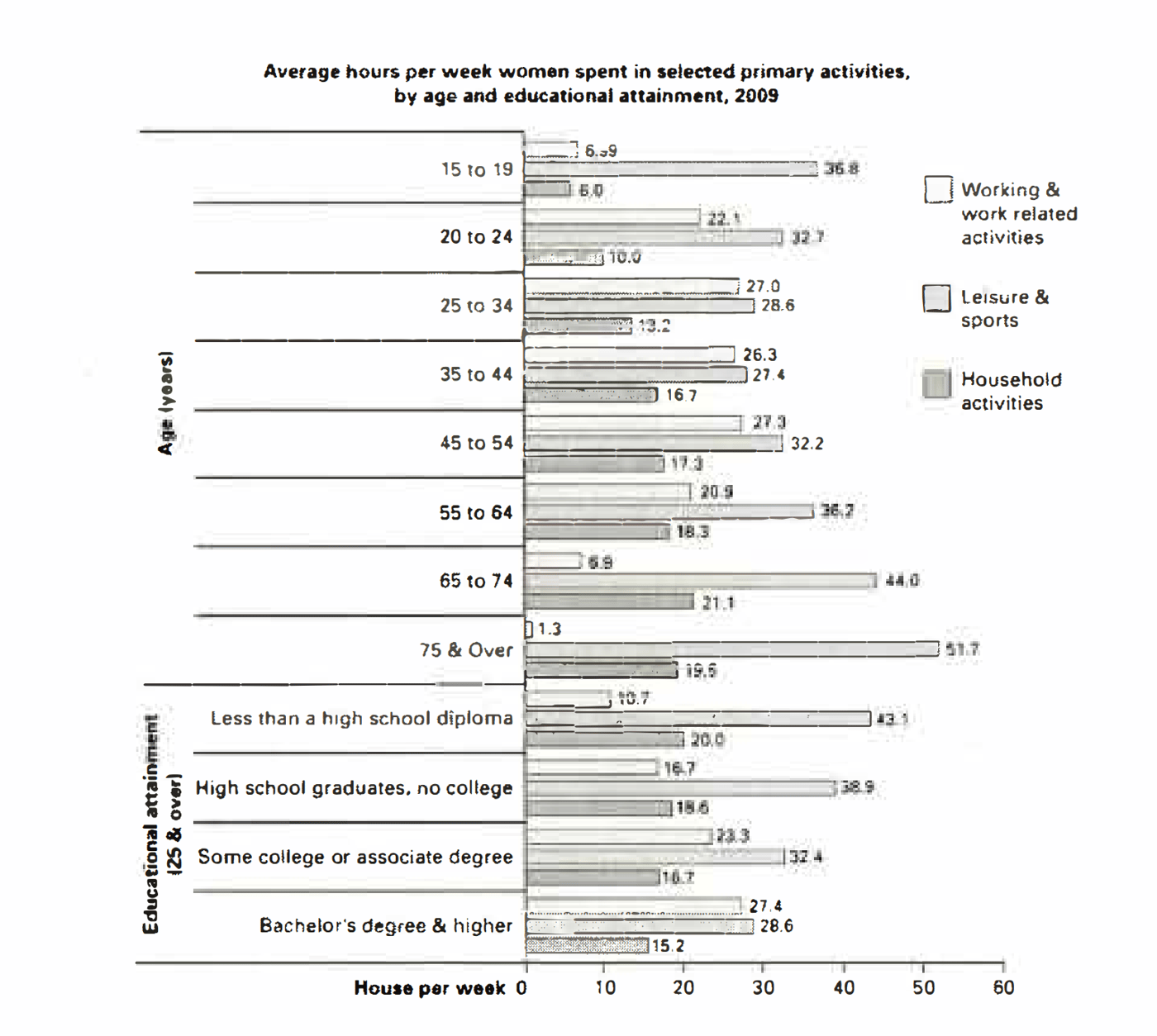
The bar chart below shows the average number of hours that women in various age groups and women with varying levels of education spend on primary activities each week.
Summarise the information by selecting and reporting the main features, and make comparisons where relevant.
Average hours per week women spent in selected primary activities, by age and educational attainment, 2009
Student answer (Band 5.0)
The bar chart tells us about the ratio of women in 2009 spent average hours per week in various primary activities.The given activities includes working and work related activities, leisure and sports, household activities.
In year 2009, the graph shows the different age group with different ratio of activities done by women.
At the young teen age, household activities done more than other activities now coming to the starting of adult age there is some decreasment in household and increasment in both leisure and sports as well as in work related activities. The household activity kept decreasing till 35 to 44 age then there is increasment from 45 to 54 till 75 and over after that it again decreases because of educational attainment in women.
Coming towards leisure and sports activity, it kept decreasing from teenage to 35 to 44 age then the ratio rose up till 75 and over and again fell as for educational attainment.
At last we have work related activities which is quite a common sense for all of us that employed women do more than the house wife itself.
AI examiner evaluation
| Criterion | Band |
|---|---|
| Task Achievement / Task Response | 4.0 |
| Coherence and Cohesion | 5.0 |
| Lexical Resource | 5.0 |
| Grammatical Range and Accuracy | 5.0 |
| Overall | 5.0 |
Task Achievement / Task Response: Band 4.0
The response identifies the chart’s three activities and attempts to describe changes across age groups, but it only minimally reports the data. There is no clear overview of the main comparisons, and several statements are inaccurate: household activity does not decrease until ages 35–44; it generally rises from 6 hours among teenagers to a peak of 21.1 hours at 65–74, then falls slightly. Leisure also rises again after 35–44, reaching 51.7 hours for women aged 75 and over. The education groups are not presented as a continuation of the age trend, so saying the figures change “because of educational attainment” confuses two separate categories. Include a concise overview and support it with accurate comparisons and selected figures.
Coherence and Cohesion: Band 5.0
There is some organisation: the response introduces the chart and then discusses household activities, leisure, and work in turn. However, the progression is difficult to follow because age groups and educational attainment are mixed together, particularly in the sentence about household activity falling “because of educational attainment.” The repeated transitions “At last” and “Coming towards” do not clearly signal relationships between the data, and the final comment about employed women and housewives does not connect to a specific chart comparison. Use separate paragraphs for the age and education data, and organise each around a clear trend, with linking phrases that show contrast or change accurately.
Lexical Resource: Band 5.0
The response uses a basic range of relevant terms, including “household activities,” “leisure and sports,” and “work related activities,” so the reader can identify the chart’s subject. However, vocabulary is repetitive and several choices are inaccurate or unnatural, such as “ratio” for hours, “decreasment,” “increasment,” and “the house wife itself.” These choices sometimes make the intended meaning harder to understand. Use precise chart language such as “number of hours,” “rose,” “declined,” and “women who were employed.” Also avoid conversational phrases such as “quite a common sense”; a neutral, data-focused style is more appropriate for an academic summary.
Grammatical Range and Accuracy: Band 5.0
The response attempts some longer sentences, but control is inconsistent, and errors frequently affect clarity. For example, “The bar chart tells us about the ratio of women in 2009 spent average hours” has an unclear clause structure, while “The given activities includes” has subject–verb disagreement. Articles and sentence boundaries are also problematic, as in “At the young teen age” and the run-on opening sentence, where no space follows the full stop. Most sentences rely on simple patterns or loosely joined clauses, so the range is limited. Build clearer sentences with a subject and verb, check agreement and articles, and use full stops to separate distinct trends.
See this exact question answered at other band scores. The same prompt compared across bands.
Browse more IELTS Writing model answers or get your own writing scored by the same AI examiner.