Band 6.0 IELTS Writing Task 1 Model Answer
Overall Band Score: 6.0 · IELTS Momentum Workout · 2026-11-10
IELTS Writing Task 1 question
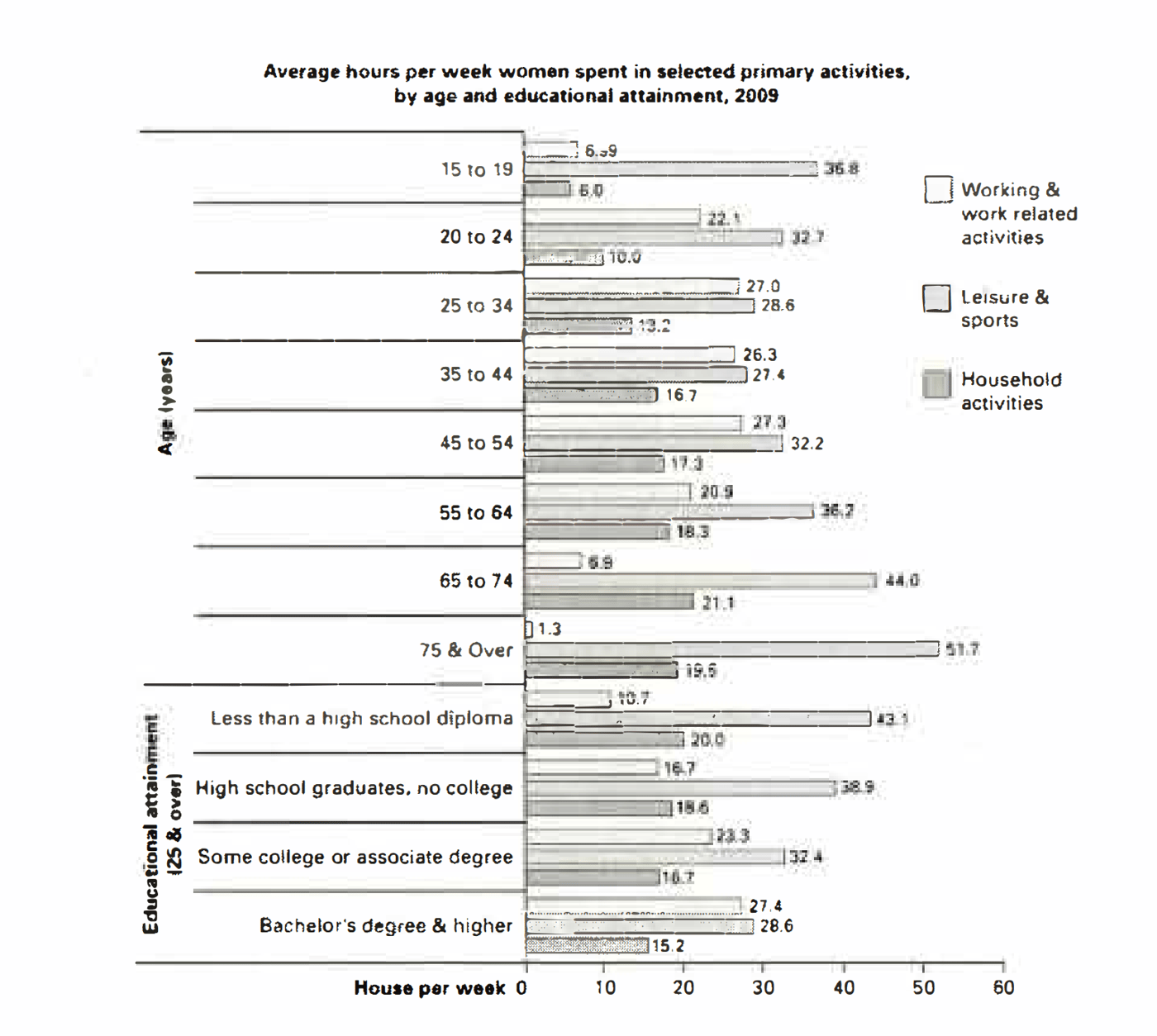
The bar chart below shows the average number of hours that women in various age groups and women with varying levels of education spend on primary activities each week.
Summarise the information by selecting and reporting the main features, and make comparisons where relevant.
Average hours per week women spent in selected primary activities, by age and educational attainment, 2009
Student answer (Band 6.0)
The bar charts illustrate how women from different age and educational background spent their average week hours in selected primary activities in 2009.
Overall, women with no high school diploma and older women spent more time in leisure & sports. Women with bachelor's degree spent less of their time in househhold chores whereas older women had the highest hours per week in household activities. They also had the lowest amount spent in working.
Women aged around 15 to 19 spent most their week hours in leisure&sports which is 36.8. This was also same for both older women aged 75 and above and women who have no high school diploma. But they spent more than 40 hours a week in this. Women who had bachelor's or master's spent most of their time working. Surprisingly, they spent more time in leisure and sports than their work which is around 28.6 hours a week.
High school graduates also spent on average 38.9 hours a week in leisure & sports. The least amount of time spent in working and work related activities were the women aged 75 and above, only 1.3 hours a week. Women aged between 35 to 44 spent around 16.7 hours a week in household chores.
AI examiner evaluation
| Criterion | Band |
|---|---|
| Task Achievement / Task Response | 6.0 |
| Coherence and Cohesion | 5.5 |
| Lexical Resource | 6.0 |
| Grammatical Range and Accuracy | 6.0 |
| Overall | 6.0 |
Task Achievement / Task Response: Band 6.0
You identify several relevant patterns, including the high leisure figure for women aged 75 and over, the low working figure for this group, and the rise in household activity time with age. The overview also notes that women with higher education spend less time on household activities. However, some comparisons are unclear or inaccurate: women with a bachelor’s degree spend the most time working among the education groups, but they do not spend most of their time working overall, since leisure is slightly higher (28.6 versus 27.4 hours). The claim that women aged 15–19 spent “most” of their week in leisure is also imprecise, as this is the largest of the three activities, not most of all weekly hours. Cover the main trends more systematically and clarify comparisons.
Coherence and Cohesion: Band 5.5
The response has a recognisable structure: an introduction, an overview, and two detail paragraphs. This gives the reader a coherent general route through the information. However, the progression within the detail paragraphs is uneven: age groups and education categories are mixed, and the final paragraph shifts from education back to age without a clear organising principle. Linking phrases such as “This was also same” and “Surprisingly” do not always make the relationship between comparisons clear, while “They” has an uncertain reference. Group the age data together and the education data together, and use explicit comparisons to guide the reader through each group.
Lexical Resource: Band 6.0
You use an adequate range of task-related vocabulary, including “leisure & sports,” “household activities,” “educational background,” and “working and work related activities.” These terms make the chart’s categories generally clear, and phrases such as “the least amount” help express comparisons. Some word choices and collocations are less natural or imprecise, however: “average week hours,” “spent most their week hours,” and “the highest hours per week” could be expressed more idiomatically. There are also spelling and form slips, notably “househhold,” and inconsistent phrasing for the chart categories. Aim for concise, standard expressions such as “hours per week” and “spent the most time,” while keeping category labels consistent.
Grammatical Range and Accuracy: Band 6.0
You use a mix of simple and more complex forms, including the overview sentence beginning “Women with bachelor's degree…” and the relative clause “women who have no high school diploma.” Most meanings remain understandable, but some grammatical errors affect accuracy. Examples include “women from different age and educational background” (number agreement), “spent most their week hours” (missing determiner), and “Women who had bachelor's or master's” (incomplete noun phrase). The sentence “Surprisingly, they spent more time in leisure and sports than their work” also has an unclear comparison structure. Check articles, plural forms, and parallel comparisons, and ensure pronouns have clear antecedents. More consistently accurate complex sentences would strengthen the report.
See this exact question answered at other band scores. The same prompt compared across bands.
Browse more IELTS Writing model answers or get your own writing scored by the same AI examiner.