Band 5.5 IELTS Writing Task 1 Model Answer
Overall Band Score: 5.5 · IELTS Momentum Workout · 2026-11-10
IELTS Writing Task 1 question
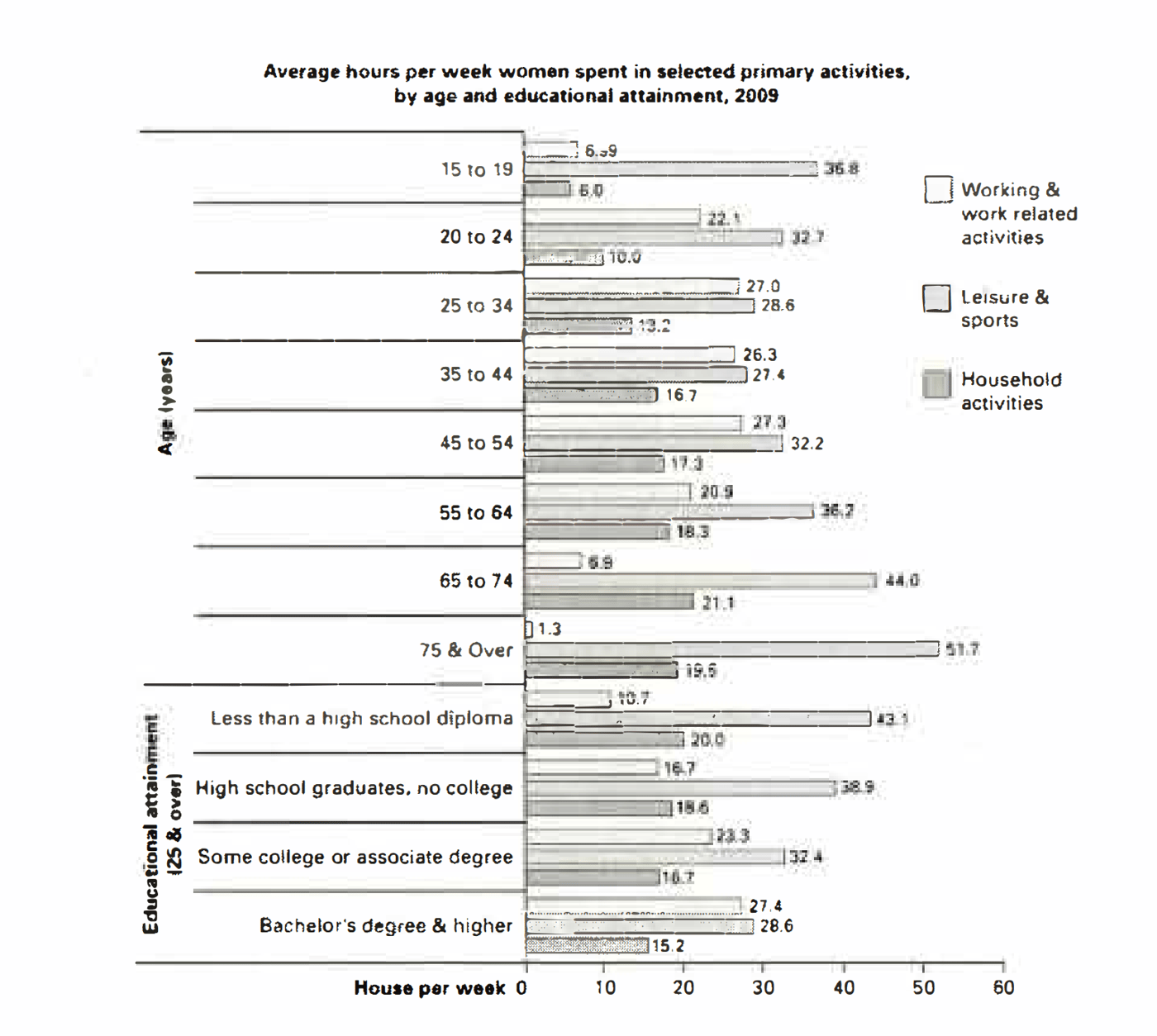
The bar chart below shows the average number of hours that women in various age groups and women with varying levels of education spend on primary activities each week.
Summarise the information by selecting and reporting the main features, and make comparisons where relevant.
Average hours per week women spent in selected primary activities, by age and educational attainment, 2009
Student answer (Band 5.5)
The bar chart compares the average time spent by women on primary activities per week. The comparison is between multiple age groups and women with different levels of education in the year 2009.
Overall, it is clear from the graph that majority of the women utilize their time in leisure and sports activities while the number of working women is very low in approximately in every group.
It is noticed that teenagers and old women above 75 spend most of their time in leisure and sports activities while number of working women is low in teenage but it increases significantly with their ages. Same goes for household activities as well as they increases with age but it reduces at the age of 75.
The number of women with leisure and sports activities is highest for women with less than high school diploma and lowest for bachelor's degrees. Working women are mostly from bachelors degree and very few from high school diplomas. But most surprising thing is that the household women are mostly from less than high school diplomas and very few from bachelor's degree.
AI examiner evaluation
| Criterion | Band |
|---|---|
| Task Achievement / Task Response | 5.5 |
| Coherence and Cohesion | 5.5 |
| Lexical Resource | 5.5 |
| Grammatical Range and Accuracy | 5.5 |
| Overall | 5.5 |
Task Achievement / Task Response: Band 5.5
You identify the chart’s two comparison groups and give an overview that leisure is prominent, then discuss age and education separately. Some key patterns are also recognised: work is highest among women with a bachelor’s degree or higher, and leisure is highest among the least-educated group. However, several claims are too broad or inaccurate. Work is not “very low in approximately every group”: it reaches about 26–27 hours for women aged 25–54 and 27.4 hours for degree holders. The age trend is not a steady increase, since work falls after 45–54 and drops sharply in older groups. Household activity rises to 65–74 before declining, rather than simply increasing with age. More precise comparisons and a clearer overview of these contrasting trends would strengthen the report.
Coherence and Cohesion: Band 5.5
The response has a recognisable structure: an introduction, an overview, and separate paragraphs for age and educational attainment. This helps the reader follow the broad categories being discussed. However, progression within the paragraphs is limited, and several points are presented as a sequence of general claims rather than being organised around clear comparisons. For example, the age paragraph moves from teenagers and older women to work and household activities without showing the key changes across the intervening groups. Linking phrases such as “Same goes for” are informal and do not clearly connect the data. Grouping related trends and using explicit contrasts—such as “by contrast” or “while”—would make the comparisons more coherent and cohesion less repetitive.
Lexical Resource: Band 5.5
You use relevant chart vocabulary, including “average time,” “age groups,” “leisure and sports,” “household activities,” and “increases significantly.” This gives you enough language to communicate the main subject and some trends. However, several expressions are imprecise or awkward for describing statistical data: “the number of working women” suggests a headcount, although the chart reports hours, and “household women” is unclear. Phrases such as “utilize their time” and “most surprising thing” are also less suitable for a neutral report. Aim for accurate collocations such as “hours spent on work,” “time devoted to household activities,” and “the highest figure.” More precise vocabulary would help distinguish time values from numbers of people.
Grammatical Range and Accuracy: Band 5.5
You attempt a mixture of simple statements and longer sentences, and the overall meaning is generally understandable. However, errors in agreement, articles, and sentence construction recur. For example, “majority of the women utilize” needs an article (“the majority”) and a singular verb (“utilizes”); “they increases” has incorrect subject–verb agreement; and “the household women are mostly from” is structurally unclear. The sentence beginning “It is noticed that” also combines several ideas without a clear grammatical relationship. Use shorter, controlled comparisons alongside a few accurate complex sentences, and check each subject against its verb. This would make the report easier to read while retaining some variety in sentence structure.
See this exact question answered at other band scores. The same prompt compared across bands.
Browse more IELTS Writing model answers or get your own writing scored by the same AI examiner.