Band 4.5 IELTS Writing Task 1 Model Answer
Overall Band Score: 4.5 · IELTS Momentum Workout · 2026-11-10
IELTS Writing Task 1 question
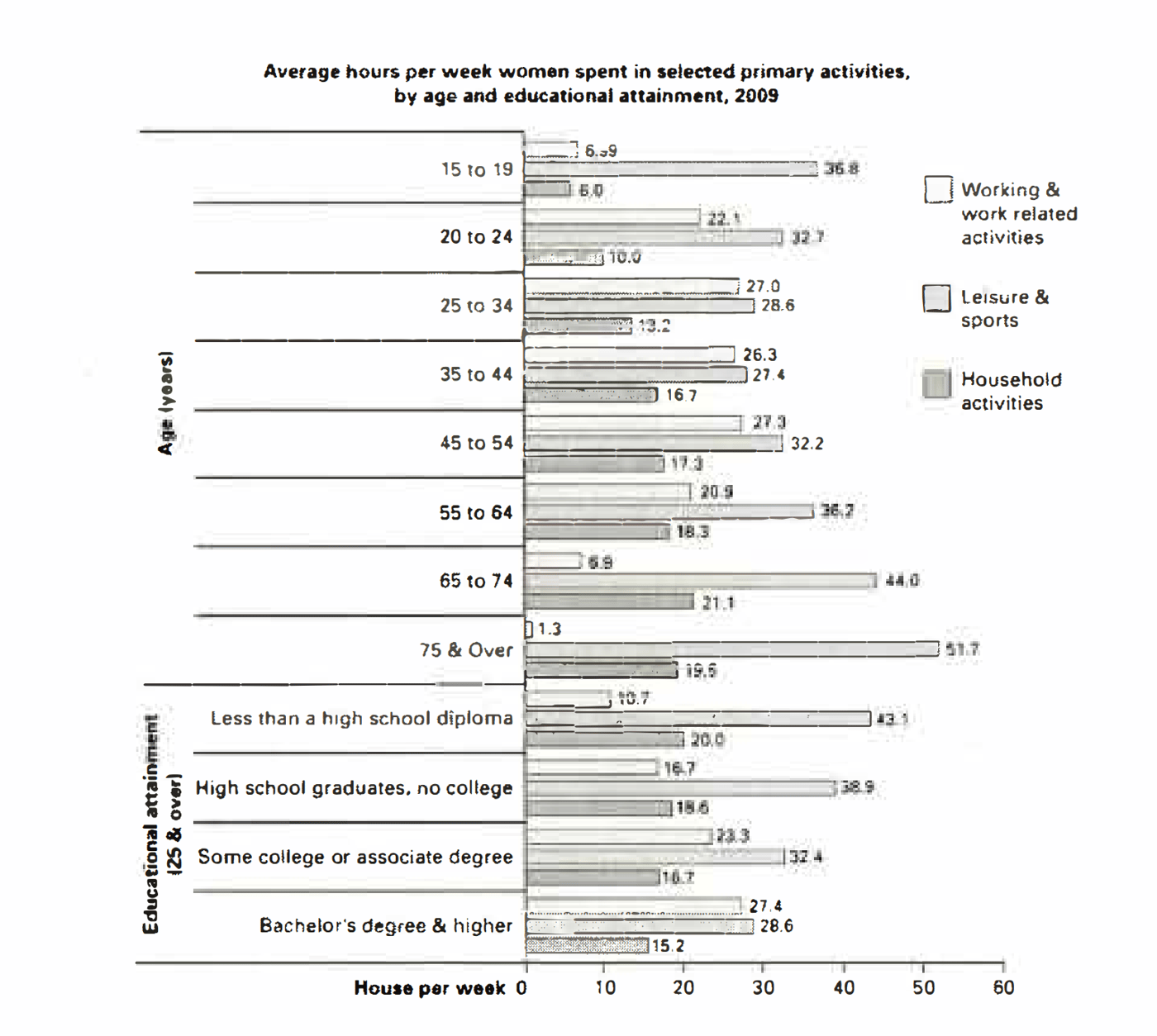
The bar chart below shows the average number of hours that women in various age groups and women with varying levels of education spend on primary activities each week.
Summarise the information by selecting and reporting the main features, and make comparisons where relevant.
Average hours per week women spent in selected primary activities, by age and educational attainment, 2009
Student answer (Band 4.5)
The women is most consistent with the time they spend in sports & leisure regardless of their age because this is something most women enjoy doing. The most inconsistency in the graph is shown about the time spent by the women of different age and level of education in house hold activities. I think that women who work and still balance to do house work are really brilliant. The graph shows that the way every woman spend their week is different according to their education and age. Tye women in early age spend most of their time in sports and enjoy because of their energetic spirit. As they age the also start spending their time in other aspects of life like household work and working. As they age they mostly spend their time less on working but more on other two parts of life. Education makes difference in working time of women mostly.
AI examiner evaluation
| Criterion | Band |
|---|---|
| Task Achievement / Task Response | 4.5 |
| Coherence and Cohesion | 4.0 |
| Lexical Resource | 5.0 |
| Grammatical Range and Accuracy | 5.0 |
| Overall | 4.5 |
Task Achievement / Task Response: Band 4.5
The response recognises the chart’s three activity categories and attempts to describe broad differences by age and education. However, it only minimally reports the data: it gives no figures and makes several inaccurate or unsupported claims. For example, leisure time is not consistently similar across ages; it ranges from 27.4 hours among women aged 35–44 to 51.7 among those aged 75 and over. The claim that younger women spend most of their time in leisure is also not true for the 20–24 group, whose working hours are lower but whose leisure is 32.7 hours. The response does not identify key patterns, such as work peaking in middle age and with higher education. Focus on accurate comparisons and a clear, data-based overview.
Coherence and Cohesion: Band 4.0
There is a basic attempt to connect ideas, using phrases such as “As they age” and “Education makes difference,” and the response stays broadly focused on the chart’s topics. However, the ideas are not arranged as a clear summary: personal comments about women being “really brilliant” interrupt the reporting, and the discussion moves between leisure, household work, age and education without a logical structure. Repeating “As they age” does not establish a precise progression, and references such as “other two parts of life” are vague. Organise the response into an overview followed by grouped comparisons, and use clear links to show how each point relates to the chart.
Lexical Resource: Band 5.0
The response uses a basic range of relevant terms, including “sports & leisure,” “household activities,” “education” and “working time,” so the general subject is usually recognisable. However, vocabulary is repetitive and several choices are inaccurate or awkward, which makes some points unclear. For instance, “most inconsistency” does not clearly describe variation, “house hold activities” is not the chart’s standard term, and “spend their time less on working” is an unnatural expression. The phrase “energetic spirit” adds an unsupported explanation rather than describing the figures. Use precise chart language such as “hours spent,” “increased,” “declined” and “varied,” and avoid speculative explanations.
Grammatical Range and Accuracy: Band 5.0
The response attempts some longer sentence forms, including clauses introduced by “because” and “as,” and the main topic can generally be followed. However, errors are frequent enough to make several sentences awkward or unclear. Examples include “The women is,” “the way every woman spend,” and “As they age the also start,” which show problems with agreement, verb forms and pronoun use. The sentence beginning “The most inconsistency in the graph is shown about…” is also poorly formed, while punctuation is missing after introductory clauses such as “As they age.” Practise accurate simple sentences first, then build longer comparisons with controlled clauses and consistent subject–verb agreement.
See this exact question answered at other band scores. The same prompt compared across bands.
Browse more IELTS Writing model answers or get your own writing scored by the same AI examiner.