Band 4.5 IELTS Writing Task 1 Model Answer
Overall Band Score: 4.5 · IELTS Momentum Workout · 2026-11-11
IELTS Writing Task 1 question
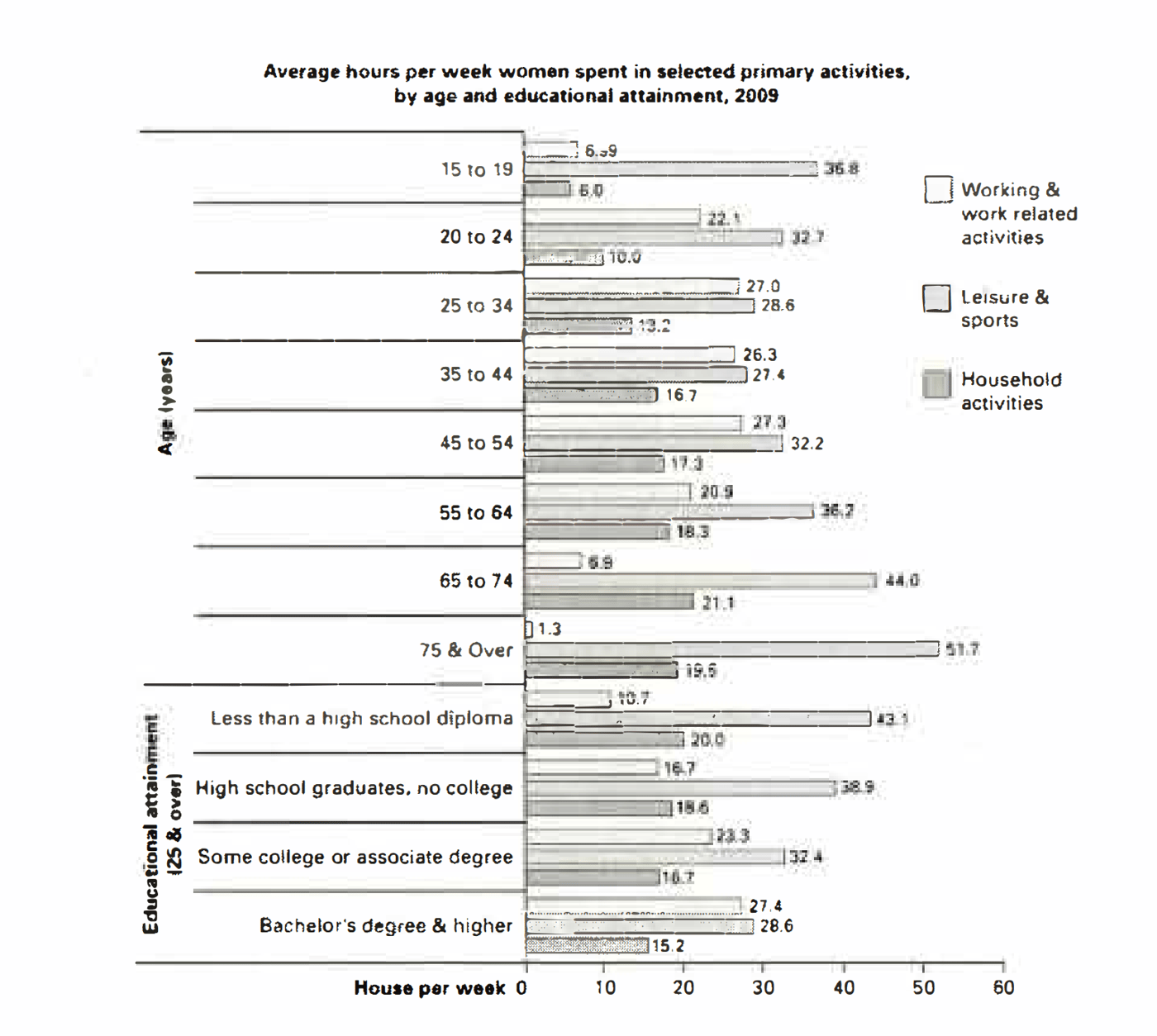
The bar chart below shows the average number of hours that women in various age groups and women with varying levels of education spend on primary activities each week.
Summarise the information by selecting and reporting the main features, and make comparisons where relevant.
Average hours per week women spent in selected primary activities, by age and educational attainment, 2009
Student answer (Band 4.5)
The bar contain data about the average number of hours that women in various age groups and women varing levels of education spend on primary activites.
The women of age fifteen to nineteen spend 6.9 hours in working and related activites,36.8 hours in leisure and sports,6 hours in household activities. The women from age 20 to 24 spend 22.1 hours in working and work related activities,32.7 in leisure and supports,10 hours in household activities.The group of age 25 to 34 spend 27 hours in working and work related activities,28.6 hours in leisure and sports which is quiet more than other activities in this age group.
30 to 44 age group also spend 27.4 hours in lesiure and sports which is also highest number of hours spend in primary activities of this group.From age 75 and over women spend their most of time in working and work related activities because they are not fit enough at that age to play sports but they still manage to play 19.6 hours and the most least hours in household activities.Less than a high school diploma womens spend their most of time in sports percentage of 42.1 hoursand bachelours degree spend their least time in supports percentage of 28.6.
AI examiner evaluation
| Criterion | Band |
|---|---|
| Task Achievement / Task Response | 4.0 |
| Coherence and Cohesion | 4.0 |
| Lexical Resource | 5.0 |
| Grammatical Range and Accuracy | 5.0 |
| Overall | 4.5 |
Task Achievement / Task Response: Band 4.0
The response identifies several relevant figures, including the 15–19 group’s 6.9 working hours and 36.8 leisure hours, and notes that leisure is high among women with a bachelor’s degree. However, it reports only a small, selective portion of the chart and gives no clear overview of the main patterns across both age and education groups. There are also important inaccuracies: women aged 75 and over spend 51.7 hours on leisure, not most of their time working; their household figure is 19.6, not the lowest. The less-than-high-school leisure figure is 43.1, not 42.1, and the 30–44 age group is not shown (the chart gives 35–44). Include an accurate overview and compare the main trends.
Coherence and Cohesion: Band 4.0
Some information is presented in a broadly chronological order, moving from younger age groups to older women and then to educational attainment. However, the response is not arranged into clear paragraphs, and it lacks a distinct overview to guide the reader through the chart’s main features. The shift from age groups to education is abrupt, while links such as “also” and “because” do not create a clear comparison between the data. Several figures are crowded together in long sentences, making relationships harder to follow. Group the age data and education data separately, use a concise overview, and connect comparisons explicitly—for example, contrast working hours with leisure hours across age groups.
Lexical Resource: Band 5.0
The response uses some relevant chart vocabulary, including “average number of hours,” “working and work related activities,” and “household activities,” so the topic is generally understandable. However, the range is limited and several word-choice or spelling errors reduce precision: “supports” is used for “sports,” “quiet more” appears to mean “quite more,” and “most least hours” is unclear. Phrases such as “spend their most of time” and “sports percentage of 42.1 hours” are also unnatural or imprecise for describing hours. Use accurate activity labels and standard comparison language, such as “spent the most time on leisure” and “recorded the fewest hours.”
Grammatical Range and Accuracy: Band 5.0
The response attempts both simple statements and longer sentences, but its grammatical range is limited and errors recur. For example, “The women of age fifteen to nineteen spend” has an awkward noun phrase, while “30 to 44 age group also spend” has a subject–verb agreement problem and does not match the chart’s age label. The sentence beginning “From age 75 and over” combines several ideas without clear grammatical control, and “women spend their most of time” has an incorrect possessive construction. Punctuation is also inconsistent, with missing spaces after commas and full stops. Build clearer sentences around one comparison at a time, check agreement and articles, and use punctuation to separate data points.
See this exact question answered at other band scores. The same prompt compared across bands.
Browse more IELTS Writing model answers or get your own writing scored by the same AI examiner.