Band 4.5 IELTS Writing Task 1 Model Answer
Overall Band Score: 4.5 · IELTS Momentum Workout · 2026-11-12
IELTS Writing Task 1 question
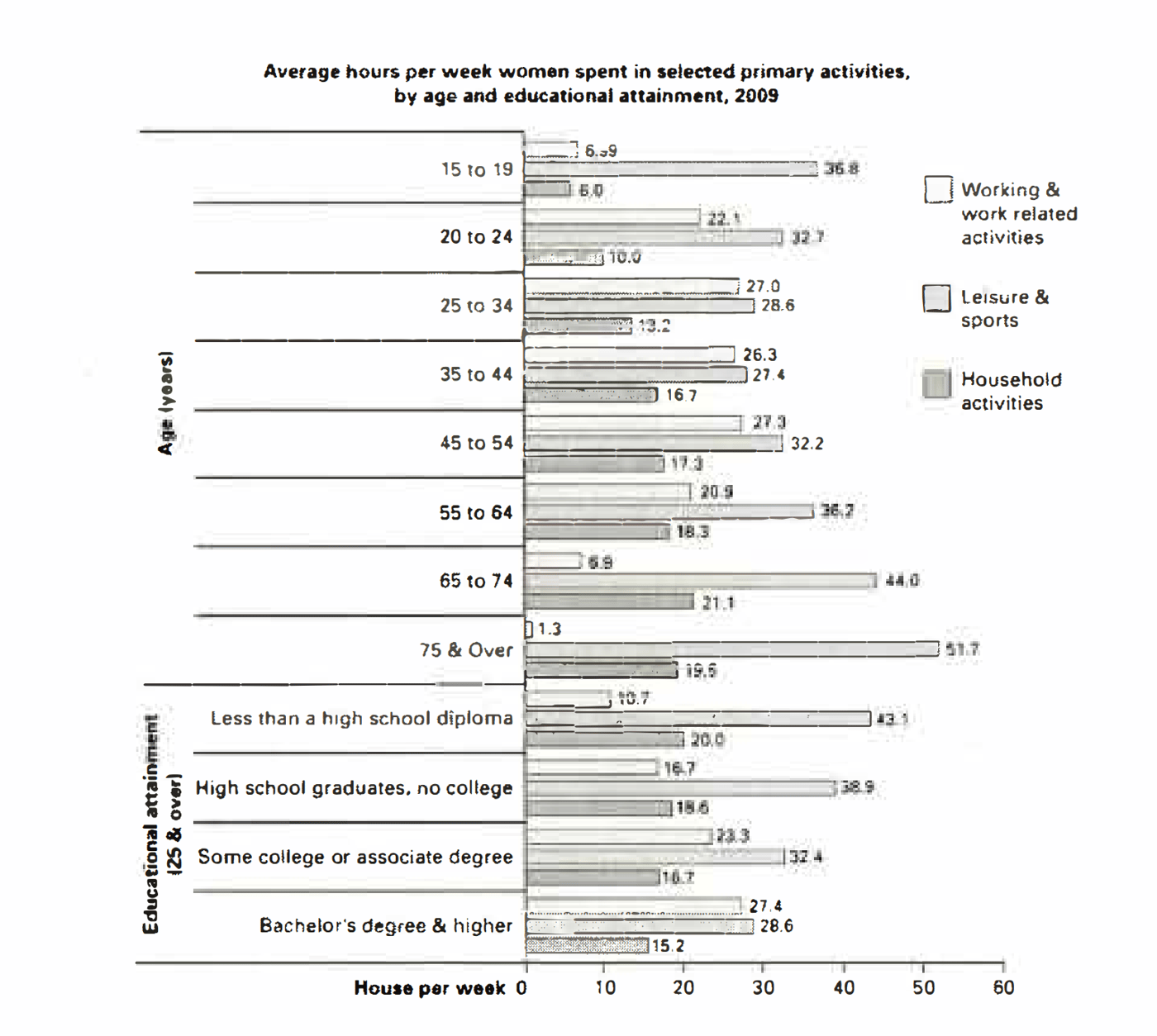
The bar chart below shows the average number of hours that women in various age groups and women with varying levels of education spend on primary activities each week.
Summarise the information by selecting and reporting the main features, and make comparisons where relevant.
Average hours per week women spent in selected primary activities, by age and educational attainment, 2009
Student answer (Band 4.5)
The provided bar chart demostrates how may hours per week women spend in three primary activities o 2009:working and work related activities,leisure and sports and household activities.The data is divided into different age groups from 15 to 19 and 70 and over.
Overall,it is clear that leisure and sports took the first rank in the category of teenagers and younger generation,while household activities took the middle ground in the age group from 35 to 64 and lastly working and work related activities has a largly audience of older women.
For the middle age groups,the pattern changed.The age group from 24 to 44 spend more time on leisure and sports at 36.8 hours per week
AI examiner evaluation
| Criterion | Band |
|---|---|
| Task Achievement / Task Response | 3.5 |
| Coherence and Cohesion | 4.5 |
| Lexical Resource | 5.5 |
| Grammatical Range and Accuracy | 5.0 |
| Overall | 4.5 |
Task Achievement / Task Response: Band 3.5
The response identifies the chart’s three activities and attempts an overview, but it reports very little accurate, relevant information. The claim that working activities have a large audience among older women reverses the pattern: work hours fall sharply in the oldest groups, while leisure is highest there. The final comparison also misreads the data: 36.8 hours belongs to leisure among 15–19-year-olds, not to women aged 24–44, whose leisure figures are lower. The age range is also misstated as “70 and over” rather than 75 and over. The response contains 114 words, below the required 150, and ends before the chart is adequately summarised. Include accurate comparisons across both age and education groups, supported by key figures.
Coherence and Cohesion: Band 4.5
There is a basic attempt to organise the response: an introduction is followed by an overview and then a paragraph beginning “For the middle age groups.” Connectors such as “Overall” and “while” help signal relationships. However, the progression is difficult to follow because the overview makes unclear comparisons, and the final paragraph introduces a claim that does not match the chart. The response stops abruptly after this point, with no developed account of the educational-attainment data or a concluding comparison. Punctuation and spacing also make the text less easy to read, for example “2009:working” and “Overall,it.” Use separate, clearly developed paragraphs and organise the details by age and education, with accurate links between comparisons.
Lexical Resource: Band 5.5
The response uses some relevant topic vocabulary, including “primary activities,” “leisure and sports,” and “household activities,” and attempts phrases such as “took the first rank” and “middle ground.” However, several choices are inaccurate or unnatural for describing chart data. “Took the first rank” is not a natural way to say an activity recorded the highest figure, while “a largly audience” does not convey the amount of time spent. There are also spelling errors, including “demostrates,” “may,” and “largly,” and the phrase “younger generation” is imprecise for the age categories shown. Build a more reliable range of chart language, such as “accounted for,” “recorded,” “rose,” and “declined,” and check spelling and collocations.
Grammatical Range and Accuracy: Band 5.0
The response attempts both simple and more complex sentence forms, including the contrast in “Overall, it is clear that … while …,” and the main meaning is generally recoverable. However, control is inconsistent. In “The age group from 24 to 44 spend,” the subject and verb do not agree, and “working and work related activities has” also has an agreement error. The sentence “For the middle age groups, the pattern changed” is followed by a claim whose time reference and comparison are unclear. Commas and spaces after punctuation are often missing, and the final sentence is incomplete as a developed account. Practise accurate subject–verb agreement and use complete, clearly punctuated sentences to report comparisons; vary sentence structures while keeping each comparison grammatically controlled.
See this exact question answered at other band scores. The same prompt compared across bands.
Browse more IELTS Writing model answers or get your own writing scored by the same AI examiner.