Band 4.5 IELTS Writing Task 1 Model Answer
Overall Band Score: 4.5 · IELTS Momentum Workout · 2026-11-16
IELTS Writing Task 1 question
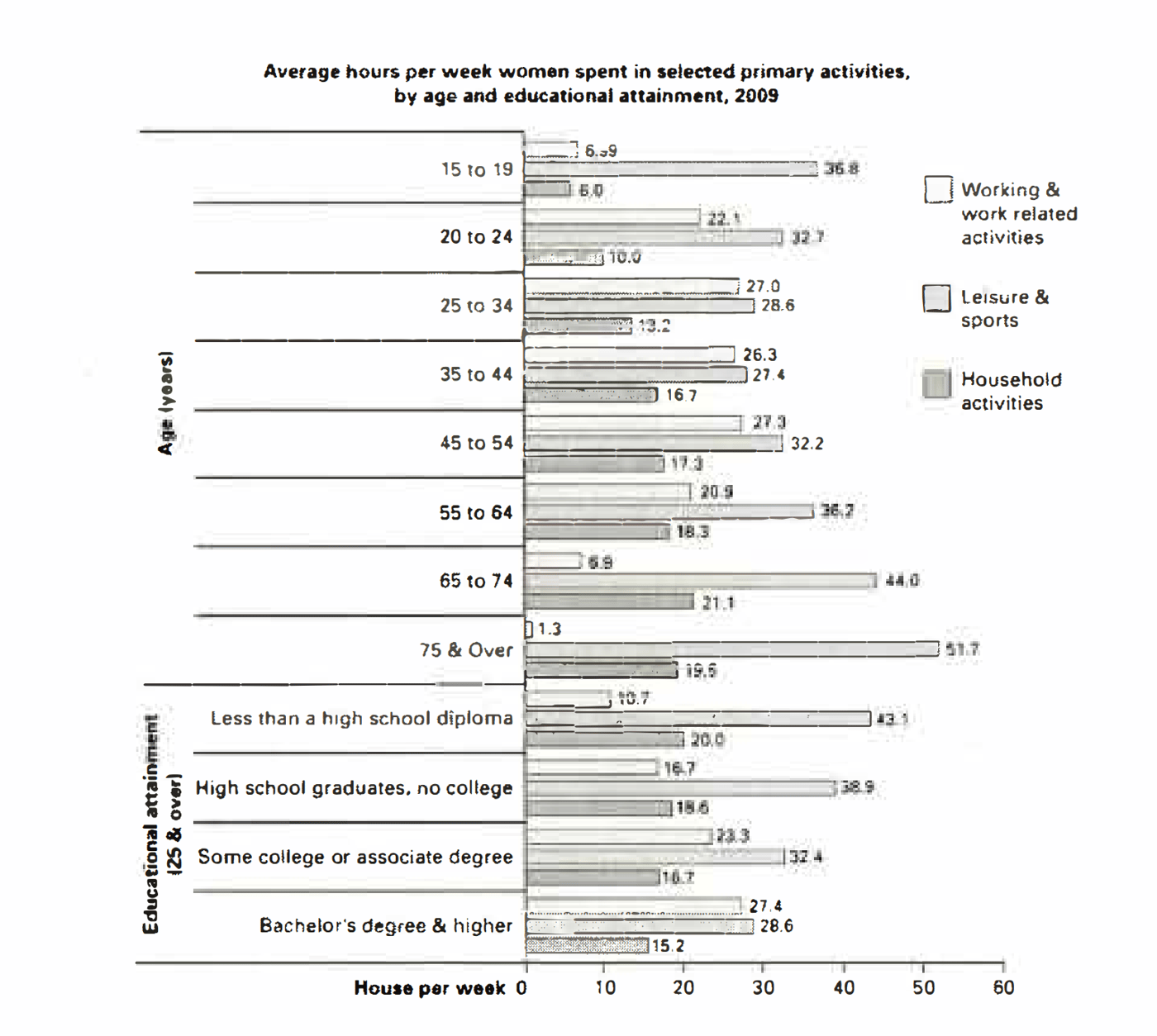
The bar chart below shows the average number of hours that women in various age groups and women with varying levels of education spend on primary activities each week.
Summarise the information by selecting and reporting the main features, and make comparisons where relevant.
Average hours per week women spent in selected primary activities, by age and educational attainment, 2009
Student answer (Band 4.5)
The bar chart illustrates average time women of different ages and with different levels of education spend every week on different activities
Overall, the woman above the age of 75 spend most of the time on leisure and sports.On the basis of education, the woman with no high school diploma spend most time on sports.The woman from 65 to 74 spend most of the time in household activities and most of the time spent working is done by woman with bachelor's & higher degree
The woman from 15 to 19, one average spend most of the time doing sports. from 20 to 24 the average is also higher in sports which is 32.7 hours. On the basis of age every age group spend highest number of time in lesiure & sports.
The woman with education also spend most time on sports
AI examiner evaluation
| Criterion | Band |
|---|---|
| Task Achievement / Task Response | 4.0 |
| Coherence and Cohesion | 4.5 |
| Lexical Resource | 5.0 |
| Grammatical Range and Accuracy | 5.0 |
| Overall | 4.5 |
Task Achievement / Task Response: Band 4.0
You identify relevant broad patterns, including that women aged 75 and over spend the most time on leisure and sports, and that women with a bachelor’s degree or higher record the most work-related hours. However, the response reports very little of the chart and includes a major misreading: women aged 65–74 do not spend the most time on household activities; their leisure figure is highest, while household time peaks at 21.1 hours for this age group. The claim that every age group spends the most time on leisure is also inaccurate for some age groups, where work is close to or exceeds leisure. The education comparisons are largely repeated rather than developed. The response is 9 words below the required minimum. Include a fuller, accurate overview and key comparisons across both categories.
Coherence and Cohesion: Band 4.5
The response has a basic structure, with an opening, an overview, and short paragraphs about age and education. This gives the reader some sense of the intended organisation. However, progression is limited: the age paragraph repeats the overview’s point about leisure, and the final sentence, “The woman with education also spend most time on sports,” adds little and does not develop the education comparison. Connections between ideas are also weak, and the full stops and spacing in “sports.On” and “sports. from” interrupt the flow. To improve, group related comparisons into clear paragraphs and use linking phrases to show contrasts, such as how leisure changes with age while work varies by educational attainment.
Lexical Resource: Band 5.0
You use some relevant chart vocabulary, including “average,” “activities,” “education,” and “leisure & sports,” so the topic is generally clear. However, the range is limited and several phrases are repeated, especially “spend most of the time” and “on the basis of.” Some word choices are imprecise for describing data: “sports” alone does not represent the chart’s combined category “leisure & sports,” and “the woman” is awkward when referring to groups. There are also spelling and form errors, such as “lesiure.” Use a wider set of accurate reporting expressions, for example “recorded,” “accounted for,” “rose,” and “declined,” while retaining the chart’s exact category labels.
Grammatical Range and Accuracy: Band 5.0
The response communicates its general subject, but grammatical control is uneven and sentence structures are mostly simple. Agreement errors occur repeatedly: “the woman … spend,” “every age group spend,” and “the woman … degree” should use plural subjects and matching verbs. The opening also lacks a full stop, and the sentence beginning “from 20 to 24” starts with a lowercase letter. The phrase “one average” appears to be an attempt at “on average,” but this is a word-choice issue rather than a grammatical pattern. Build accuracy by checking subject–verb agreement and sentence boundaries, then practise combining comparisons with controlled clauses, such as “While leisure time was highest among the oldest group, work-related hours peaked among women with higher education.”
See this exact question answered at other band scores. The same prompt compared across bands.
Browse more IELTS Writing model answers or get your own writing scored by the same AI examiner.