Band 5.0 IELTS Writing Task 1 Model Answer
Overall Band Score: 5.0 · IELTS Momentum Workout · 2026-11-17
IELTS Writing Task 1 question
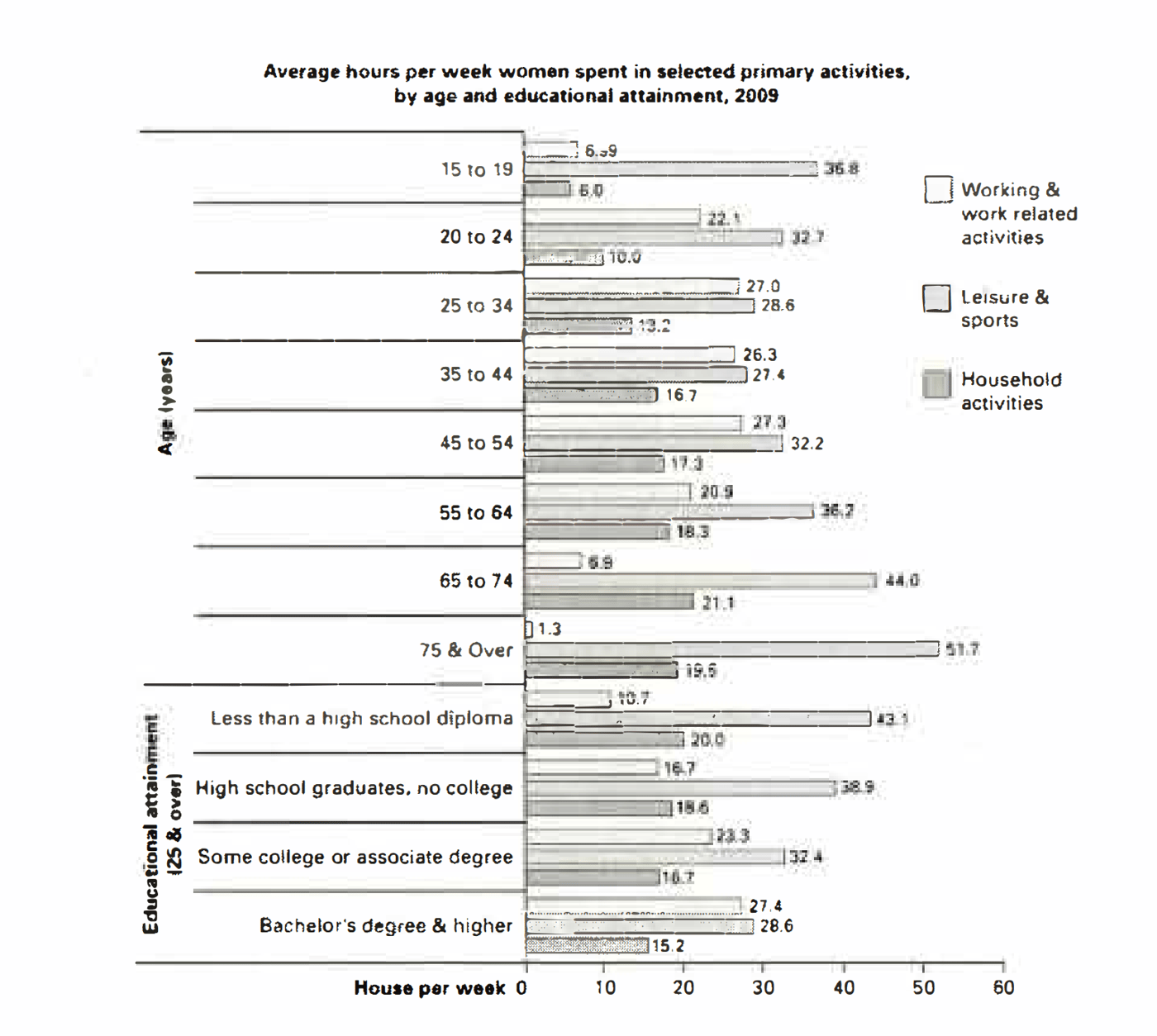
The bar chart below shows the average number of hours that women in various age groups and women with varying levels of education spend on primary activities each week.
Summarise the information by selecting and reporting the main features, and make comparisons where relevant.
Average hours per week women spent in selected primary activities, by age and educational attainment, 2009
Student answer (Band 5.0)
The bar chart isslutrates the number of average education hour of women in various age groups,verying by levels of education in 2009.
From this chart it is clear that most of the time they enjoy leasure and free time in a week.And the teenagers and most adults are do this than others ages.
There are two catagories in this chart - Educational attainment and ages.In education attainment ,there are several type like-Bachelor's degree,associate degree,High school graduates and less than high school diploma.Woman from less than diploma sector spend their most of the time in week as free time.On the contrast,this number is low in bachelor's degree's level.If we notice the working sector bachelor's are also in the first position.Besides this sector some are interested in household activities and less than higher level's woman are highly interested in this and their parcentage is 10.7.On the other hand the age chart represent the view of woman ages.And the 75 & over woman are enjoying leasure a lot.On the other hand between 25 to 34,are not spend a lots of time in it.Most of the time 45 above ages woman's are busy to manage their household activities.
AI examiner evaluation
| Criterion | Band |
|---|---|
| Task Achievement / Task Response | 5.0 |
| Coherence and Cohesion | 5.0 |
| Lexical Resource | 5.0 |
| Grammatical Range and Accuracy | 5.0 |
| Overall | 5.0 |
Task Achievement / Task Response: Band 5.0
You identify the chart’s two groupings and mention relevant broad patterns, including that women aged 75 and over spend the most time on leisure and that women with higher education spend more time working. However, the summary is only partial: it gives no clear overview of the main contrasts across all three activities, and several claims are unclear or inaccurate. For example, the figure 10.7 refers to working hours for women with less than a high-school diploma, not a percentage or time spent on household activities. The statement that women aged 45 and above are mostly busy with household activities also misses that leisure remains higher than household time in these age groups. Select a few accurate comparisons and report the units as hours per week.
Coherence and Cohesion: Band 5.0
The response has some organisation: it begins with an introduction, gives a brief general statement, and then discusses educational attainment and age groups. This provides a basic structure, but the progression is not consistently clear. The second paragraph combines several comparisons without a clear order, and transitions such as “On the contrast” and repeated “On the other hand” do not always show the relationship between the points accurately. Some references are also difficult to follow, as in “this number is low” and “this sector.” Use separate, focused paragraphs for the overview and the two chart groupings, and connect each comparison explicitly—for example, contrast leisure with work or household activities using the relevant group names.
Lexical Resource: Band 5.0
You use some task-relevant vocabulary, including “educational attainment,” “household activities,” and “working sector,” so the reader can recognise the chart’s subject. However, the range is limited and several spelling, word-form, and collocation errors make parts of the report difficult to understand: “isslutrates,” “verying,” “leasure,” “catagories,” and “parcentage.” Phrases such as “enjoying leisure a lot” and “interested in household activities” are also imprecise for describing time-use data. Prefer neutral reporting language such as “spent the most time on leisure” and “recorded the highest number of hours.” Check spelling carefully and use the chart’s activity labels consistently.
Grammatical Range and Accuracy: Band 5.0
You attempt both simple and longer sentences, but control is inconsistent, and errors frequently affect clarity. Examples include “the teenagers and most adults are do this,” “between 25 to 34, are not spend,” and “45 above ages woman's are busy,” where verb forms, sentence structure, and agreement are faulty. Articles and plurals are also often missing or misused, as in “there are several type” and “the 75 & over woman.” Punctuation and spacing around commas and sentence boundaries need attention as well. Build accurate simple comparison sentences first, such as “Women aged 75 and over spent 51.7 hours per week on leisure,” then practise combining them with clauses using “while” or “whereas.”
See this exact question answered at other band scores. The same prompt compared across bands.
Browse more IELTS Writing model answers or get your own writing scored by the same AI examiner.