Band 5.0 IELTS Writing Task 1 Model Answer
Overall Band Score: 5.0 · IELTS Momentum Workout · 2026-11-17
IELTS Writing Task 1 question
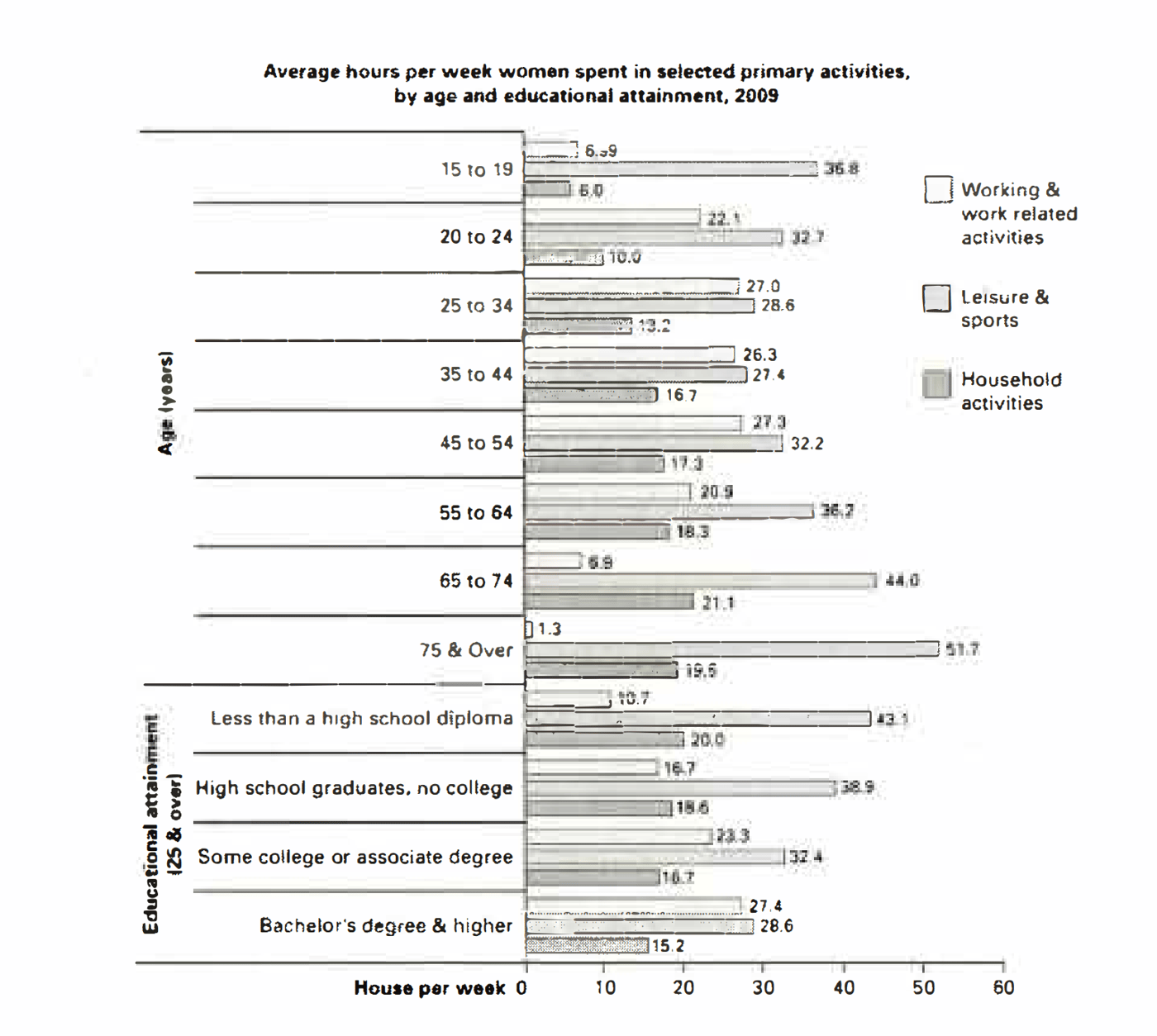
The bar chart below shows the average number of hours that women in various age groups and women with varying levels of education spend on primary activities each week.
Summarise the information by selecting and reporting the main features, and make comparisons where relevant.
Average hours per week women spent in selected primary activities, by age and educational attainment, 2009
Student answer (Band 5.0)
The bar gragh shows that women with various age gaps and women with fluctuating levels of education spend on essential activities every week on the basis of average number of hours.
On the basis of age years,the age over 75 year was more interested in leisure and sports then young women,accounted for 51.7 hours that is the most one among all the age groups.They were the least interested in work and work relating activities.The age groups of women less then almost 65 had almost the same interest in household activities.
Other thing bar gragh also shows that all women educational attainment had almost equal interest in household activities.The women who done less than a high school diploma spent the major hours in leisure and sports,after them there is one who did high school graduates but not college appropriately same with some college women students.Women spent the leat hours in work related activities are who done the less then a high school diploma.
AI examiner evaluation
| Criterion | Band |
|---|---|
| Task Achievement / Task Response | 5.0 |
| Coherence and Cohesion | 5.5 |
| Lexical Resource | 5.0 |
| Grammatical Range and Accuracy | 5.0 |
| Overall | 5.0 |
Task Achievement / Task Response: Band 5.0
You identify relevant broad patterns, especially that women over 75 spend the most time on leisure and the least on work, and you include the accurate figure of 51.7 hours. However, the response only partially summarises the chart: it gives no clear overall overview of the main contrasts across both age and education groups, and several comparisons are inaccurate or too vague. For example, household hours do not remain almost the same across women under 65; they rise from 6.0 hours among 15–19-year-olds to 18.3 among those aged 55–64. The education comparison also misstates the pattern: leisure falls as educational attainment rises, while work hours increase. Select these key trends and support them with accurate figures.
Coherence and Cohesion: Band 5.5
The response has a basic two-part organisation, moving from age groups to educational attainment, and phrases such as “On the basis of age years” and “Other thing” signal a change of focus. However, progression within each paragraph is difficult to follow because comparisons are not consistently ordered or clearly linked. The sentence about women under 65 and household activities, for instance, does not explain the trend or give supporting figures. Some linking expressions are awkward or repetitive, and the final sentence introduces a comparison without making its meaning clear. Use a concise overview first, then separate paragraphs for age and education, grouping related trends and using clear links such as “by contrast” and “as attainment rises.”
Lexical Resource: Band 5.0
You use some relevant chart vocabulary, including “leisure and sports,” “household activities,” “educational attainment,” and “hours,” so the topic is generally recognisable. However, the range is limited and several word choices or collocations make the meaning unclear. “Age gaps” does not describe age groups, “fluctuating levels of education” is not appropriate here, and “interested in” suggests preference rather than time spent. There are also noticeable spelling and word-form errors, including “gragh,” “leat,” and “then” where “than” is intended. Aim for precise reporting language such as “spent,” “accounted for,” “rose,” and “declined,” and check spelling and collocations carefully.
Grammatical Range and Accuracy: Band 5.0
You attempt some longer sentence forms, including a sentence beginning “The age groups of women…” and one comparing educational categories, but these structures are often faulty and make relationships between ideas hard to understand. Errors include missing or misplaced articles and plurals (“the age over 75 year”), subject–verb and clause problems (“The women who done…”), and incorrect comparative constructions (“less then almost 65”). Punctuation is also inconsistent, with missing spaces after commas and sentences that run together. Build accuracy with clear simple sentences first, then add controlled comparisons—for example, “Women aged 75 and over spent 51.7 hours on leisure, the highest figure among the age groups.”
See this exact question answered at other band scores. The same prompt compared across bands.
Browse more IELTS Writing model answers or get your own writing scored by the same AI examiner.