Band 5.0 IELTS Writing Task 1 Model Answer
Overall Band Score: 5.0 · IELTS Momentum Workout · 2026-11-17
IELTS Writing Task 1 question
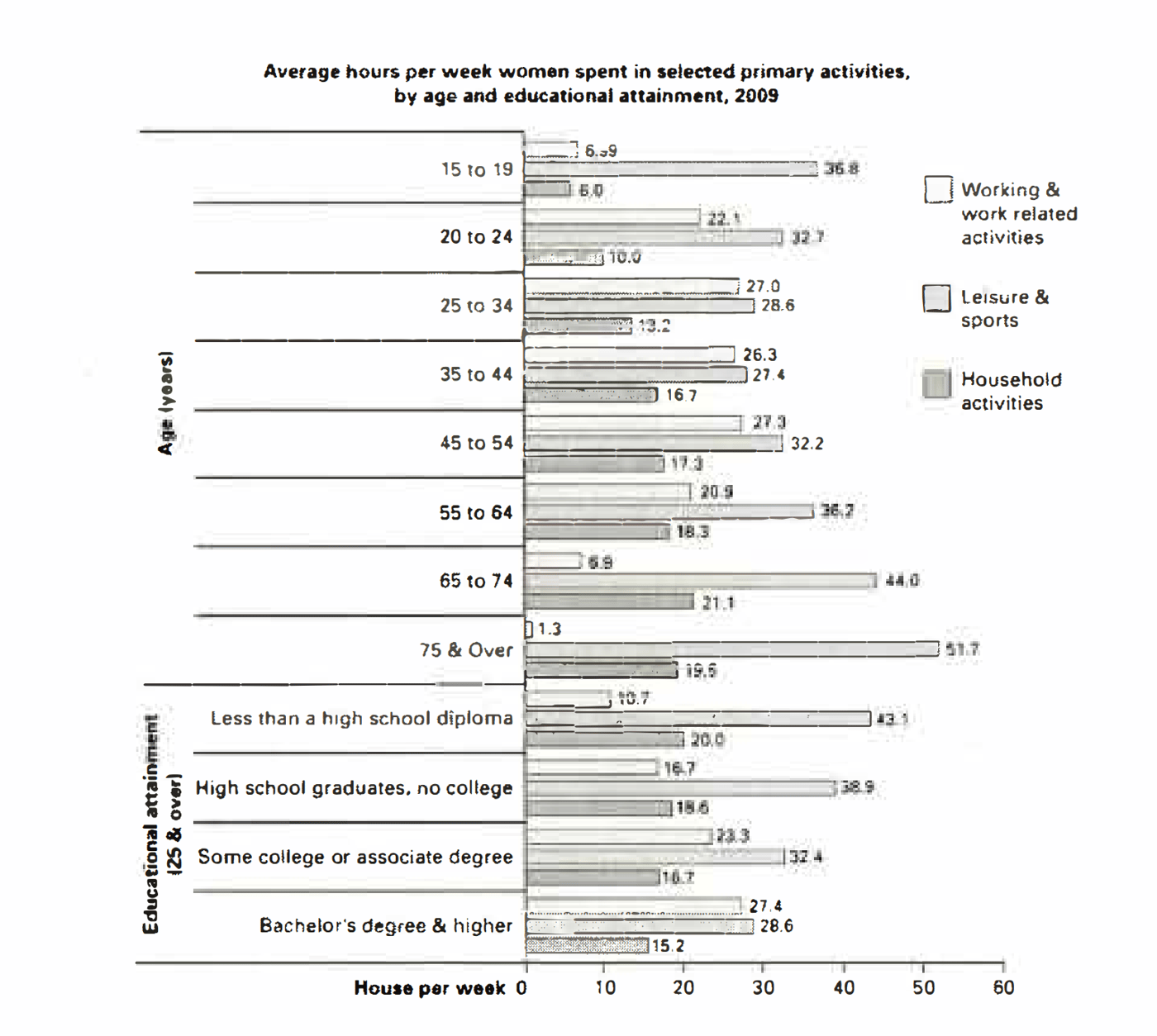
The bar chart below shows the average number of hours that women in various age groups and women with varying levels of education spend on primary activities each week.
Summarise the information by selecting and reporting the main features, and make comparisons where relevant.
Average hours per week women spent in selected primary activities, by age and educational attainment, 2009
Student answer (Band 5.0)
The bar chart below illustrates the average number of hours that women of different age groups and women with different levels of education spend on primary activities each week.
The bar chart demonstrates the comparsion between women of different age groups and levels of education and time which women are spending on different activities every week. These activities include working & work related activities, leisure & sports, and household activities. The age group varies from 15 to more than 75 years old women. The group 15 to 19 and 75 & over spend most of their time on leisure and sports and very less on working and work related activities. While the age group between 20 to 24 spend almost more than half of their time on leisure and sports but the also spend on work and work related activities. The age group from 45 to 54, 55 to 64, and 65 to 74 spends most of their time on leisure and sports but also on household activities.
The women having degree of Bachelor and higher spends half of their week time on work related activities. While the women with other degrees like less than high school diploma, high school graduates, and college or associate degree graduates spend more time on leisure and household activities.
AI examiner evaluation
| Criterion | Band |
|---|---|
| Task Achievement / Task Response | 5.0 |
| Coherence and Cohesion | 4.5 |
| Lexical Resource | 5.5 |
| Grammatical Range and Accuracy | 5.0 |
| Overall | 5.0 |
Task Achievement / Task Response: Band 5.0
You identify the chart’s three activities and make relevant observations about age and education, including that the youngest and oldest groups spend relatively little time working. However, the response only partially reports the main features: it gives no figures and misses important patterns, such as work peaking around ages 25–54 and leisure reaching its highest level among women aged 75 and over. The education comparison is also inaccurate: women with a bachelor’s degree or higher work about 27.4 hours, not half their week, and they spend more time on work than on leisure or household activities. A clearer overview and accurate, selected comparisons would make the report more complete.
Coherence and Cohesion: Band 4.5
The response has a basic sequence: it introduces the chart, discusses age groups, and then turns to educational attainment. This gives the reader some sense of organisation. However, the opening is repeated in two sentences, and the main discussion is packed into one long paragraph with several ideas joined by “and” or “while.” As a result, comparisons are not always easy to follow, and there is no distinct overview summarising the chart’s main trends. Use separate paragraphs for the age and education data, and organise each around a clear comparison. More precise linking and reference would also help connect the observations without making the progression feel list-like.
Lexical Resource: Band 5.5
You use relevant chart vocabulary, including “age groups,” “levels of education,” “leisure and sports,” and “household activities,” so the topic remains understandable. However, the range is limited and some word choices or collocations are inaccurate or awkward, such as “the comparsion,” “very less,” “spend almost more than half,” and “week time.” “The women having degree” is also an imprecise way to describe the education category. These errors sometimes make the intended comparison less clear. Aim for concise reporting language and accurate terms such as “hours per week,” “spend the most time,” and “women with a bachelor’s degree or higher.”
Grammatical Range and Accuracy: Band 5.0
The response attempts some longer sentences, including clauses beginning with “While,” and the general meaning is usually recoverable. However, sentence structures are limited, and errors occur frequently in agreement and sentence construction. For example, “The age group … spends” does not agree naturally with the plural people being described, while “The women having degree … spends” has both an awkward subject construction and incorrect agreement. The sentence beginning “While the age group between 20 to 24” is also left as a fragment, and “but the also spend” contains an incorrect pronoun. Practise complete comparisons with consistent plural subjects and verbs, and check each sentence for a clear main clause.
See this exact question answered at other band scores. The same prompt compared across bands.
Browse more IELTS Writing model answers or get your own writing scored by the same AI examiner.