Band 4.5 IELTS Writing Task 1 Model Answer
Overall Band Score: 4.5 · IELTS Momentum Workout · 2026-11-18
IELTS Writing Task 1 question
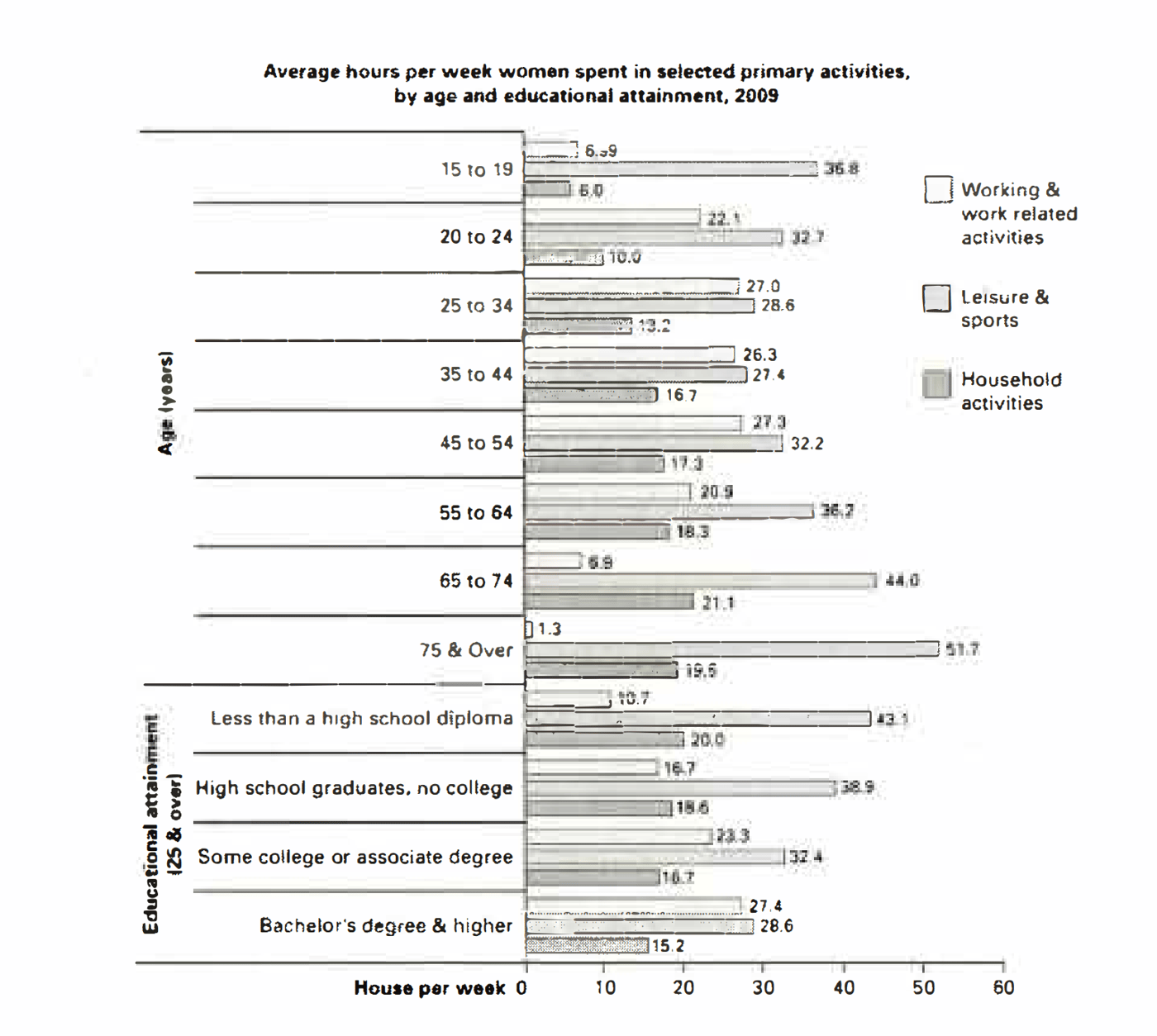
The bar chart below shows the average number of hours that women in various age groups and women with varying levels of education spend on primary activities each week.
Summarise the information by selecting and reporting the main features, and make comparisons where relevant.
Average hours per week women spent in selected primary activities, by age and educational attainment, 2009
Student answer (Band 4.5)
The bar graph shows that average hours per week women spent in selected primary activities, by age and educational attainment, 2009. Firstly, 15 to 19 years old girls spent time in ouse old activities with 36.8 percent and 6.9% womens working and work related activities. And when we go for sports activies they spent 6% on it. However, 20 to 24 year womens spent 32.7% in house hold activities and 10% in leisure and sports and 22.1% working & work related activies. 25 to 34 old ladies houseold activities 28.6%, Leisure and sports 13.2%, work related activities 27.0 percent. On the other hand, 35 to 44 old womens usally spent 16.7 household activities , 27.4 sports activities, 26.3 percent working and work related activities. Furthurmore, 45 to 54 old womens 17.2 household, 32.2 sport , and 27.3% working activities. While 55 to 64 old ladies spent time in 21.1% household, 36.7 sports, 20.9% working activities. 65 to 74 year old ladies spent household activities 21.1, 44% sports activities, and 6.9 working womens. 75& over womens usally spent 19.5% household, 51.7 leisure and sports activities. The Educational attainment 25 and over is high school diploma
AI examiner evaluation
| Criterion | Band |
|---|---|
| Task Achievement / Task Response | 4.0 |
| Coherence and Cohesion | 4.5 |
| Lexical Resource | 5.0 |
| Grammatical Range and Accuracy | 5.0 |
| Overall | 4.5 |
Task Achievement / Task Response: Band 4.0
You identify the chart’s subject and report several age-group figures, including leisure at 51.7 hours for women aged 75 and over and work-related activity at 22.1 hours for those aged 20–24. However, the response does not provide a clear overview of the main patterns, and it stops before meaningfully covering educational attainment: “The Educational attainment 25 and over is high school diploma” is incomplete and omits the four education categories. Several figures are assigned to the wrong activities or are inaccurate—for example, 36.8 is leisure for ages 15–19, not household activity, and 6.0 is household activity, not sports. The response therefore addresses the chart only minimally. Group the main trends in an overview, compare the age and education data, and check each figure against its category.
Coherence and Cohesion: Band 4.5
There is some chronological sequencing through the age groups, and linking expressions such as “Firstly,” “However,” “On the other hand,” and “Furthermore” show an attempt to connect information. Nevertheless, the response reads largely as a list of figures rather than a clearly organised summary. The transitions do not consistently signal meaningful contrasts, and the final sentence about educational attainment is unfinished, leaving the second part of the chart disconnected and incomplete. Several sentences also combine multiple figures without a clear structure, making comparisons difficult to follow. Organise the response into a brief introduction, an overview of the main patterns, and focused paragraphs comparing age groups and education levels; use linking words only where they express a genuine relationship.
Lexical Resource: Band 5.0
You use relevant chart vocabulary, including “average hours per week,” “leisure and sports,” and “working and work related activities,” so the reader can recognise the topic. However, the range is limited and repetitive, with “spent,” “activities,” and “womens” recurring throughout. Some word choices and collocations are inaccurate or unclear, such as “go for sports activies” and “spent time in household activities,” while spelling errors including “ouse old,” “Furthurmore,” and “activies” reduce precision. The repeated use of “percent” is also unsuitable because the chart reports hours per week, not percentages. Use accurate terms such as “hours,” “devoted to,” and “time spent on,” and vary reporting verbs and comparison language.
Grammatical Range and Accuracy: Band 5.0
The response attempts both simple and joined sentences, for example, “However, 20 to 24 year womens spent…” and “On the other hand, 35 to 44 old womens…”. However, sentence structures are often incomplete or awkward, and grammatical errors frequently make relationships between figures harder to understand. Examples include “25 to 34 old ladies houseold activities 28.6%,” which lacks a clear verb, and “The Educational attainment 25 and over is high school diploma,” which is an incomplete and unclear construction. There are also recurring problems with plural forms, articles, and sentence boundaries, as in “20 to 24 year womens.” Build complete sentences with a clear subject and verb, and use consistent patterns such as “Women aged 25–34 spent…” followed by correctly punctuated comparisons.
See this exact question answered at other band scores. The same prompt compared across bands.
Browse more IELTS Writing model answers or get your own writing scored by the same AI examiner.