Band 4.5 IELTS Writing Task 1 Model Answer
Overall Band Score: 4.5 · IELTS Momentum Workout · 2026-11-18
IELTS Writing Task 1 question
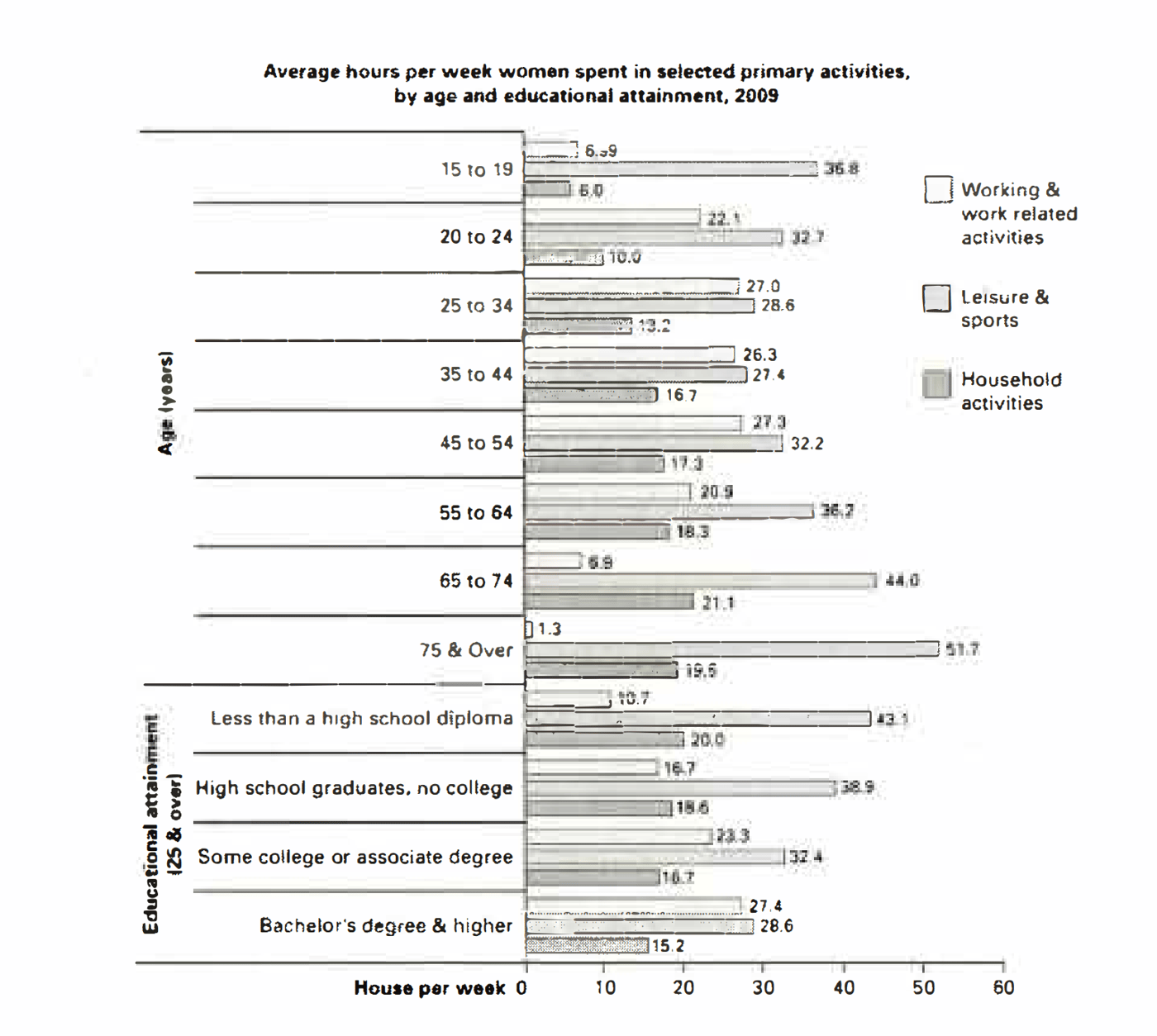
The bar chart below shows the average number of hours that women in various age groups and women with varying levels of education spend on primary activities each week.
Summarise the information by selecting and reporting the main features, and make comparisons where relevant.
Average hours per week women spent in selected primary activities, by age and educational attainment, 2009
Student answer (Band 4.5)
The bar chartillustrates the average number of hours that women in various age groups and women with varying levels of education spend on primary activities each week 2009. Overall, there are three primary activities working & work related activities, leisure & sports and household activities. One of the most highest peak is leisure & sports because this women spent an hours of that leisure up tp 75 & over. However, working & work related activitiess is less rather leisure and sports it not higher tha others very small is 15 to 19 is 6.9 it mean their work is not more. Household activities is alos higher but not than lisure and sports. Therefore, less than a high school diploma is working 7 work related activities is 10.7 and lisure is 43.5 and household and activities is 20.0 it mean in diploma leisure is almost higher peak. High school graduate, no college is lisure is 38.9 and household is 18.6 last one is working 16.7. Furthermore, i relaized that some college or associate degree in lisure is 32.4 and working is 23.3 last one is household is 16.7. In conclusion, bachelor;s degree and higher leisure28.6 and working is 27.4 and again household is 15.2. I think these all three of them especially, working is not uch less and much higher is leisure sports.
AI examiner evaluation
| Criterion | Band |
|---|---|
| Task Achievement / Task Response | 4.5 |
| Coherence and Cohesion | 4.5 |
| Lexical Resource | 5.0 |
| Grammatical Range and Accuracy | 4.5 |
| Overall | 4.5 |
Task Achievement / Task Response: Band 4.5
You identify the chart’s three activities and make a relevant general observation that leisure takes the most time in several groups. You also include figures for the education categories, showing an attempt to report specific data. However, the overview is unclear and does not accurately capture the main patterns across both age and education groups. For example, leisure peaks at 51.7 hours among women aged 75 and over, while work peaks at 27.4 hours for those with a bachelor’s degree or higher; these key comparisons are not clearly summarised. Some figures are inaccurate: leisure for women with less than a high-school diploma is 43.1, not 43.5, and household activity for high-school graduates is 19.6, not 18.6. A clearer overview and more accurate, selective comparisons would strengthen the report.
Coherence and Cohesion: Band 4.5
The response has a basic sequence: an introduction, general comments, several education-group details and a concluding statement. Linking expressions such as “Overall,” “However,” “Furthermore” and “In conclusion” show an effort to connect ideas. However, the progression is difficult to follow because age-group data and education-group data are not organised into clear sections, and the overview mixes several points without establishing a comparison. The repeated pattern of listing leisure, work and household figures for each education category also makes the report feel mechanical. Some connections are unclear, as in “Therefore, less than a high school diploma is working…” A more coherent structure would give a concise overview first, then separate paragraphs comparing age groups and educational attainment.
Lexical Resource: Band 5.0
You use relevant chart vocabulary, including “average number of hours,” “age groups,” “educational attainment,” “leisure & sports” and “household activities,” so the topic is generally recognisable. However, the range is limited and several repeated or inaccurate expressions make the report less clear. Phrases such as “one of the most highest peak,” “this women spent an hours,” and “not higher tha others” are awkward or imprecise. There are also noticeable spelling errors, including “lisure,” “alos” and “activitiess.” Try using precise comparison language and standard forms of the chart labels, rather than repeatedly saying “higher peak” or “last one.” This would make the data descriptions clearer and more appropriate for an academic report.
Grammatical Range and Accuracy: Band 4.5
You attempt both simple statements and longer sentences, and the reader can identify some intended comparisons. However, sentence structures are often incomplete or inaccurately formed, which sometimes obscures the relationships between the figures. For example, “Overall, there are three primary activities working…” needs punctuation or a linking structure, while “this women spent an hours” has problems with agreement and article use. The sentence beginning “Therefore, less than a high school diploma is working…” does not form a clear grammatical comparison. Capitalisation and punctuation are also inconsistent, particularly in the final sentence. Practise writing complete subject–verb sentences, using accurate articles and plurals, and separating the overview from data details with clear punctuation.
See this exact question answered at other band scores. The same prompt compared across bands.
Browse more IELTS Writing model answers or get your own writing scored by the same AI examiner.