Band 6.0 IELTS Writing Task 1 Model Answer
Overall Band Score: 6.0 · IELTS Momentum Workout · 2026-11-18
IELTS Writing Task 1 question
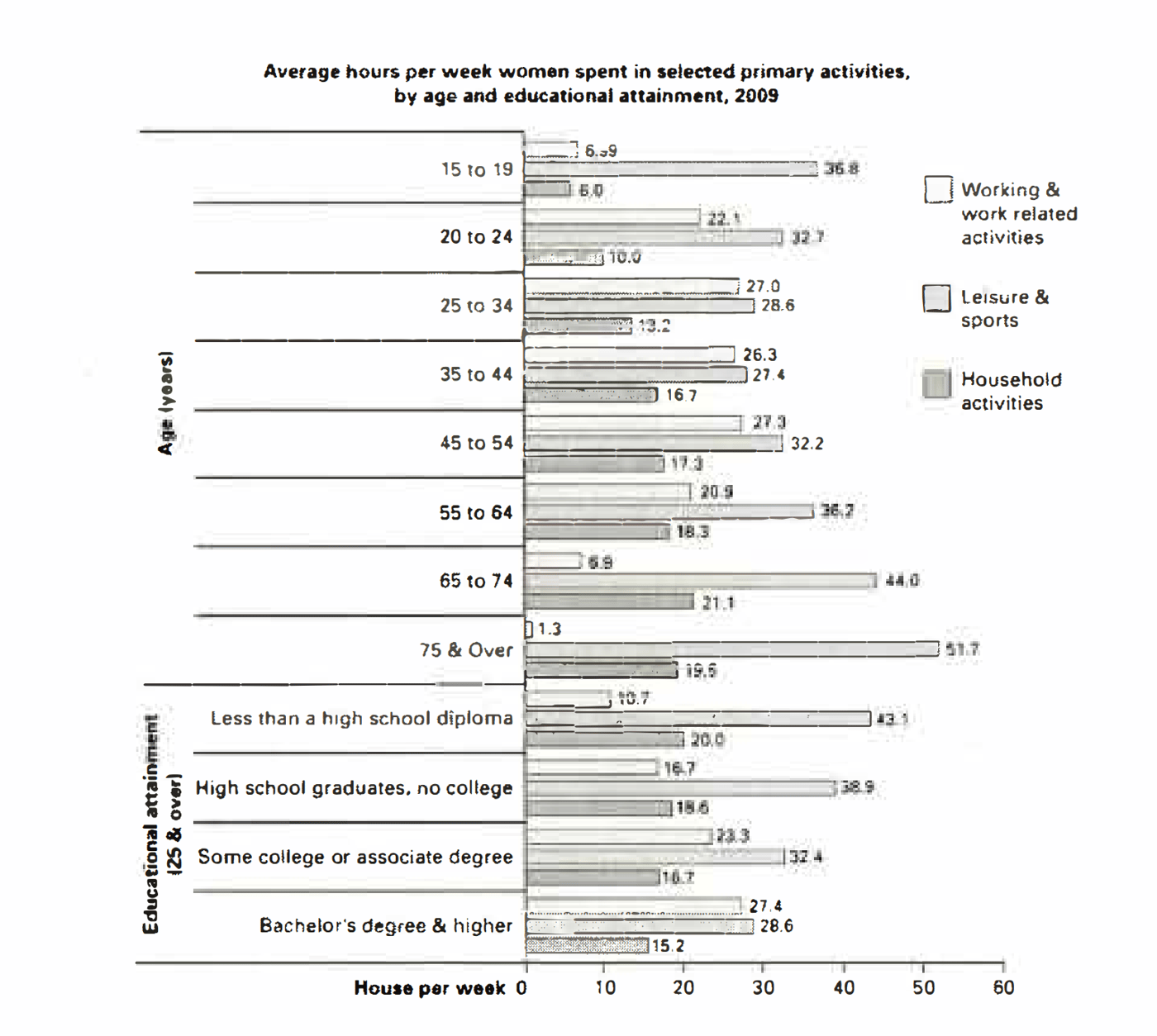
The bar chart below shows the average number of hours that women in various age groups and women with varying levels of education spend on primary activities each week.
Summarise the information by selecting and reporting the main features, and make comparisons where relevant.
Average hours per week women spent in selected primary activities, by age and educational attainment, 2009
Student answer (Band 6.0)
The bar chart illustrates the average number of hours that women spent on primary activities each week in various groups and varying level of education.
Overall, leisure and sports seems to be the most popular activity among all women. While, every age group and graduates seems to be less attracted towards the household activities.
In 2009, people belonging to all age groups participated mostly in sports and leisure activities. The group aged 75 and above spent 51.7 hours in this activity which is highest among all. The group accounted for spending least hours is aged 35 to 44 which is only 27 hours per week.
The groups who took part in work related activities, the women holding bachelor's degree spent 27.4 hours making it on top in this category. The group aged 75 and above ranked on the bottom in this particular activity. The household activities are the least common among all activities. The highest number of hours spent on this came from group aged 65 to 74 while, the lowest hours are 6 hours that was spent by age group 15 to 19.
AI examiner evaluation
| Criterion | Band |
|---|---|
| Task Achievement / Task Response | 6.0 |
| Coherence and Cohesion | 6.0 |
| Lexical Resource | 6.0 |
| Grammatical Range and Accuracy | 5.5 |
| Overall | 6.0 |
Task Achievement / Task Response: Band 6.0
You identify the chart’s broad pattern that leisure and sports takes the most time overall, and you include relevant comparisons such as 51.7 hours for women aged 75 and over and 27.4 hours for women with a bachelor’s degree or higher in work-related activities. However, some key details are inaccurate: the lowest leisure figure is 27.4 hours for ages 35–44, not 27 hours, and the highest household figure is 21.1 hours for ages 65–74, while the lowest is 6.0 hours for ages 15–19. The overview also overgeneralises: household activities are not the least common for every group, and the education groups are not clearly summarised. Include the education trends and report comparisons more precisely.
Coherence and Cohesion: Band 6.0
The response has a clear overall arrangement: an introduction, a general overview, and paragraphs describing leisure, work and household activities. This makes the main categories easy to follow. However, the progression within the body is sometimes abrupt, and the education data receives only one brief comparison rather than being developed as a distinct pattern. Linking is also occasionally awkward: “While,” begins a sentence fragment, and “The groups who took part in work related activities” does not clearly connect the following comparison. Organise the details into clearer age and education comparisons, and use linking phrases to show contrasts or trends rather than relying mainly on repeated category openings.
Lexical Resource: Band 6.0
You use an adequate range of task-related vocabulary, including “average number of hours,” “ranked on the bottom,” and “household activities,” so the chart is generally understandable. There are also attempts at more varied phrasing, such as “participated mostly” and “accounted for spending.” However, some choices are unnatural or imprecise: women do not usually “participate in” leisure hours in this context, and “less attracted towards” describes preference rather than time allocation. “The group accounted for spending least hours” is also an awkward construction. Choose neutral reporting language such as “spent,” “recorded,” and “the lowest figure,” and use consistent terms for the age and education groups.
Grammatical Range and Accuracy: Band 5.5
You use both simple sentences and some more complex forms, including “While…” and “which is highest among all,” and the main meaning is usually clear. Some grammatical errors remain, however. “While, every age group and graduates seems” has faulty punctuation and subject–verb agreement; “every age group and graduates” also combines singular and plural subjects awkwardly. In “The group accounted for spending least hours is aged 35 to 44,” the clause structure is incomplete, while “the lowest hours are 6 hours that was spent” has problems with agreement and sentence construction. Check punctuation after introductory conjunctions and build comparisons with complete clauses, for example, “The lowest figure was recorded for women aged 35–44.”
See this exact question answered at other band scores. The same prompt compared across bands.
Browse more IELTS Writing model answers or get your own writing scored by the same AI examiner.