Band 5.0 IELTS Writing Task 1 Model Answer
Overall Band Score: 5.0 · IELTS Momentum Workout · 2026-11-18
IELTS Writing Task 1 question
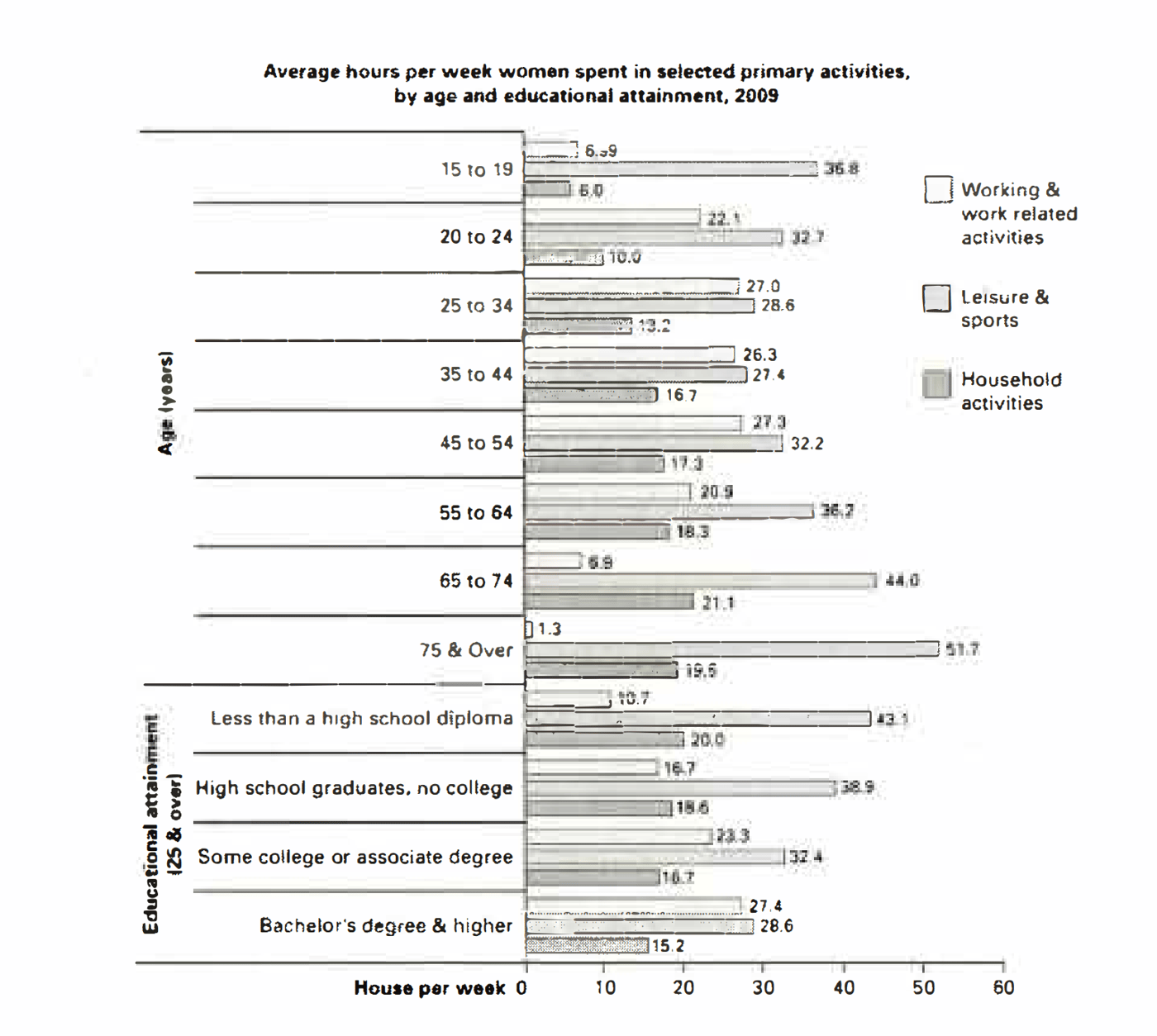
The bar chart below shows the average number of hours that women in various age groups and women with varying levels of education spend on primary activities each week.
Summarise the information by selecting and reporting the main features, and make comparisons where relevant.
Average hours per week women spent in selected primary activities, by age and educational attainment, 2009
Student answer (Band 5.0)
The bar chart compares the percentage of hours different ages girls spend time selected primary activitis and womens spend on primary activitis every week.
It is clear that the highest proportion of womens spend time for leisure and sports, which higher in every age group. By contrast, the percentage of women who spend time for household activitis was the lowest.
In terms of the percentage of 15 to 19 years girls spend time for leisure activitis 36.8 house per week and they did household activitis and working and work related activits 6.9 house per week and 6.0 house per week respectivelly. It is noticeable that the all of age group spend more time for leisure activitis than other two catagoris. However, the percentage of age 75 and over age group women only 1.3 speend for working and working related activits .
Addtionally. the percentage of womens who educated ess than high school diploma they gradually higher spend for working & work related activitis, but other two activitis are similar in every where.
AI examiner evaluation
| Criterion | Band |
|---|---|
| Task Achievement / Task Response | 5.0 |
| Coherence and Cohesion | 5.0 |
| Lexical Resource | 5.0 |
| Grammatical Range and Accuracy | 5.0 |
| Overall | 5.0 |
Task Achievement / Task Response: Band 5.0
You identify the chart’s broad subject and give an overview that leisure is generally the largest activity, showing an attempt to select key features. However, the overview is not fully accurate: household activities are not the lowest for every age group, since working hours are lower for women aged 15–19 and those aged 65 and over. The response also reports only a few figures and does not adequately compare the age groups or the education categories. The final point about women with less than a high-school diploma is unclear and does not reflect the pattern: working hours rise with higher educational attainment, while leisure hours fall. Develop a clearer overview and support it with accurate comparisons across both sets of categories.
Coherence and Cohesion: Band 5.0
The response has some basic organisation: an opening, a general overview, and paragraphs that attempt to describe age and education data. Linking expressions such as “By contrast,” “However,” and “Additionally” show an effort to connect ideas. However, progression is limited because the details are not grouped into clear comparisons, and the education paragraph ends with a vague statement that the activities are “similar in every where.” Some connections are also confusing, particularly the sentence about 15–19-year-olds, where the figures and activity labels are difficult to follow. Organise the body into one paragraph on age and one on education, and use clear comparison language to guide the reader through the main trends.
Lexical Resource: Band 5.0
You use relevant chart vocabulary, including “leisure,” “household activities,” “working and work related activities,” and “age group,” so the topic is generally recognisable. However, the range is limited and several word-choice, form, and spelling errors make parts difficult to understand. Examples include “percentage of hours,” “girls” for the chart’s women, “house” for hours, and repeated misspellings such as “activitis,” “respectivelly,” and “catagoris.” The repeated use of “spend time” also sounds unnatural in this context. Build a more precise set of terms for describing data, and check spelling and collocations so that the figures and categories are communicated clearly.
Grammatical Range and Accuracy: Band 5.0
You attempt a range of sentence forms, including a contrast with “By contrast” and a longer sentence beginning “It is noticeable that,” but control is inconsistent. Frequent errors in agreement, articles, and sentence construction can make the meaning hard to follow. For example, “the highest proportion of womens spend” has an incorrect noun form and verb agreement, while “the percentage of 15 to 19 years girls spend” is not a well-formed clause. The sentence listing the three figures also lacks clear grammatical structure, and punctuation around “Additionally” is faulty. Practise accurate subject–verb agreement and use straightforward patterns such as “Women aged 15–19 spent…” before attempting longer comparisons.
See this exact question answered at other band scores. The same prompt compared across bands.
Browse more IELTS Writing model answers or get your own writing scored by the same AI examiner.