Band 5.0 IELTS Writing Task 1 Model Answer
Overall Band Score: 5.0 · IELTS Momentum Workout · 2026-11-18
IELTS Writing Task 1 question
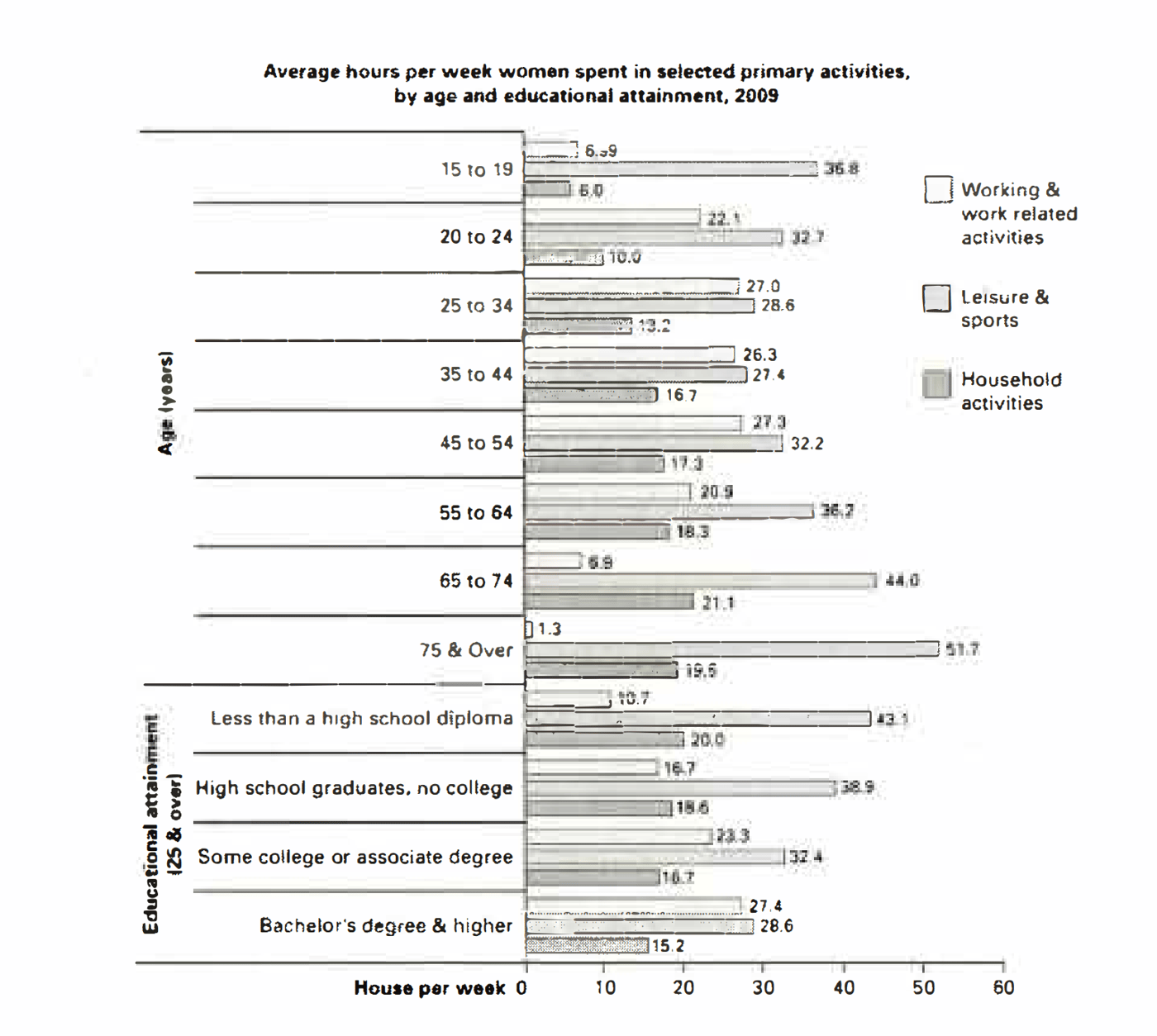
The bar chart below shows the average number of hours that women in various age groups and women with varying levels of education spend on primary activities each week.
Summarise the information by selecting and reporting the main features, and make comparisons where relevant.
Average hours per week women spent in selected primary activities, by age and educational attainment, 2009
Student answer (Band 5.0)
The bar chart illustrate the number of hours that women in variour age and also it's demonstrate the levels of education spend on other activities in 2009.
overall, work was a dominant activity for women in the age of 15 to 64 while leisure and sport took up the most time for older women as well as education level also effected how women divided their time.
for younger women the working activity from 6.9 for 15 to 19 are rose increaseingly to 22.1 for 20 to 24 age of women as well as it's slighhtly increase 27.0 for age 25 to 34 and then decreased at the age of 35 to 44 and again increase from 27.3 for 45 to 64 and then 20.9 in the age of 55 to 64 at last, working related activities had decreased 6.9 in 65 to 74 and 1.3 at the age of 75 over women,
Meanwhile, the leisure and sport had highest time from 51.7 at the age of 75 over women and it is significantly increase from 15 to 74 age of women. In the education high school diploma women ha highest time 43.1 hr for sports while high school graduated women has 38.9 while for the women who is associated with degree has less time from 32.4 and lastly bachelors degree has 28.6
AI examiner evaluation
| Criterion | Band |
|---|---|
| Task Achievement / Task Response | 5.0 |
| Coherence and Cohesion | 5.5 |
| Lexical Resource | 5.0 |
| Grammatical Range and Accuracy | 5.0 |
| Overall | 5.0 |
Task Achievement / Task Response: Band 5.0
You identify several relevant patterns, including the rise and later fall in work-related hours across age groups and the high leisure figure for women aged 75 and over. You also compare leisure time across education levels. However, the task is only partly covered: household activities are not reported, and the education comparison for work is omitted. The overview is also too broad: work is not dominant for every age group from 15 to 64, since leisure exceeds work for women aged 15–19 and 55–64. Some figures are inaccurate or unclear, such as “27.3 for 45 to 64” (the chart gives 27.0 for ages 45–54) and the claim that leisure increases significantly from ages 15 to 74, despite a decline through age 44. Select the main patterns more accurately and include all three activities.
Coherence and Cohesion: Band 5.5
The response has a basic overall structure: an introduction, an overview, and paragraphs describing age and education patterns. This gives the reader some sense of how the information is grouped. However, progression within the age paragraph is difficult to follow because several changes are packed into one long sentence, with repeated “and then” links. The final paragraph shifts from age to education without a clear transition, and it ends without summarising the household-activity data or the overall comparison. Use separate sentences for the main trends, group related comparisons together, and use linking phrases such as “By contrast” or “Regarding educational attainment” to make the relationships clearer.
Lexical Resource: Band 5.0
You use some relevant chart vocabulary, including “dominant activity,” “decreased,” “leisure and sport,” and “education level,” so the topic is generally recognisable. However, the range is limited and several word-choice, collocation, word-form, and spelling errors make parts difficult to interpret. Examples include “variour age,” “rose increaseingly,” “ha highest time,” and “associated with degree.” “Working activity” is also repeated where more precise wording such as “work-related activities” would help. Aim for accurate, consistent terms for the three categories and use verbs that describe trends naturally. Proofreading spelling and choosing standard phrases for qualifications would make the comparisons clearer.
Grammatical Range and Accuracy: Band 5.0
You attempt to combine comparisons and trend descriptions in longer sentences, but these structures are often faulty, and errors frequently make the meaning hard to follow. For example, “the working activity from 6.9 for 15 to 19 are rose” has problems with sentence structure, verb form, and agreement; “it is significantly increase” also uses an incorrect verb form. Articles and plural forms are inconsistent, as in “the age of 75 over women” and “high school graduated women.” Most sentences rely on simple clauses joined together, with limited accurate control of more complex forms. Build shorter, complete sentences first, then practise accurate past-tense reporting and comparison structures.
See this exact question answered at other band scores. The same prompt compared across bands.
Browse more IELTS Writing model answers or get your own writing scored by the same AI examiner.