Band 5.5 IELTS Writing Task 1 Model Answer
Overall Band Score: 5.5 · IELTS Momentum Workout · 2026-11-20
IELTS Writing Task 1 question
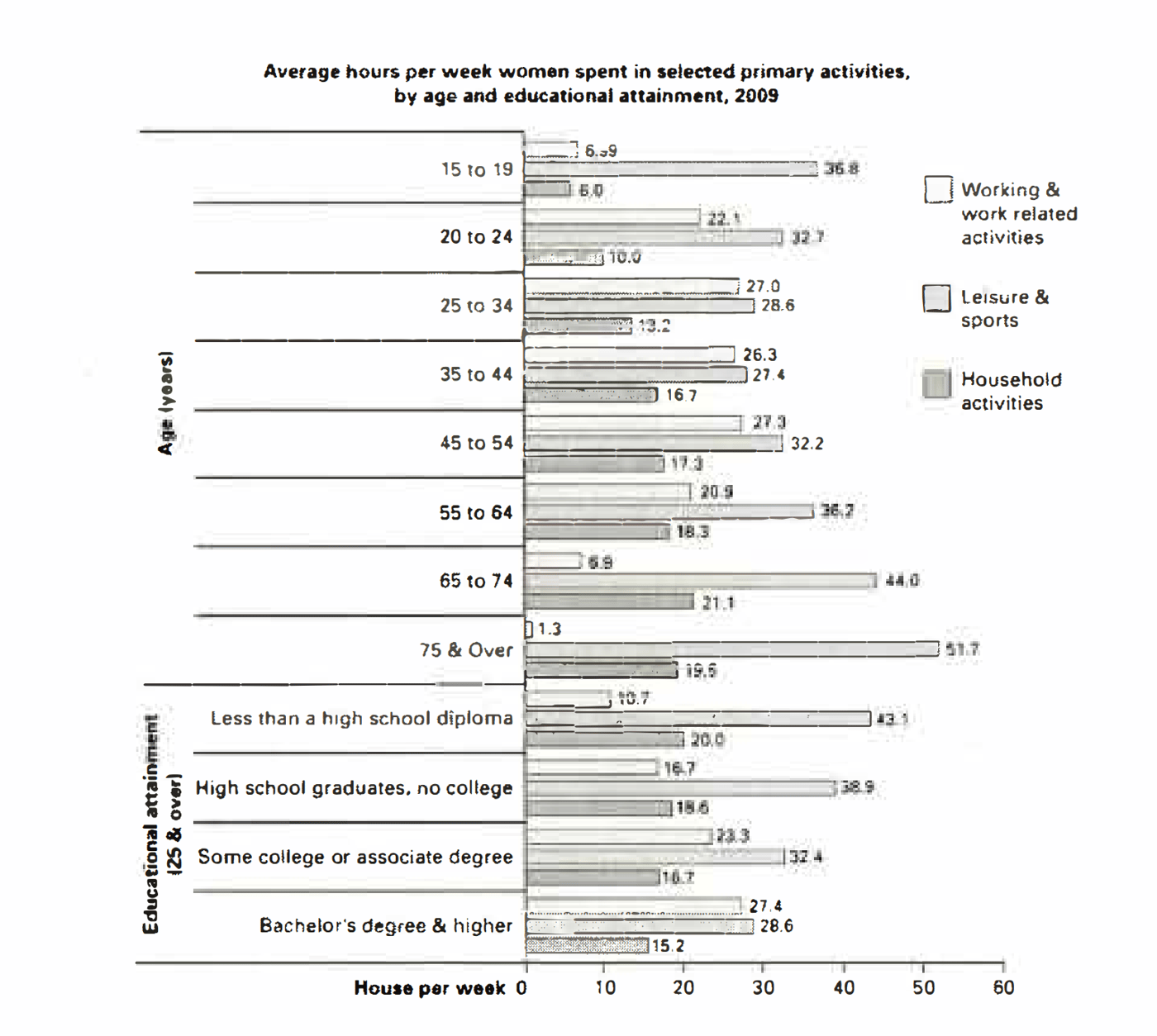
The bar chart below shows the average number of hours that women in various age groups and women with varying levels of education spend on primary activities each week.
Summarise the information by selecting and reporting the main features, and make comparisons where relevant.
Average hours per week women spent in selected primary activities, by age and educational attainment, 2009
Student answer (Band 5.5)
Introduction :
The bar chat illustrates the average number of hours per week that women in different age group and with different educational background spent on three main activites on 2009
Overview:
Overall, small spent more time on leisure and sports activites then on working activites also accounted for a amount for their time.
Body Paragraph 1
looking at the age groups women spend 15 to 19 spend approximately 36.8 hours per on leisure and sports compare with only 6.9 hours on working activites and 6 hours on household task.In the 20 20 to 24 age groups leisure time stood at 32.7 hours while working activites for 22.1 hours for women age 24 to 35 the figure was 28.6 hours leisue and 27 hours for work
body Paragraph 2
Regarding education attaintlment women without a high school diploma spent 43.1 hoursper week on leisure and sports compare with 10.7 hours on working activites
by contrast, women with a bechalor degree on higer spent 27.4 hours on work and 28.6 hours on leisure.
house hold activites accounted for 20 hours and 15.2 hours respectively.
AI examiner evaluation
| Criterion | Band |
|---|---|
| Task Achievement / Task Response | 5.0 |
| Coherence and Cohesion | 5.5 |
| Lexical Resource | 5.5 |
| Grammatical Range and Accuracy | 5.0 |
| Overall | 5.5 |
Task Achievement / Task Response: Band 5.0
You identify the chart’s subject and make relevant comparisons, including the high leisure figure for women aged 15–19 and the contrast between women with the least and highest education. However, the overview is unclear: “small spent more time” does not identify which group you mean, and the main patterns across age groups are not summarised. Several age details are missing, and “for women age 24 to 35” mislabels the 25–34 group. The education section reports useful figures, but the age section stops before the older groups, so the account is only partial and key features are under-developed. State the overall trends clearly—for example, leisure rises among older women, while work peaks in middle age—and select representative comparisons from both categories.
Coherence and Cohesion: Band 5.5
The response has a recognisable structure, with an introduction, an overview, and separate paragraphs for age and educational attainment. This helps the reader distinguish the two sets of information. However, progression within the age paragraph is difficult to follow: the phrase “In the 20 20 to 24 age groups” is unclear, and the next comparison runs into the following sentence without clear punctuation. Linking is also limited, with “while” and “by contrast” doing much of the work, and the overview does not provide a clear organising summary. Use complete sentences, order the age groups consistently, and add clear transitions when moving between groups or activities. These changes would make the existing paragraph structure more coherent.
Lexical Resource: Band 5.5
You use relevant chart vocabulary such as “average number of hours,” “leisure and sports,” “working activities,” and “household activities,” so the topic is generally understandable. There are also attempts at comparison, including “compare with” and “by contrast.” However, spelling errors are frequent—“activites,” “leisue,” “attaintlment,” and “bechalor”—and some phrases are imprecise or unnatural, such as “small spent more time” and “accounted for a amount.” The repeated use of “hours” and “activities” also limits variety. Aim for accurate, conventional reporting language and check spelling carefully; terms such as “time spent,” “whereas,” and “the figure for” would help express comparisons more precisely.
Grammatical Range and Accuracy: Band 5.0
You attempt both simple statements and comparisons, but sentence structures are limited and errors occur frequently enough to make some parts difficult to interpret. For example, “women spend 15 to 19 spend” has an unclear subject and verb pattern, while “In the 20 20 to 24 age groups leisure time stood…” lacks punctuation to separate the introductory phrase. The sentence beginning “for women age 24 to 35” also has an incomplete comparison structure. Tense and agreement are inconsistent, as in “women … spent” in the introduction but “women spend” in the body. Practise building complete sentences with a clear subject, verb, and comparison, and use commas and full stops to separate each data point.
See this exact question answered at other band scores. The same prompt compared across bands.
Browse more IELTS Writing model answers or get your own writing scored by the same AI examiner.