Band 4.5 IELTS Writing Task 1 Model Answer
Overall Band Score: 4.5 · IELTS Momentum Workout · 2026-11-21
IELTS Writing Task 1 question
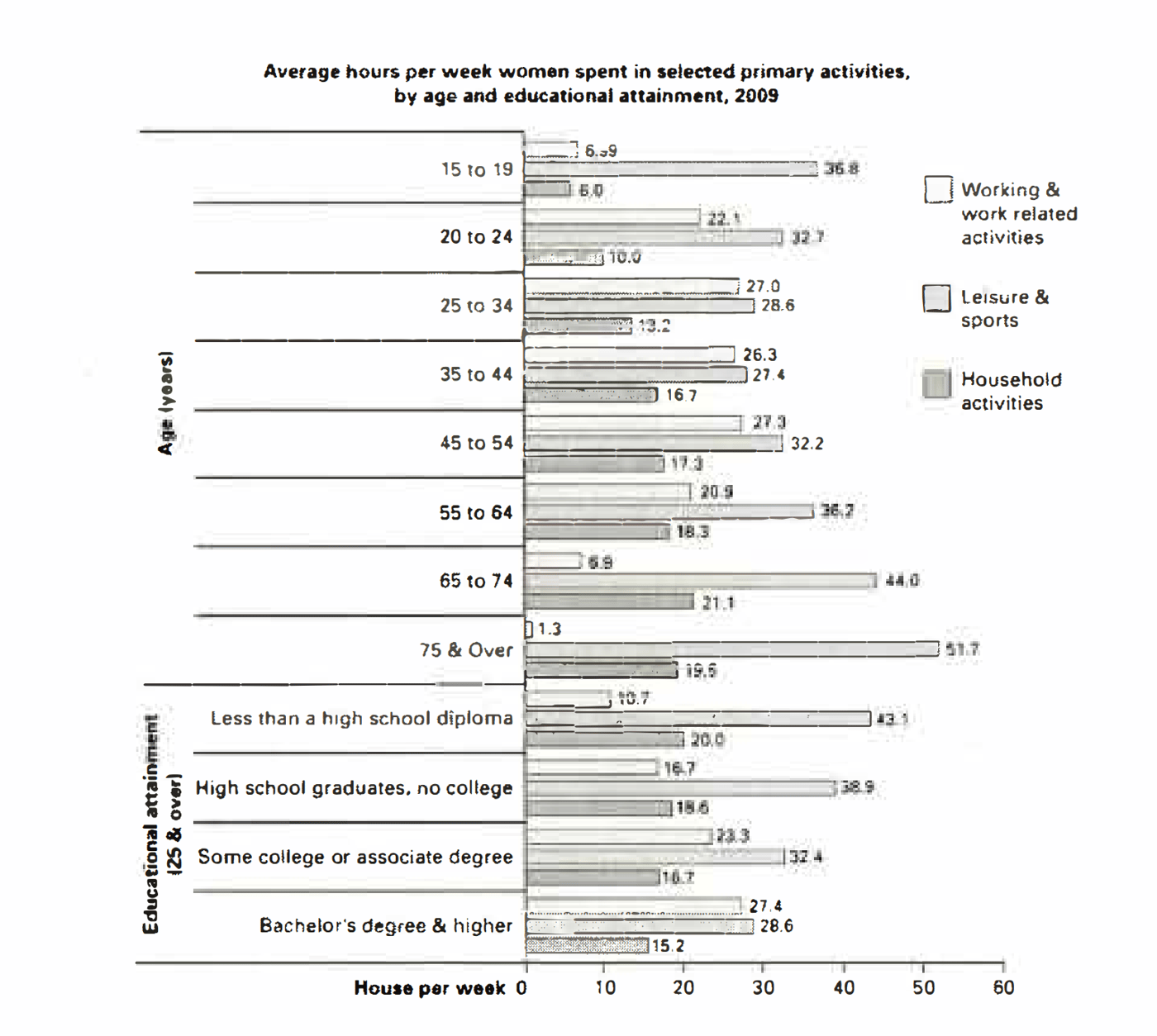
The bar chart below shows the average number of hours that women in various age groups and women with varying levels of education spend on primary activities each week.
Summarise the information by selecting and reporting the main features, and make comparisons where relevant.
Average hours per week women spent in selected primary activities, by age and educational attainment, 2009
Student answer (Band 4.5)
THE BAR CHART ILLUSTRATES THE PROPORTION THAT WOMEN OF DIFFERENT AGES AND EDUCATED WOMEN FROM DIFFERENT FIELDS SPENDING TIME ON DAILY-ROUTINE ACTIVITES. IN THIS CHART I WILL DISCUSS THE INFORMATION THAT HOW MANY HOURS DID WOMEN TOTALLY SPENT.
OVERALL, IT IS NOTICEABLE THAT WOMEN SPENT MORE TIME IN LEISURE AND SPORTS AND IN WORK RELATED ACTIVITES. THE FIGURE OF HOUSEHOLD ACTIVITIES IS LITTLE WEAKER AS COMPARISON TO OTHERS.
THE FIRST POINT IS WOMEN HAVING AGE 75 AND ABOVE WERE SPENT MORE TIME IN LEISURE AND SPORTS FOR THEIR HEALTH FITNESS HIGHER THAN OTHERS. AND WOMEN THOSE ASSOCIATES DEGREE AND AGE GROUP OF 35 TO 44 SPENT LESS TIME. THE FIGURE CONTAINS AGE BETWEEN 65 TO 74 SPENT MORE TIME HOUSEHOLD ACTIVITIES. IN WORKING AND WORK RELATED ACTIVITES THE FIGURE LOWER THAN OTHERS. AS I CAN SEE THERE IS VERY LESS DIFFERENCE AMONG LEISURE AND SPORTS AND HOUSEHOLD ACTIVITIES. THE AGE OF 75 AND OVER WOMEN SPENT LESS TIME AS COPMARED TO OTHERS.
AI examiner evaluation
| Criterion | Band |
|---|---|
| Task Achievement / Task Response | 4.0 |
| Coherence and Cohesion | 4.5 |
| Lexical Resource | 5.0 |
| Grammatical Range and Accuracy | 5.0 |
| Overall | 4.5 |
Task Achievement / Task Response: Band 4.0
The response identifies the chart’s general subject and attempts an overview, but it reports the main features only minimally and includes several inaccurate or unclear comparisons. For example, women aged 75 and over do spend the most time on leisure, but the claim that this is “for their health fitness” is unsupported. The statement that women with an associate degree and those aged 35–44 spent the least time is not accurate across the chart: the lowest working hours are among women aged 75 and over and those aged 15–19, while the lowest leisure figure is for ages 35–44. The overview also says work and leisure take more time without distinguishing the age and education groups. Select the clearest trends and support them with accurate figures.
Coherence and Cohesion: Band 4.5
There is a basic attempt to organise the response, moving from an introduction and overview to selected details. However, the progression is difficult to follow because the body shifts abruptly between age groups, education levels and activity types. Phrases such as “The first point” and “As I can see” do little to show how the comparisons relate, and “the figure” is repeatedly used without a clear reference. The final sentence about women aged 75 and over spending less time is especially confusing because it does not specify the activity and appears to conflict with the earlier leisure comparison. Group the information by age and education, and use clear links and references between comparisons.
Lexical Resource: Band 5.0
The response uses some relevant chart vocabulary, including “leisure and sports,” “household activities” and “work related activities,” so the topic is generally recognisable. However, the range is limited and several word choices or collocations are inaccurate, making some points hard to interpret. “The figure of household activities is little weaker” is not a natural way to describe the data, while “women from different fields” misrepresents educational attainment. There are also spelling errors such as “activites” and “copmared.” Use precise terms such as “hours,” “spent,” “educational attainment” and “accounted for,” and check spelling carefully. Avoid adding explanations that the chart does not provide.
Grammatical Range and Accuracy: Band 5.0
The response attempts a few longer sentence forms, but control is inconsistent and errors frequently affect clarity. For instance, “women of different ages and educated women … spending time” lacks a correctly formed main verb, and “how many hours did women totally spent” uses an incorrect question structure and verb form. “Women having age 75 and above were spent” also has an incorrect construction; write “women aged 75 and over spent.” Articles and prepositions are often missing or awkward, as in “spent less time household activities.” Most sentences rely on simple patterns, and the attempted complex clauses are often faulty. Practise accurate subject–verb structures and past-tense reporting before adding more complex sentences.
See this exact question answered at other band scores. The same prompt compared across bands.
Browse more IELTS Writing model answers or get your own writing scored by the same AI examiner.