Band 4.5 IELTS Writing Task 1 Model Answer
Overall Band Score: 4.5 · IELTS Momentum Workout · 2026-11-23
IELTS Writing Task 1 question
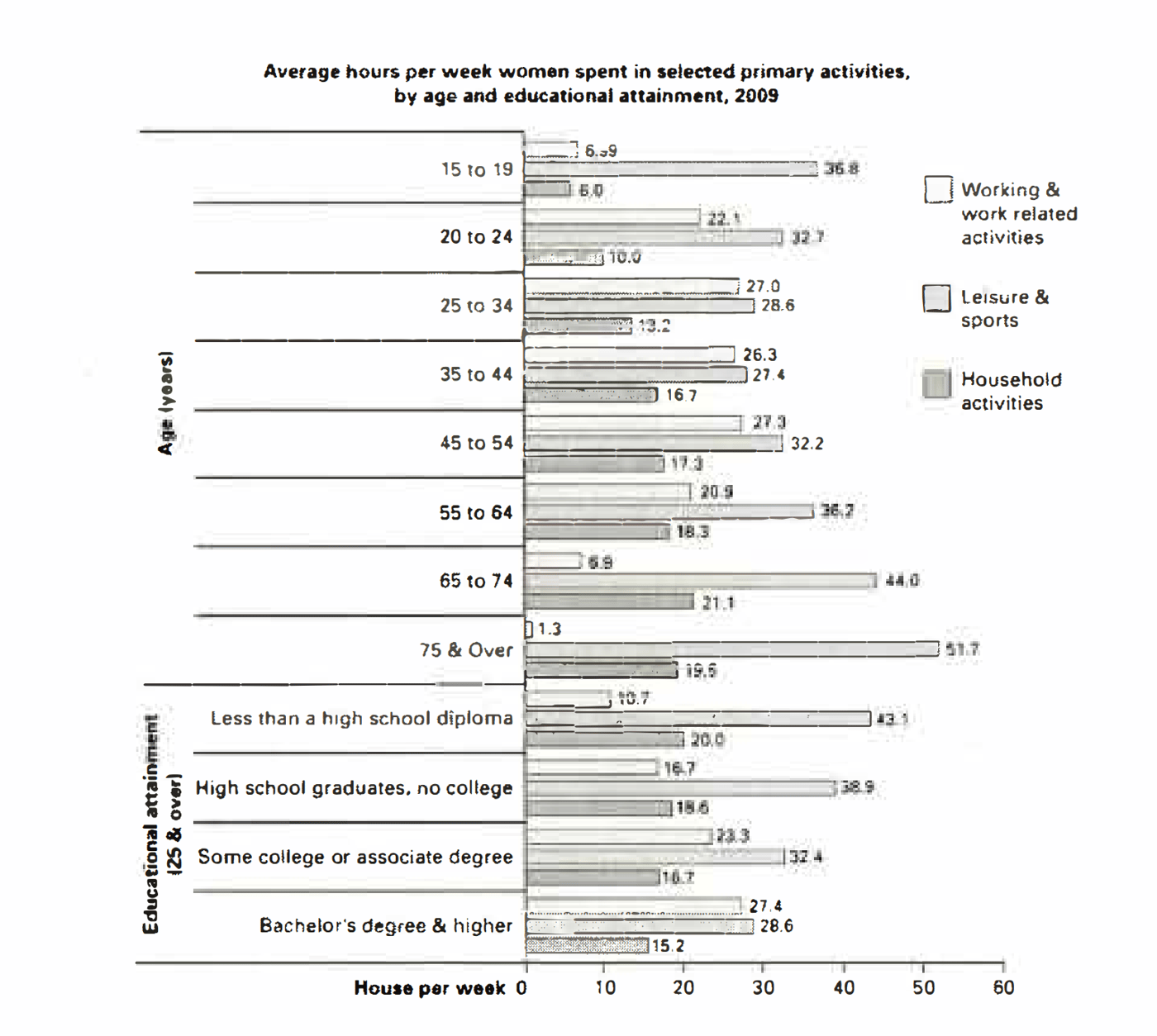
The bar chart below shows the average number of hours that women in various age groups and women with varying levels of education spend on primary activities each week.
Summarise the information by selecting and reporting the main features, and make comparisons where relevant.
Average hours per week women spent in selected primary activities, by age and educational attainment, 2009
Student answer (Band 4.5)
womens plays an important role in our society moreover, wormens become leader. this graph show multiple things about womens life where she spends their time. in between the age of 15 to 19 years females spend around 36.8 hours a week in leisure or sports. but when the age becomes higher the spending hours in leisure and sports could reduced. and in 45 to 54 year old womens her job activities and sports hours is almost same but house hold significantely higher. Leisure and sports spending houres a week in similarly higher in every kind of age group of womens. When the age curve is incline the house holding activities is also gained and when the age curve is declined the house holding activities is getting reduced after 65 to 75 age group. The work related activities is scynosydle it starts with lower side and get peaked then declined and then inclined.
AI examiner evaluation
| Criterion | Band |
|---|---|
| Task Achievement / Task Response | 4.0 |
| Coherence and Cohesion | 4.0 |
| Lexical Resource | 5.0 |
| Grammatical Range and Accuracy | 5.0 |
| Overall | 4.5 |
Task Achievement / Task Response: Band 4.0
The response makes some relevant references to the chart, including the 36.8 hours of leisure and sports for women aged 15–19 and the broad rise and later fall in work-related activity. However, it only minimally reports the data and does not provide a clear, accurate overview of the main patterns across both age and education groups. The claim that leisure time “could reduced” as age rises overlooks its increase among the oldest groups, reaching 51.7 hours for women aged 75 and over. The description of household activity after age 65 is also inaccurate: it rises to 21.1 hours at 65–74 before falling slightly to 19.6. Include the education comparisons and select a few accurate figures to support the key trends.
Coherence and Cohesion: Band 4.0
There is a loose sequence from a general opening to comments about leisure, work and household activities, and linking words such as “but” and “when” show attempts to connect ideas. However, the information is not arranged into a clear report structure: there is no distinct overview, and the discussion shifts between categories without a consistent order. The opening comments about women’s importance and leadership do not help organise the chart description. Some links are also difficult to follow, particularly “When the age curve is incline” and “The work related activities is scynosydle.” Group the main overview first, then describe age patterns and education patterns in separate, logically ordered sections, using clear comparisons between categories.
Lexical Resource: Band 5.0
The response uses some task-relevant vocabulary, including “leisure or sports,” “house hold activities,” “work related activities,” and “peaked” and “declined” to describe trends. However, the range is limited and several inaccurate or unclear choices make the report difficult to understand. “Spending hours” is not a natural way to describe time use, while “age curve” and “scynosydle” do not communicate the intended trends clearly. Spelling and word-form errors, such as “womens,” “houres,” and “significantely,” are also noticeable. Aim for precise chart language and accurate collocations, such as “spent time on,” “rose steadily,” and “fell slightly,” rather than repeating general terms.
Grammatical Range and Accuracy: Band 5.0
The response attempts to combine ideas using clauses with “when” and “but,” and some basic meanings can be understood. However, sentence structures are limited, and errors in agreement, verb forms, articles and sentence boundaries occur frequently. For example, “this graph show” needs subject–verb agreement, and “the spending hours … could reduced” has an incorrect modal construction. In “the house holding activities is also gained,” the verb form does not express the intended trend. Several sentences also run together or lack clear punctuation, making relationships between ideas harder to follow. Practise accurate simple comparisons first, then build longer sentences with controlled clauses, such as “Leisure time fell until middle age, then rose among older women.”
See this exact question answered at other band scores. The same prompt compared across bands.
Browse more IELTS Writing model answers or get your own writing scored by the same AI examiner.