Band 6.0 IELTS Writing Task 1 Model Answer
Overall Band Score: 6.0 · IELTS Momentum Workout · 2026-11-23
IELTS Writing Task 1 question
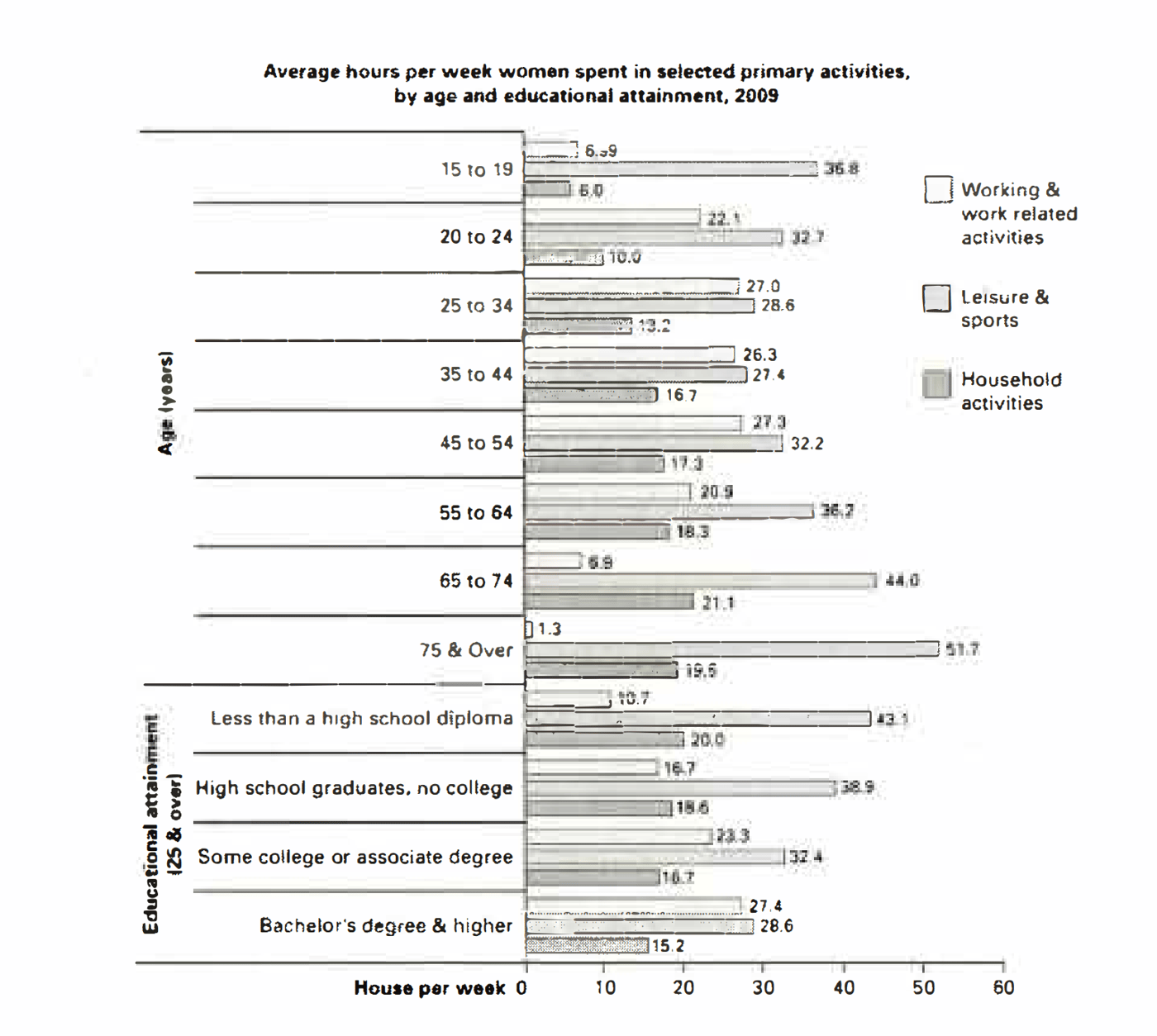
The bar chart below shows the average number of hours that women in various age groups and women with varying levels of education spend on primary activities each week.
Summarise the information by selecting and reporting the main features, and make comparisons where relevant.
Average hours per week women spent in selected primary activities, by age and educational attainment, 2009
Student answer (Band 6.0)
The bar chart illustrates the the average hour per week womens spent on different activities grouped by age and educational attainment.
Overall, for every age group most of the time is spent on sports or being leisure, which also similar for educational attainment. In high school or school work related activities is more but it changes as the education level increases. Womens with college degree or more higer degree spents more time in work related activities.
In the chart the from age 15 to 54 the time womens spent on work related activities incresaes steadily. Further more, as the age increases the time they spent on household activities increases steadily but lower then work activities until age 65. But it changes when womens become old at the time they tend to spent more time in house hold activities then work activities and when age is over 75 they spent the lowest time doing work.
For educational most of time is spent on leisure or sport activities, even though it dclined steadily as the education level increases. Furthermore as womens are persuing more higher studies they spent less time in houshold activities and spent more time in working.
AI examiner evaluation
| Criterion | Band |
|---|---|
| Task Achievement / Task Response | 6.0 |
| Coherence and Cohesion | 6.5 |
| Lexical Resource | 5.5 |
| Grammatical Range and Accuracy | 5.0 |
| Overall | 6.0 |
Task Achievement / Task Response: Band 6.0
You identify several important patterns, including leisure being the largest activity for most groups and work-related time being highest among women with a bachelor’s degree or above. You also note that household activity generally rises with age. However, some comparisons are incomplete or imprecise: work time does not increase steadily from 15 to 54, since it falls slightly from ages 25–34 to 35–44 and then rises again; and household time is already higher than work time for women aged 65–74, not only when they are older. The education overview is relevant, but the claim that work is greater for “high school or school” groups is unclear and does not accurately describe the pattern. Select key figures to support these trends and make the overview more precise.
Coherence and Cohesion: Band 6.5
The response has a clear overall structure: an introduction, an overview, and separate paragraphs discussing age and educational attainment. This gives the reader a sensible route through the information, and linking phrases such as “Overall,” “Furthermore,” and “But” help connect points. The age paragraph also moves broadly from younger to older groups. To make the progression more controlled, group related comparisons and avoid abrupt or unclear transitions, particularly “But it changes when womens become old.” Some references, such as “it” and “the time,” do not clearly identify the activity being discussed. The organisation is coherent, but more precise referencing and smoother links would make cohesion less noticeable and more effective.
Lexical Resource: Band 5.5
You use relevant task vocabulary, including “age group,” “educational attainment,” “work related activities,” and “household activities,” so the main categories are generally understandable. There is also an attempt to describe trends with words such as “increases” and “declined.” However, the range is limited and several word-choice, collocation, and spelling errors reduce precision: “being leisure,” “persuing,” “higer,” and “incresaes” are examples. Phrases such as “most of the time is spent on sports” are also less natural than “the most time is devoted to leisure and sports.” Build a more accurate set of trend verbs and comparison phrases, and check spelling and word forms carefully.
Grammatical Range and Accuracy: Band 5.0
You attempt both simple statements and longer sentences with clauses, for example, “Further more, as the age increases…” and “even though it dclined steadily…”. This shows some range, but control is inconsistent, and errors sometimes make relationships between ideas difficult to follow. Examples include “the average hour per week womens spent,” “which also similar,” and “they spent the lowest time,” where articles, agreement, or verb forms are missing or incorrect. Several sentences also contain awkward clause construction, especially “But it changes when womens become old at the time they tend to spent…”. Practise accurate subject–verb agreement, past-tense reporting, articles, and sentence boundaries. Clearer, shorter sentences would help you express the comparisons reliably.
See this exact question answered at other band scores. The same prompt compared across bands.
Browse more IELTS Writing model answers or get your own writing scored by the same AI examiner.