Band 6.0 IELTS Writing Task 1 Model Answer
Overall Band Score: 6.0 · IELTS Momentum Workout · 2026-11-24
IELTS Writing Task 1 question
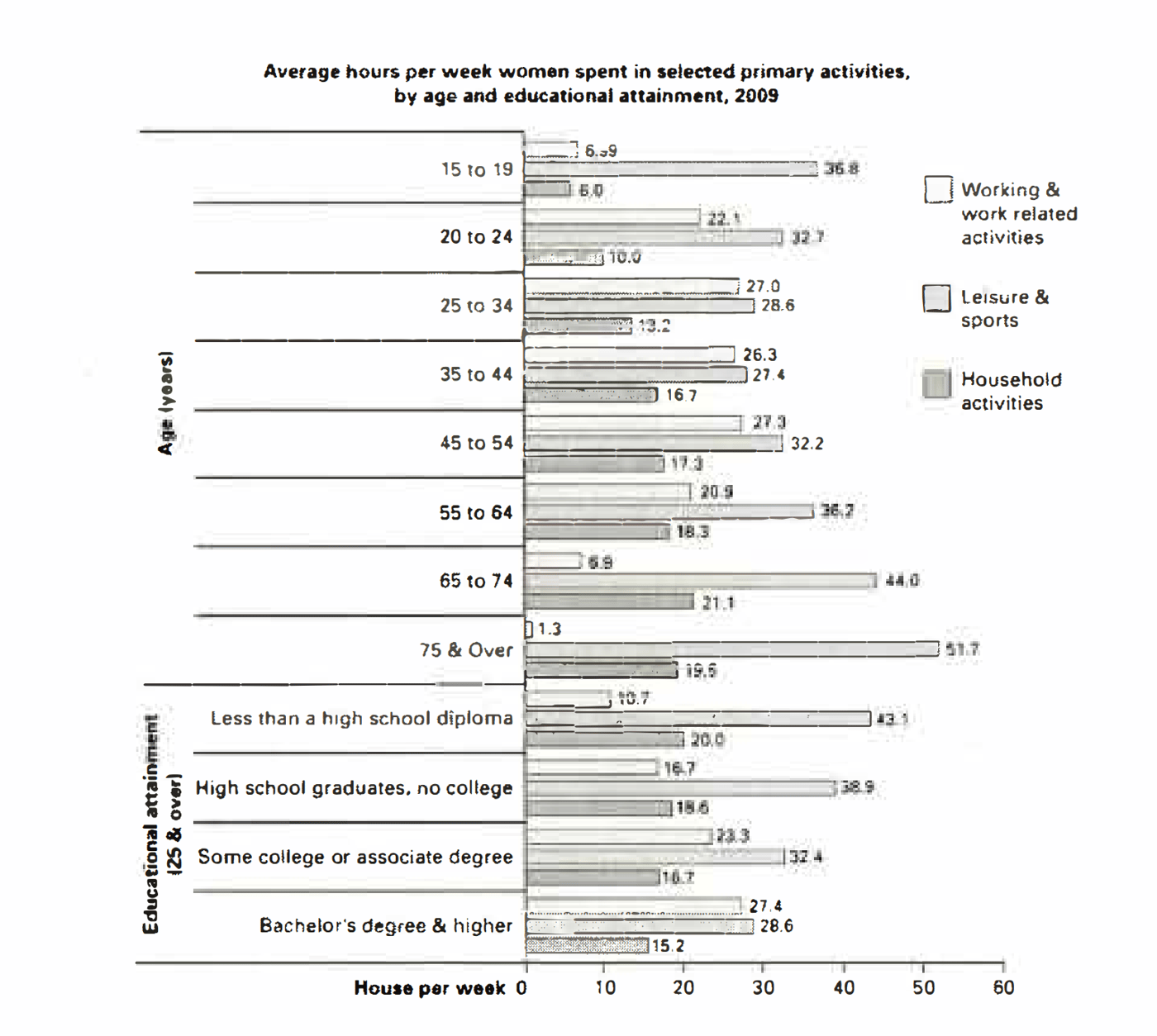
The bar chart below shows the average number of hours that women in various age groups and women with varying levels of education spend on primary activities each week.
Summarise the information by selecting and reporting the main features, and make comparisons where relevant.
Average hours per week women spent in selected primary activities, by age and educational attainment, 2009
Student answer (Band 6.0)
The bar chart illustrates the mean number of hours per week spent as primary activity by women in different age groups and level of schooling.
Overall, for the women of different ages, they spent their most of the time in leisure and sports. The number of hours they spent on working and work related activity also rose gradually with the level of study.
For the age of 15 to 19, they spent most of their time in leisure and sports. Subsequently, as the they ages, working related activity increased and it peaked in the age group of 45 to 54 which is 27.3 hours per week. However, it starts to decline after that age. Household activity increases gradually, till the 65 to 74, then it declines to 19.5h at the age of 75 & over.
Women that have educational attaintement of less than a high school diploma, spent 10.7h on work related activity. It increased with the level of study and peaked to 27.4h for bachelor degree and higher. The leisure and sports also declines gradually with the level of education. However, the time spent on household activity, has shown a slight downward trend.
AI examiner evaluation
| Criterion | Band |
|---|---|
| Task Achievement / Task Response | 6.5 |
| Coherence and Cohesion | 6.5 |
| Lexical Resource | 6.0 |
| Grammatical Range and Accuracy | 5.5 |
| Overall | 6.0 |
Task Achievement / Task Response: Band 6.5
You identify the chart’s two groupings and report several important patterns, including the rise in work-related hours with educational attainment and the decline in leisure time as education rises. You also describe the age-related increase and later fall in household activity. These are relevant comparisons, and the overview gives the reader a useful general picture. However, the age overview is too broad: leisure is not the leading activity for every age group, since work slightly exceeds leisure among women aged 35–44. The work peak is also assigned to ages 45–54, although the chart shows equal highs of 27 hours for ages 25–34 and 45–54. More precise comparisons and a fuller overview of the contrasting age trends would strengthen the report.
Coherence and Cohesion: Band 6.5
The response has a clear four-part structure: an introduction, an overview, and separate paragraphs for age and education. This makes the two chart categories easy to follow, and transitions such as “However” help signal contrasts. The progression is generally logical, but some links are awkward or repetitive, particularly “Subsequently, as the they ages,” which interrupts the movement through the age groups. The overview also focuses on leisure and work but does not clearly preview the household trend or the age-related leisure pattern. Use more precise referencing and transitions to connect comparisons—for example, contrast the middle-aged groups with the youngest and oldest—so the organisation feels more fully integrated rather than mainly a sequence of observations.
Lexical Resource: Band 6.0
You use an adequate range of chart-reporting vocabulary, including “peaked,” “declines,” “gradually,” and “downward trend,” and the meaning is generally clear. Some choices are imprecise or unnatural, however: “primary activity” should be plural or framed as “activities,” “level of schooling” is less exact than “educational attainment,” and “the age of 15 to 19” is better expressed as “the 15–19 age group.” There are also spelling and form errors in “attaintement” and “bachelor degree.” Repeated use of “activity” and “spent” limits flexibility. Aim for accurate collocations such as “hours devoted to household tasks” and “work-related activities,” while checking spelling and using consistent labels from the chart.
Grammatical Range and Accuracy: Band 5.5
You attempt both simple and more complex sentences, including a contrast with “However” and a time sequence using “as.” Most of the intended comparisons remain understandable, but some grammatical errors make the writing less controlled. For example, “for the women of different ages, they spent their most of the time” has an awkward construction and incorrect determiner use; “as the they ages” contains a faulty subject and verb pattern; and “the time spent on household activity, has shown” has an unnecessary comma separating the subject from its verb. There are also article and number issues in phrases such as “for bachelor degree and higher.” Build accuracy by using straightforward comparative sentence patterns, checking subject–verb agreement and articles, and removing commas that split essential sentence elements.
See this exact question answered at other band scores. The same prompt compared across bands.
Browse more IELTS Writing model answers or get your own writing scored by the same AI examiner.