Band 5.0 IELTS Writing Task 1 Model Answer
Overall Band Score: 5.0 · IELTS Momentum Workout · 2026-11-25
IELTS Writing Task 1 question
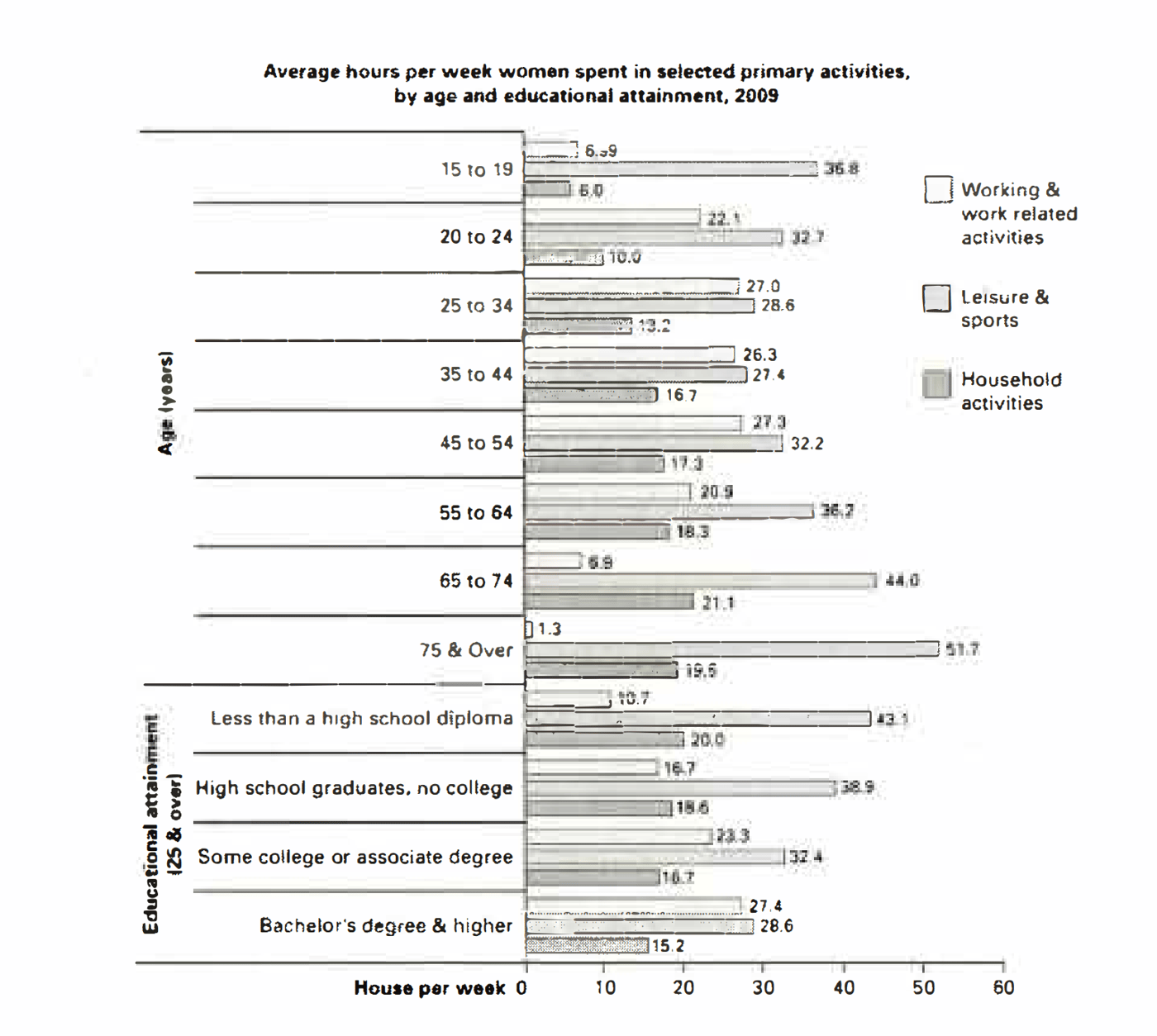
The bar chart below shows the average number of hours that women in various age groups and women with varying levels of education spend on primary activities each week.
Summarise the information by selecting and reporting the main features, and make comparisons where relevant.
Average hours per week women spent in selected primary activities, by age and educational attainment, 2009
Student answer (Band 5.0)
Thr bar graph compares average number of hours per week women spent in selected primary activities by didderent age groups and educational attainments in 2009.
overall, leisure and sopprts are the most common activities in women of almost all ages and and eduactional levels. while households activities showed stable trend. Work related activities are the least common among 75 years and older age group.
women aged from 15 to 19 spent around 10 hours per week at work, which significantly inreased in the next following age groups and reached at its peak in 45 to 54 years old age group before decreasing in older age age categories. Bachelor's and higher education holder women spent most of their time, inwor
AI examiner evaluation
| Criterion | Band |
|---|---|
| Task Achievement / Task Response | 4.0 |
| Coherence and Cohesion | 5.0 |
| Lexical Resource | 5.0 |
| Grammatical Range and Accuracy | 5.0 |
| Overall | 5.0 |
Task Achievement / Task Response: Band 4.0
The response identifies the chart’s subject and offers a broad overview, noting that leisure is generally prominent and that work falls among the oldest women. However, it reports only a small part of the data and does not adequately compare the age and education groups. Some details are inaccurate: work for women aged 15–19 was 6.9 hours, not around 10, and its peak was shared by the 25–34 and 45–54 groups at 27 hours, rather than occurring only at 45–54. The claim that household activity was stable also misses its rise with age. The response is 109 words, below the required 150, and ends mid-sentence, leaving the education comparison incomplete. Develop a fuller overview and support it with accurate figures from both categories.
Coherence and Cohesion: Band 5.0
There is a basic sequence: an introduction, an overview, and then a detail about age-related work hours. This gives the reader some sense of the intended structure. However, the response is very short and its progression is incomplete: it moves from the overview to one age comparison, then begins an education point (“Bachelor's and higher education holder women…”) without finishing it. The overview also combines several claims without clearly organising them into age and education comparisons. Use separate, complete paragraphs for the overview and the main details, and group related figures together. Linking words such as “while” can help contrast trends, but make sure each clause is complete and the relationship between the points is clear.
Lexical Resource: Band 5.0
The response uses some relevant chart vocabulary, including “average number of hours,” “age groups,” “educational attainments,” and “peak,” so the topic is generally recognisable. However, the range is limited and several spelling errors make the writing less clear, including “Thr,” “didderent,” “sopprts,” “eduactional,” and “inreased.” Some expressions are also awkward or imprecise: “most common activities” is not the best way to describe time spent, and “households activities” does not accurately name the category. Aim for precise terms such as “time spent on leisure and sports” and “household activities,” and check spelling carefully. More varied comparison language would also help describe increases, decreases, and differences between groups.
Grammatical Range and Accuracy: Band 5.0
The response attempts both simple statements and a longer sentence describing a trend, for example, “which significantly increased in the next following age groups.” This shows an effort to connect information, but the sentence is not controlled: the relative clause has an unclear reference, and the phrasing makes the trend difficult to follow. There are also problems with sentence boundaries and capitalisation, such as beginning “overall” and “women” in lowercase, and the final sentence is unfinished (“spent most of their time, inwor…”). The opening sentence is understandable, but the response does not demonstrate a consistent range of accurate structures. Write complete sentences, use clear subjects for trend descriptions, and proofread punctuation and sentence endings.
See this exact question answered at other band scores. The same prompt compared across bands.
Browse more IELTS Writing model answers or get your own writing scored by the same AI examiner.