Band 4.5 IELTS Writing Task 1 Model Answer
Overall Band Score: 4.5 · IELTS Momentum Workout · 2026-11-25
IELTS Writing Task 1 question
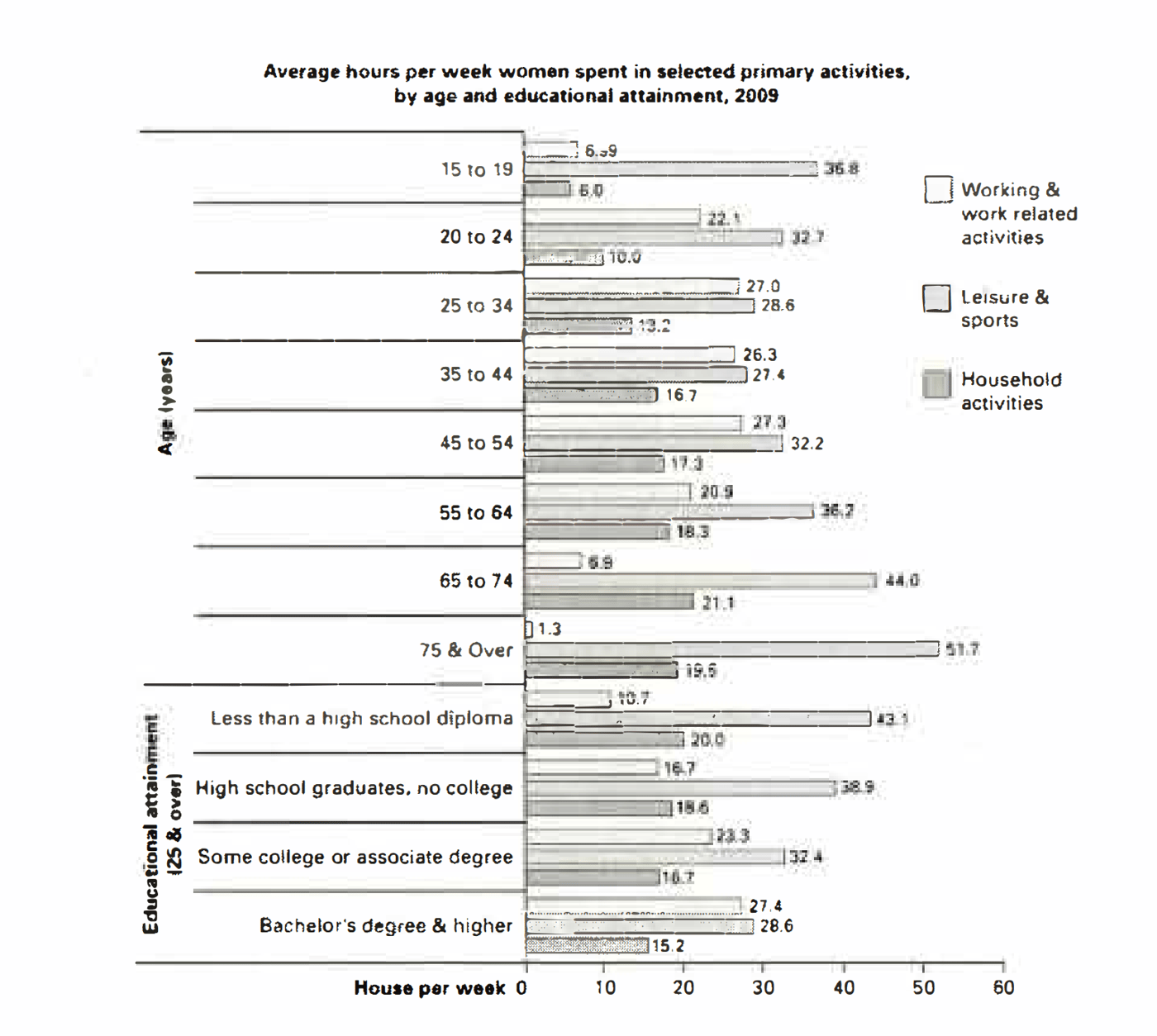
The bar chart below shows the average number of hours that women in various age groups and women with varying levels of education spend on primary activities each week.
Summarise the information by selecting and reporting the main features, and make comparisons where relevant.
Average hours per week women spent in selected primary activities, by age and educational attainment, 2009
Student answer (Band 4.5)
The bar chart below illustrates the average number of hours that women in different age groups and women with varying level of education spend on basic activities in a week in 2009.
Overall, the teenagers are very active in leisure and sports while older are spend there time in house hold activities
The age of 15 to 19 ,teenage they are very less active in working and householding activities ,is 6.9and 6.0 hours per week while they are very active in leisure and sports ,is 36.8 hours in a week.Altough the age of 20 to 24 and 25 to 34 are very significant in working activities and sports but less figure in householding activities.while the age of 35to 44 and 45 to 54 is similar to teenagers. The older 55 to 64
AI examiner evaluation
| Criterion | Band |
|---|---|
| Task Achievement / Task Response | 3.5 |
| Coherence and Cohesion | 4.0 |
| Lexical Resource | 5.0 |
| Grammatical Range and Accuracy | 5.0 |
| Overall | 4.5 |
Task Achievement / Task Response: Band 3.5
The response identifies some relevant figures, including 6.9 hours of work and 6.0 hours of household activity for teenagers, and correctly notes their high leisure time. However, the overview is unclear and partly inaccurate: the chart does not show older women spending most time on household activities; women aged 75 and over spend 51.7 hours on leisure and sports. The discussion ends mid-comparison at “The older 55 to 64,” and it omits the education data and most key trends. The response is also 26 words below the 150-word minimum (the eight words copied from the prompt are excluded). To improve, provide a complete overview and select the main contrasts across both age and education groups, supporting them with accurate figures.
Coherence and Cohesion: Band 4.0
There is a basic attempt to organise the response, beginning with an introduction and then moving to an overview and age-group details. Some linking words, such as “Overall,” “while,” and “Although,” show an effort to connect ideas. However, the progression is difficult to follow because several comparisons are compressed into one long passage, and the final sentence is unfinished. The overview does not clearly guide the reader through the main features, while repeated references to age groups do not develop into a complete comparison. Use separate paragraphs for the overview and selected details, and group related age ranges or education levels together. Complete each comparison and use linking expressions only where they clarify the relationship between figures.
Lexical Resource: Band 5.0
The response uses some task-relevant vocabulary, including “average number of hours,” “leisure and sports,” and “working activities,” so the topic is generally recognisable. However, the range is limited and several word choices or forms are inaccurate or awkward, such as “house holding activities,” “householding,” and “very significant in working activities.” “Very active” is also imprecise for describing time spent, and “older” is too broad when referring to specific age groups. These choices sometimes make the intended comparison harder to understand. Aim for standard chart language such as “spent,” “recorded,” “accounted for,” and “the highest/lowest figure,” and use the chart’s category labels consistently.
Grammatical Range and Accuracy: Band 5.0
The response attempts to combine ideas using clauses, for example, “while they are very active in leisure and sports,” but the sentence structures are often faulty and the range remains limited. Errors include “older are spend,” “they are very less active,” and “the age of 20 to 24 and 25 to 34 are,” where verb forms, sentence construction, or agreement are not controlled. Punctuation is also inconsistent: several sentences run together, and the final clause is incomplete. These problems can make relationships between the figures difficult to follow. Practise writing complete, shorter comparison sentences first, then combine them with accurate clauses—for example, “Women aged 15–19 spent 36.8 hours on leisure, compared with 6.9 hours on work.”
See this exact question answered at other band scores. The same prompt compared across bands.
Browse more IELTS Writing model answers or get your own writing scored by the same AI examiner.