Band 6.0 IELTS Writing Task 1 Model Answer
Overall Band Score: 6.0 · IELTS Momentum Workout · 2026-11-25
IELTS Writing Task 1 question
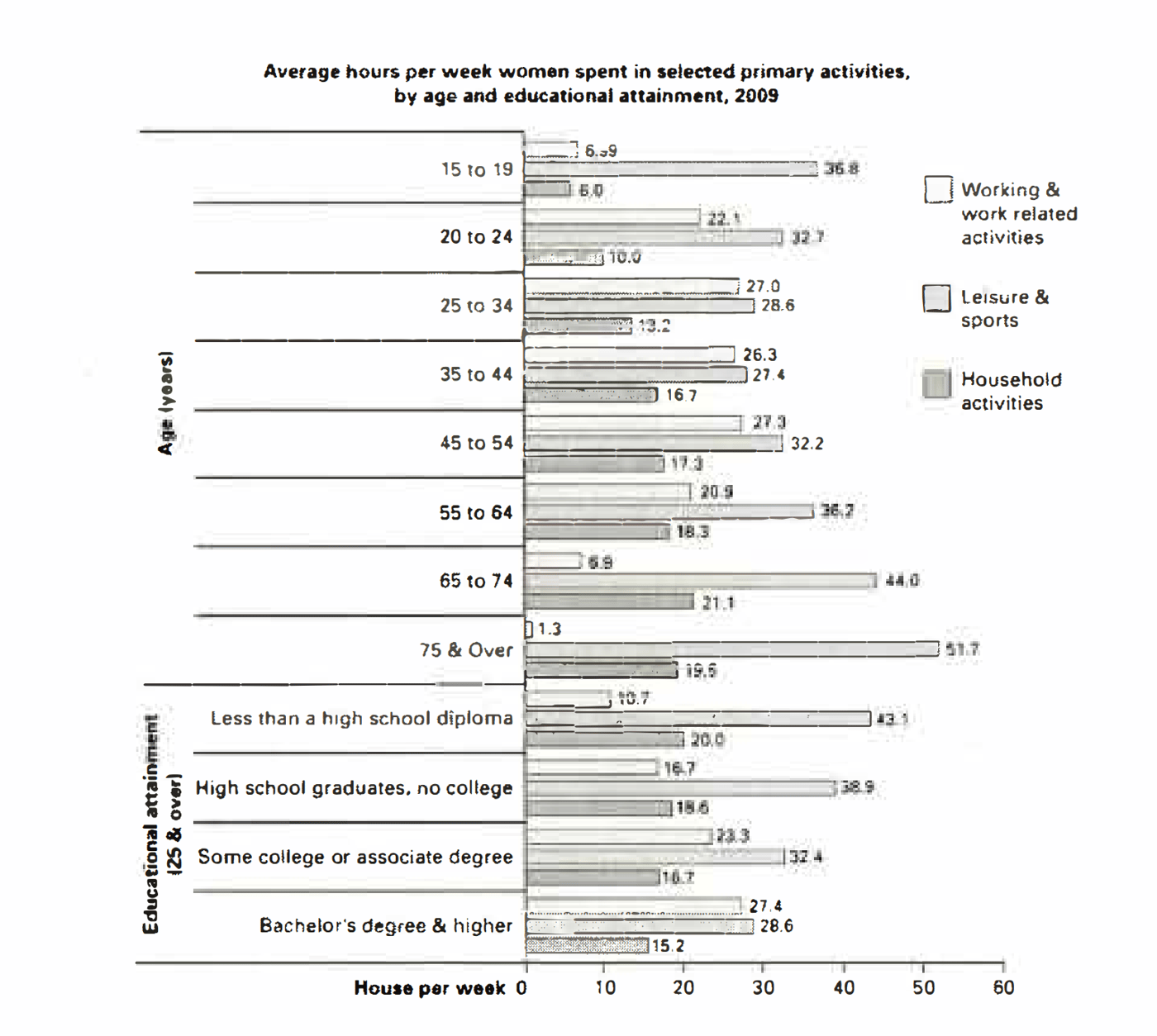
The bar chart below shows the average number of hours that women in various age groups and women with varying levels of education spend on primary activities each week.
Summarise the information by selecting and reporting the main features, and make comparisons where relevant.
Average hours per week women spent in selected primary activities, by age and educational attainment, 2009
Student answer (Band 6.0)
This bart chart illustrates the average hours per week women spent in different activitites, discriminating by age and educational attachment in 2009. We can clearly see that, for all age groups given, leisure&sports take the lead for most time spent. Leisure and sports also take the lead, considering all educational attachment. It is especially popular among 75& over age groups with 51.7 hours per week. For different age groups, it seems that it starts out at 36.8 hours for people between the ages of 15 to 19, then we can see it declining slightly until it reaches the women aged between 45 to 54. Then it is on a sharp incline, raising from 32.2 to 36.6 hours for women aged 55-64. Also, the women that hold less than a high school diploma spend more time on sports, and time spent on sports seems to decline as the higher education progresses.
Household activities appears to be the one activity every age group spent the least amount of time compared to others, except for the women aged 75 and over. Household activities also can be seen in the chart as the activity that women spent less and less time on, as their education levels progress.
AI examiner evaluation
| Criterion | Band |
|---|---|
| Task Achievement / Task Response | 5.5 |
| Coherence and Cohesion | 6.0 |
| Lexical Resource | 6.0 |
| Grammatical Range and Accuracy | 6.0 |
| Overall | 6.0 |
Task Achievement / Task Response: Band 5.5
You identify the main pattern that leisure and sports take the most time, and you include useful figures such as 51.7 hours for women aged 75 and over. You also correctly note that leisure time generally falls as educational attainment rises, while household time declines across education levels. However, the account is incomplete and some details are inaccurate: leisure rises from 32.2 hours at ages 45–54 to 36.2 at 55–64, not 36.6, and the age trend is not simply a decline followed by an increase because leisure is already 36.8 among teenagers. The claim that household activities are the least-time activity for every age group except the oldest is also incorrect; working time is lower for women aged 15–19 and 20–24. Include the work-related activity trend and a clearer overall comparison.
Coherence and Cohesion: Band 6.0
The response has a generally understandable sequence: it introduces the chart, discusses leisure by age and education, then turns to household activities. Linking phrases such as “For different age groups,” “Then,” and “Also” help show the direction of the discussion. However, the response is organised around only two activities, so the comparison feels incomplete, and the first paragraph moves between age and education without a clear separation. Some connections are also imprecise: “Then it is on a sharp incline” follows a description of a decline but does not clearly identify the age groups being compared. Grouping the age data in one paragraph and educational attainment in another, with a concise overview, would make the progression clearer and less dependent on sequential linking words.
Lexical Resource: Band 6.0
You use an adequate range of chart-related vocabulary, including “average hours,” “declining,” “sharp incline,” and “education levels progress,” and the meaning is generally clear. There are, however, several spelling and word-choice problems: “bart chart” and “activitites” are misspelled, while “educational attachment” is not the appropriate term for attainment. “Take the lead” and “popular” are less precise for describing time allocation, and “raising” is an awkward choice for an increase in hours. Repeated use of “spend more time” and “activity” also limits variety. Use accurate terms such as “account for the most time,” “educational attainment,” and “rise,” and check spelling and collocations before submitting.
Grammatical Range and Accuracy: Band 6.0
You use a mix of simple and more complex sentence forms, including clauses introduced by “as” and “that,” and most sentences remain understandable. Some grammatical errors are present, particularly with agreement and sentence construction. For example, “Household activities appears” should use a plural verb (“appear”), while “the activity that women spent less and less time on” is awkwardly structured and would be clearer as “the activity on which women spent progressively less time.” The phrase “considering all educational attachment” also lacks a natural grammatical construction. Punctuation and spacing around “leisure & sports” and “75 & over” are inconsistent. More controlled sentence patterns and careful checking of agreement and clause structure would improve accuracy.
See this exact question answered at other band scores. The same prompt compared across bands.
Browse more IELTS Writing model answers or get your own writing scored by the same AI examiner.