Band 4.5 IELTS Writing Task 1 Model Answer
Overall Band Score: 4.5 · IELTS Momentum Workout · 2026-11-26
IELTS Writing Task 1 question
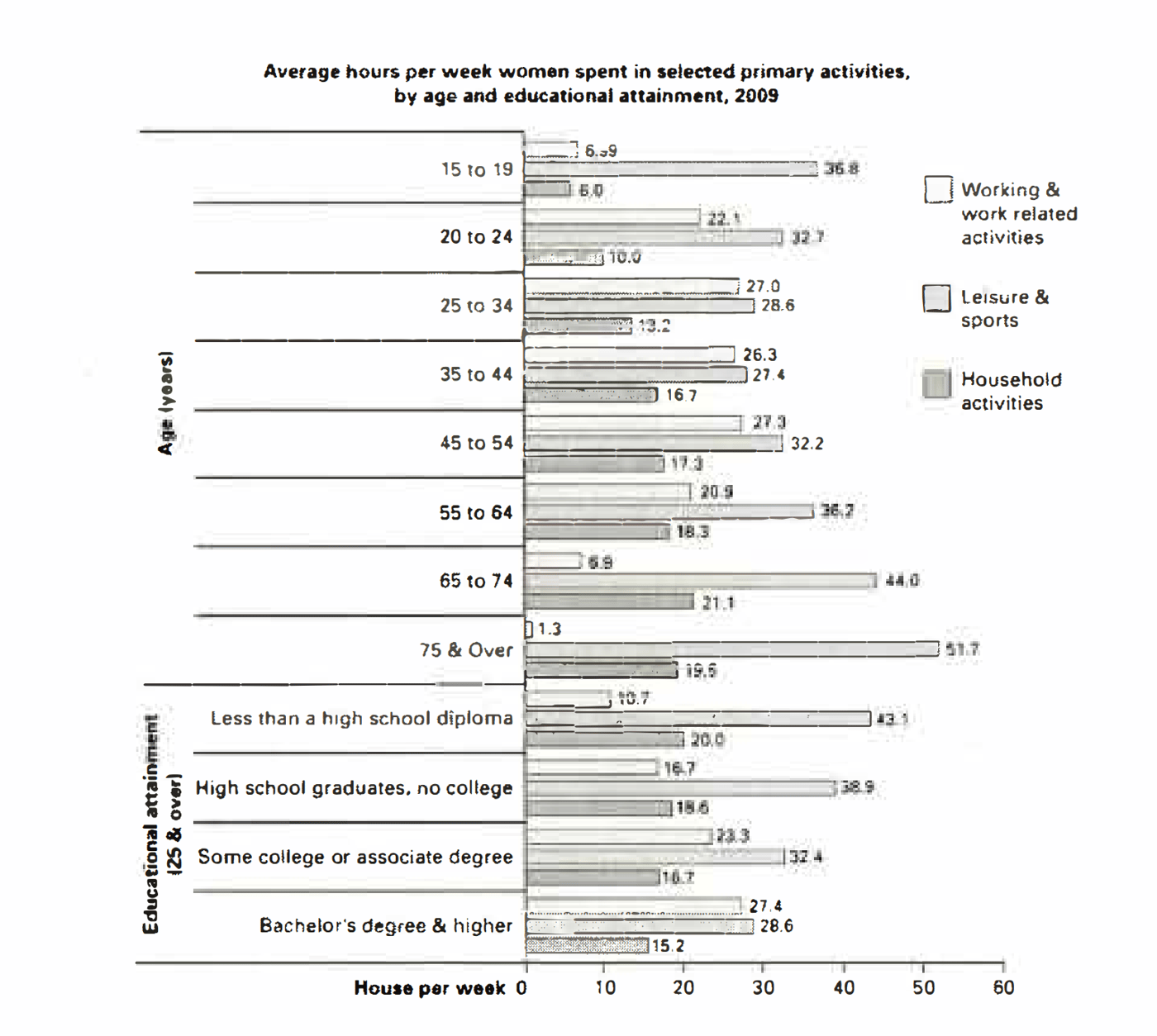
The bar chart below shows the average number of hours that women in various age groups and women with varying levels of education spend on primary activities each week.
Summarise the information by selecting and reporting the main features, and make comparisons where relevant.
Average hours per week women spent in selected primary activities, by age and educational attainment, 2009
Student answer (Band 4.5)
grap depict the data of different women catagorized on the base of their pedagogy and age and described the time they spend more on work activites , sports related activities and hose related activies .
firstly, analyze the work related activities in on the basis of their age. In house hold activies, participation contineously increase with the age of women and lowest in 15 to 19 years and highest in 75 & over aged women while work related acitivies is lower in 15 to 19 year and remained steady in 25 to 55 year aged women near to 28 percent after that as the aged increase it becomed to decrease continues with age. However, house hold activites in 15 to 19 year aged women is near to 6 percent and remain steady in 24 to 55 year aged women and than start increased and reached to 21 percent in 75 & over aged women .
conclusion is that in education women same pattern follow and show that bachelor passed women balance in their activites
AI examiner evaluation
| Criterion | Band |
|---|---|
| Task Achievement / Task Response | 4.0 |
| Coherence and Cohesion | 4.5 |
| Lexical Resource | 5.0 |
| Grammatical Range and Accuracy | 5.0 |
| Overall | 4.5 |
Task Achievement / Task Response: Band 4.0
You identify the chart’s broad subject and make a relevant attempt to describe age-related patterns, especially the rise in household activity and the fall in work among older women. However, the response addresses the data only minimally: it gives no clear overview of the main contrasts and largely omits leisure and sports, which is the highest figure for many groups. Several details are inaccurate or unclear. For example, work hours are described as “near to 28 percent” and steady from ages 25 to 55, although the chart reports hours and the values are around 26–27; household hours peak at 21.1 for ages 65–74, not 75 and over. The education comparison is only asserted, not explained. Select the main trends and support them with accurate figures.
Coherence and Cohesion: Band 4.5
There is a basic attempt to organise the response, beginning with an introduction and then discussing age before ending with education. Connectors such as “firstly” and “however” show an effort to guide the reader. However, the progression is difficult to follow because the paragraph repeatedly shifts between household and work activities, and the same household trend is stated twice. The final sentence introduces education without developing the comparison, so the response does not reach a clear, complete conclusion. Some linking is also confusing: “However” does not clearly signal the relationship between the points that follow. Group the information into clear sections—for example, age patterns and education patterns—and use each paragraph to compare the three activities in a consistent order.
Lexical Resource: Band 5.0
You use some relevant topic vocabulary, including “work related activities,” “household activities,” “participation,” and “increase,” so the reader can recognise the subject of the chart. However, the range is limited and several word choices or spellings make the description less clear, such as “pedagogy” for educational attainment, “sports related activities” for leisure and sports, and “balance in their activities.” Repeated use of “activities” and “women” also makes the writing imprecise. There are frequent spelling errors, including “grap,” “catagorized,” and “contineously,” which can slow the reader. Use the chart’s labels accurately and choose precise terms for time and comparison, such as “hours per week,” “rose,” and “declined.”
Grammatical Range and Accuracy: Band 5.0
The response attempts longer sentences and some subordination, as in “while work related activities is lower…” and “as the aged increase…,” but these structures are often faulty. Subject–verb agreement is inconsistent (“activities … is”), and verb forms and tense are frequently inaccurate (“it becomed to decrease,” “start increased”). Articles, plurals, and sentence boundaries also need attention; the opening is a fragment-like sentence, while several long sentences join multiple ideas without clear punctuation. These errors sometimes make the intended comparisons difficult to interpret. Build accuracy first with clear simple sentences, then add controlled clauses using “while” or “whereas.” Check that each subject agrees with its verb and keep the chart description consistently in the past tense.
See this exact question answered at other band scores. The same prompt compared across bands.
Browse more IELTS Writing model answers or get your own writing scored by the same AI examiner.