Band 5.5 IELTS Writing Task 1 Model Answer
Overall Band Score: 5.5 · IELTS Momentum Workout · 2026-11-26
IELTS Writing Task 1 question
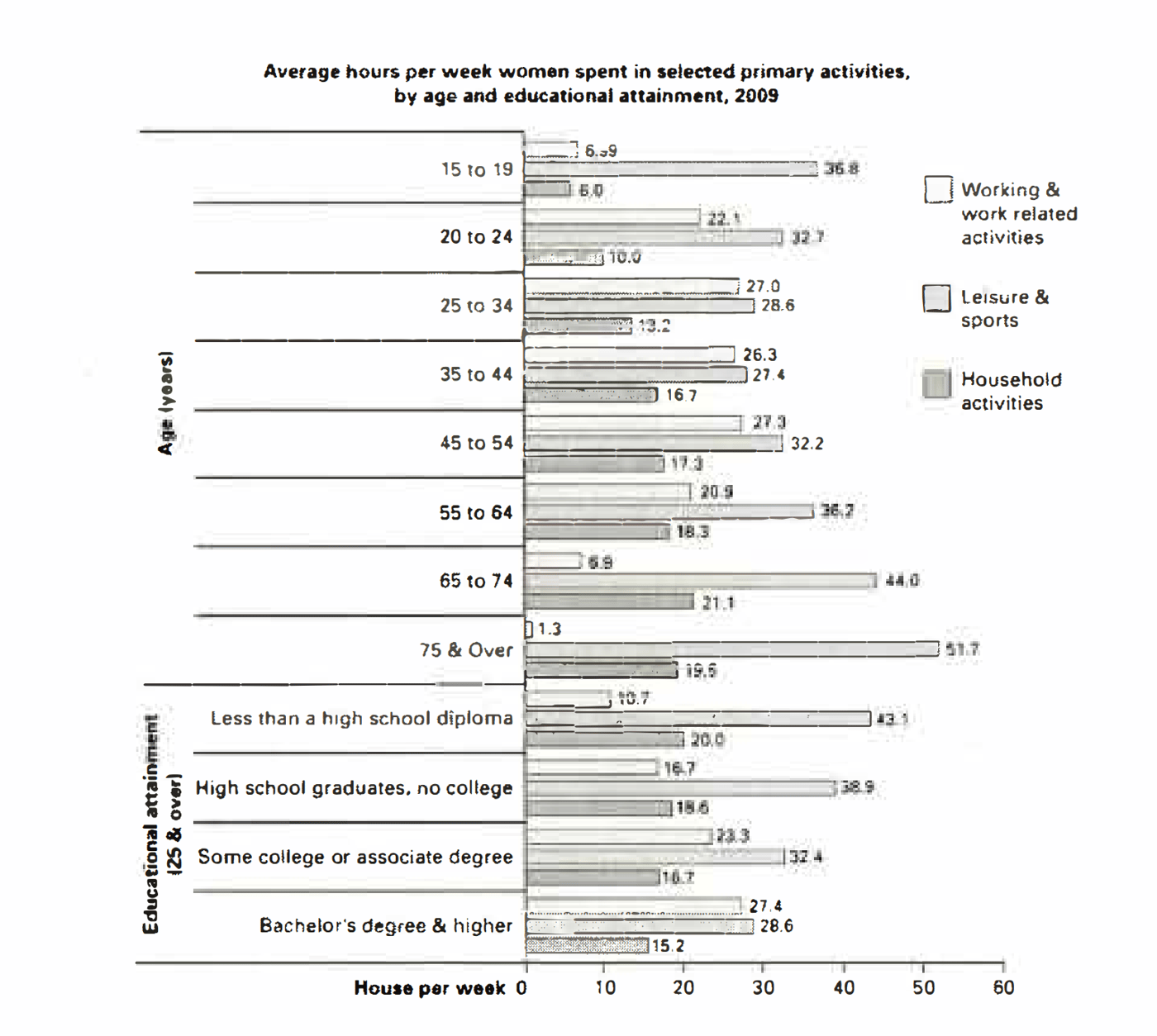
The bar chart below shows the average number of hours that women in various age groups and women with varying levels of education spend on primary activities each week.
Summarise the information by selecting and reporting the main features, and make comparisons where relevant.
Average hours per week women spent in selected primary activities, by age and educational attainment, 2009
Student answer (Band 5.5)
The bar graph depicts the mean of hours per week females utilized in particular primary activities according to age group and acedamic attainment in 2009.
Overall, 45 to 54 aged women's used the highest hours in working activities in 2009 among other activities. Whereas, Household activities ranked second highest in all age group compared to others activities.
Regarding education attainment and 25 and over, in high school graduates and no collage, 16.7 hours spent in work and work realted activities by women , 38.9 hours and 18.6 hours used in leisureand sports activity and household activities, respectively. Which was the highest working age group in acedamic sector. Less than a high school diploma women utilized the second highest hours in work, sports and household activities. While, some collage or associate degree and bachelor's degree & higher female's recorded approximately same hours in three catagories. They used between 15 to 33 hours per week in 2009.
Turning to the various age group, 15 to 19 age group females used highest in sports activities compared to work and household activity, which was 36.8 hours. The least number of used in workin activites by 75 & over aged womens, that was 1.3 hours per week. However, 45 to 54 and 55 to 64 age group feamle's utilized almost same amount of hours in three catogaries, from15 to 39 hours. working and leisure activities constituted 27.0 and 28.6 hours in 25 to 34 age group women.
AI examiner evaluation
| Criterion | Band |
|---|---|
| Task Achievement / Task Response | 5.0 |
| Coherence and Cohesion | 6.0 |
| Lexical Resource | 5.5 |
| Grammatical Range and Accuracy | 5.0 |
| Overall | 5.5 |
Task Achievement / Task Response: Band 5.0
You identify several relevant figures, including 36.8 hours of leisure for women aged 15–19 and 1.3 hours of work for those aged 75 and over. However, the overview is substantially inaccurate: women aged 45–54 did not spend the most time working (their figure was 27.0 hours, close to the peak of 27.4 for degree holders), and household activities were not the second-highest category across all age groups; leisure was generally higher. Some comparisons are also unclear or incorrect, such as calling high-school graduates the highest working group when the degree group recorded more. The response covers both age and education, but important trends are missed and some details are under-developed. A more accurate overview and carefully selected comparisons would strengthen the report.
Coherence and Cohesion: Band 6.0
The response has a recognisable structure: an introduction, an overview, and separate paragraphs for educational attainment and age. This gives the reader a basic route through the information, and transitions such as “Regarding education attainment” and “Turning to the various age group” signal the shift in focus. However, progression within paragraphs is sometimes difficult to follow because several figures and categories are compressed into long, loosely connected sentences. For example, the sentence beginning “Less than a high school diploma women…” moves from work to sports and household activities without clearly identifying the comparisons. “Whereas” and “While” also introduce fragments rather than complete linked ideas. Grouping the main trends more clearly and using precise references would make the organisation more effective.
Lexical Resource: Band 5.5
You use some task-relevant vocabulary, including “mean,” “attainment,” “utilized,” and “constituted,” and the activity categories are generally recognisable. However, word choice and collocation are often inaccurate or awkward, which sometimes makes the meaning harder to interpret. Examples include “the mean of hours,” “highest working age group in academic sector,” and “used highest in sports activities.” There are also noticeable spelling errors, such as “acedamic,” “realted,” “collage,” and “catogaries,” alongside inconsistent forms such as “females” and “women.” Aim for simpler, accurate phrasing rather than forcing formal vocabulary, and check spelling carefully. More precise expressions for describing amounts and comparisons would improve clarity and range.
Grammatical Range and Accuracy: Band 5.0
You attempt both simple and more complex sentence forms, but control is inconsistent, and errors sometimes make relationships between ideas unclear. For example, “45 to 54 aged women's used” has problems with word order, possessive form, and agreement, while “Which was the highest working age group…” is an incomplete sentence. The construction “16.7 hours spent in work…” also lacks a clear subject and auxiliary verb. Other sentences combine several clauses without reliable punctuation, as in the education paragraph. Practise forming complete sentences with a clear subject and verb, and check agreement, articles, and plural forms. Using a few well-controlled complex sentences will be more effective than joining many ideas into one.
See this exact question answered at other band scores. The same prompt compared across bands.
Browse more IELTS Writing model answers or get your own writing scored by the same AI examiner.