Band 5.0 IELTS Writing Task 1 Model Answer
Overall Band Score: 5.0 · IELTS Momentum Workout · 2026-11-26
IELTS Writing Task 1 question
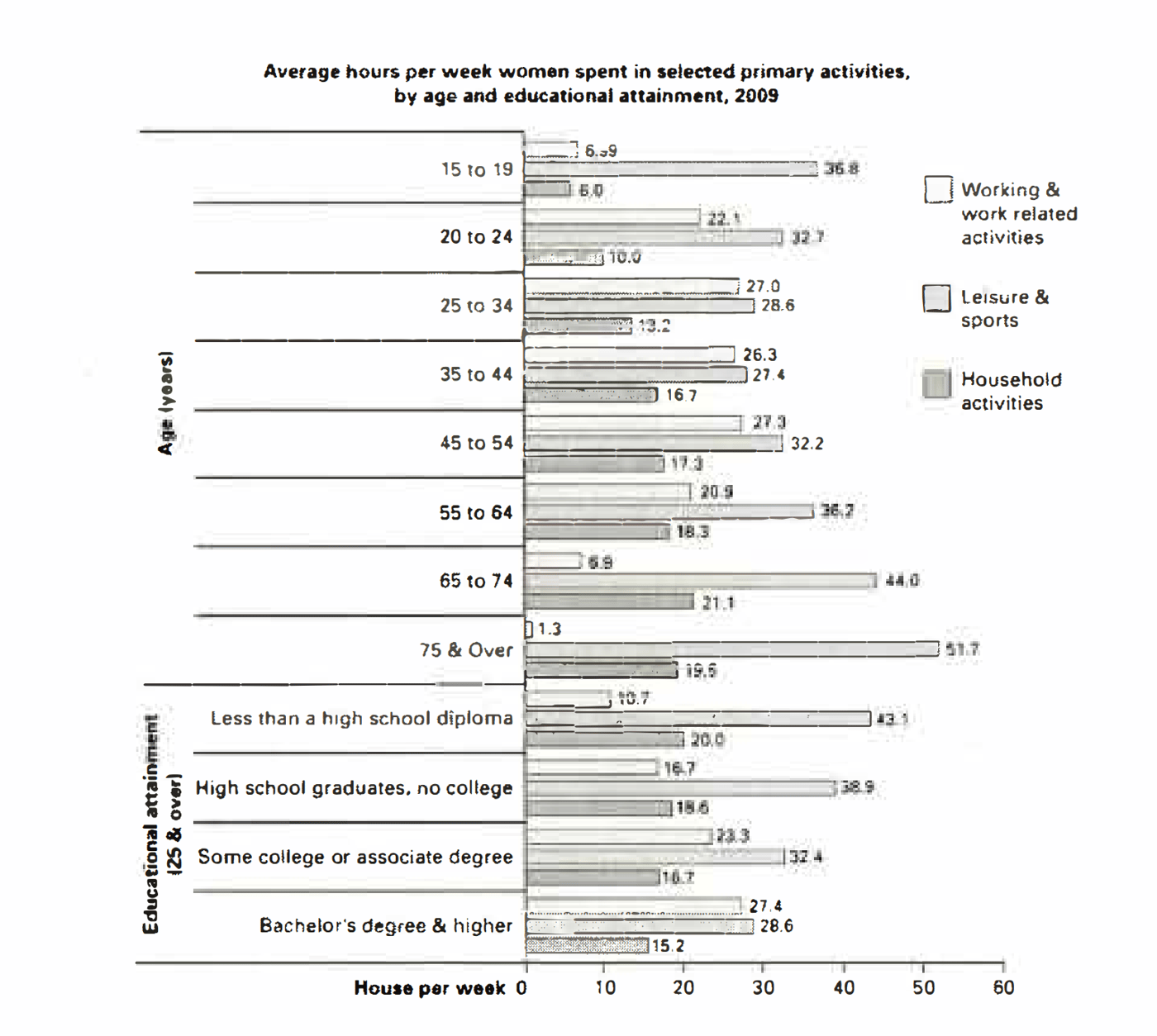
The bar chart below shows the average number of hours that women in various age groups and women with varying levels of education spend on primary activities each week.
Summarise the information by selecting and reporting the main features, and make comparisons where relevant.
Average hours per week women spent in selected primary activities, by age and educational attainment, 2009
Student answer (Band 5.0)
The bar chart illustrates the average number of hours women in different age groups and with varying levels of attainment spent on three primary activities per week in three different groups in 2009.
Overall, we see in a chart women having age 75 & over spend too much time on leisure and sports activities its percentage equal to 51.7 hours. Also these age group people donot work and other work related activities its percentage only 1.3 hours. This age group is a very distinct age group among all. Beside these if we talk about the educational attainment people having age above 25 & over. Only 43.1 hours womens having less than a high school diploma. While only 15.2 hours have only Bacelor's degree & higher education.
Firstly, we talk about the age group of 25 to 34 in this age womens spent much time on working & work related activities because this is mature age everyone should have struggling time.
Secondly, age group age 65 to 74 women spent much time on household activities among all other ages.
AI examiner evaluation
| Criterion | Band |
|---|---|
| Task Achievement / Task Response | 5.0 |
| Coherence and Cohesion | 4.5 |
| Lexical Resource | 5.0 |
| Grammatical Range and Accuracy | 5.0 |
| Overall | 5.0 |
Task Achievement / Task Response: Band 5.0
You identify some relevant extremes, including the 75-and-over group’s 51.7 hours of leisure and 1.3 hours of work, and note that women with less than a high-school diploma spend 43.1 hours on leisure. However, the overview is incomplete and some comparisons are inaccurate or unclear. The 43.1 figure is leisure time, not a general measure of those women’s hours, while 15.2 refers to household activities among women with a bachelor’s degree or higher, not their total time. You also say ages 25–34 spend the most time working, although the 45–54 group matches them at 27.0 hours and the highest figure is 27.4 for degree-holders. The response selects a few details but leaves the main patterns underdeveloped.
Coherence and Cohesion: Band 4.5
The response has a basic paragraph structure, with an introduction, an overview-like paragraph, and two detail paragraphs. However, the information does not progress clearly: the second paragraph shifts between age and education comparisons, then the final paragraphs mention isolated age groups without developing a systematic comparison. Connectors such as “Firstly” and “Secondly” signal sequence, but they do not explain how the selected figures relate to the chart’s broader patterns. Some references are also difficult to follow, as in “this age group people” and “these age group.” Organise the report into a clear overview followed by separate comparisons of age and educational attainment, and use linking phrases to show contrasts and trends rather than simply listing points.
Lexical Resource: Band 5.0
You use some relevant chart vocabulary, including “average number of hours,” “age groups,” “educational attainment,” and “work related activities.” This gives the response a minimally adequate range for the task. However, several word choices and collocations are inaccurate or awkward, such as “spend too much time” (which expresses judgement), “its percentage equal to 51.7 hours,” and “mature age everyone should have struggling time.” “Percentage” is also unsuitable when reporting hours. Spelling errors such as “donot” and “Bacelor's” further reduce precision. Aim for neutral reporting language and accurate activity labels, for example, “spent the most time on leisure” and “recorded 51.7 hours per week.”
Grammatical Range and Accuracy: Band 5.0
The response communicates its general subject, but grammatical errors are frequent and sometimes make relationships between ideas difficult to understand. For example, “we see in a chart women having age 75 & over spend” has an unclear sentence structure, while “Only 43.1 hours womens having less than a high school diploma” lacks a clear verb and grammatical connection. There are also problems with agreement and sentence formation in “this age group people donot work” and “age group age 65 to 74 women spent.” Most sentences rely on simple patterns, and attempts to combine ideas are often faulty. Practise complete subject–verb sentences, such as “Women aged 75 and over spent 51.7 hours per week on leisure,” and use a controlled range of comparison clauses.
See this exact question answered at other band scores. The same prompt compared across bands.
Browse more IELTS Writing model answers or get your own writing scored by the same AI examiner.