Band 5.0 IELTS Writing Task 1 Model Answer
Overall Band Score: 5.0 · IELTS Momentum Workout · 2026-11-27
IELTS Writing Task 1 question
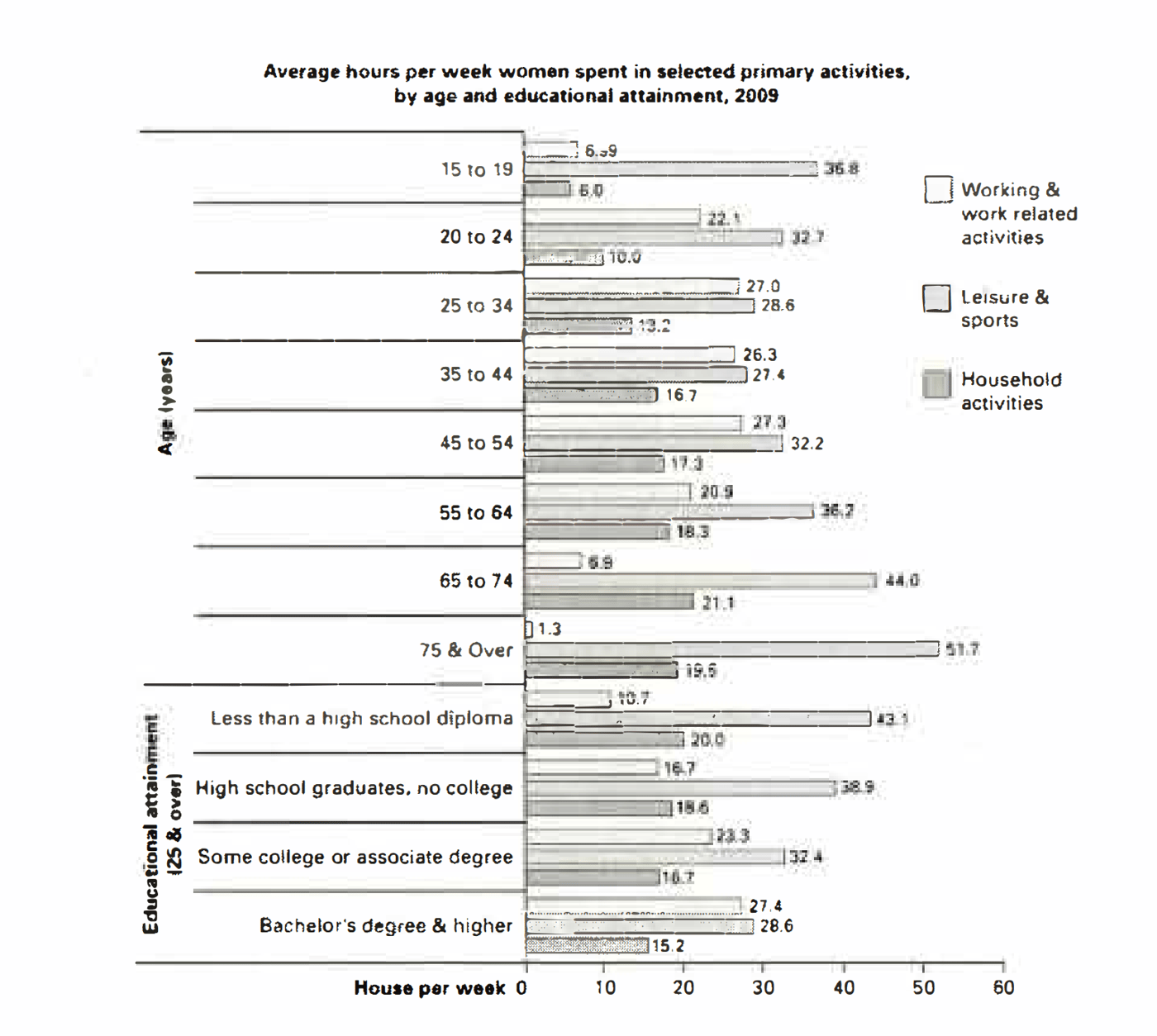
The bar chart below shows the average number of hours that women in various age groups and women with varying levels of education spend on primary activities each week.
Summarise the information by selecting and reporting the main features, and make comparisons where relevant.
Average hours per week women spent in selected primary activities, by age and educational attainment, 2009
Student answer (Band 5.0)
The bar chart illustrates the average number of hours that women in various age groups and women with varying levels of education spend on primary activities each week.
Overall, the average number of hours spent in working increased from initial figures in various age group. Whereas, the average age groups of women spent much time in leisure and sports. Moreover, they spent a much less time in household activities than leisure and sports.
Initially, The age groups between 15 to 19 less interested in working but the average age group 20 to 24 and towards all age groups were quite interested in working, while the educational attainment women were more passionated in working from starting which was over 25 years.
Similarly, the women in between all ages groups from 15 to over 75 were predominantly wanted to spent more time/hours in leisure and sports while education attainment women were spent less hours in sports and leisure.
Meanwhile, the women spent their time in household activities more in senior age and less in the age group between 15 to 19.
AI examiner evaluation
| Criterion | Band |
|---|---|
| Task Achievement / Task Response | 5.0 |
| Coherence and Cohesion | 5.5 |
| Lexical Resource | 5.0 |
| Grammatical Range and Accuracy | 5.0 |
| Overall | 5.0 |
Task Achievement / Task Response: Band 5.0
You identify the chart’s three activities and make relevant broad comparisons, including that leisure takes more time than household activities and that household time is higher among older women than teenagers. However, the overview is unclear and partly inaccurate: work does not simply increase across the age groups, since it peaks around ages 25–54 before falling sharply, and the education figures show a clear rise in work as attainment increases. The claim that women with education “spent less hours in sports and leisure” is too broad; leisure declines with higher attainment, but remains substantial. Most importantly, the response gives almost no figures or precise comparisons, so the main patterns are only partially reported. Select key highs, lows and turning points, and support them with accurate data.
Coherence and Cohesion: Band 5.5
The response has a basic paragraph structure: an introduction, an overview and separate comments on age and education. This gives the reader some sense of organisation, and words such as “Overall,” “Similarly” and “Meanwhile” signal relationships between points. However, progression is limited because the body paragraphs make broad statements without developing them through specific comparisons. Some linking is also mechanical or unclear: “Initially” does not introduce a clear sequence, and “Similarly” connects ideas that are not quite parallel. The overview and later paragraphs repeat general claims about leisure and work. Group the age data and education data more clearly, and use comparisons to move logically from one key feature to the next.
Lexical Resource: Band 5.0
You use relevant topic vocabulary, including “average number of hours,” “age groups,” “educational attainment,” and the activity labels, so the subject is generally understandable. However, the range is limited and several word choices or collocations are noticeably inaccurate, sometimes making the meaning awkward: women are described as “more passionated in working,” and age groups as “quite interested in working,” although the chart measures time rather than interest. Phrases such as “spent a much less time” and “more time/hours” are also imprecise or repetitive. Aim for neutral reporting language such as “spent,” “recorded,” “rose,” and “declined,” and use accurate comparative phrases to describe the data rather than attributing preferences or motivation.
Grammatical Range and Accuracy: Band 5.0
You attempt some longer sentences using contrast and time clauses, for example, “Whereas…” and “while…,” but these structures are often faulty or incomplete. “Whereas, the average age groups…” is not a complete, well-formed contrast, and “the average number of hours … increased from initial figures” has an unclear subject and comparison. There are frequent errors in agreement, articles, plurals and verb forms, as in “age groups … were predominantly wanted” and “women … were spent.” Capitalisation and punctuation are also inconsistent, including the unnecessary capital in “The age groups” after a comma. Build accuracy with clear subject–verb patterns, then add controlled comparisons such as “Leisure time was highest among…”
See this exact question answered at other band scores. The same prompt compared across bands.
Browse more IELTS Writing model answers or get your own writing scored by the same AI examiner.