Band 4.5 IELTS Writing Task 1 Model Answer
Overall Band Score: 4.5 · IELTS Momentum Workout · 2026-11-27
IELTS Writing Task 1 question
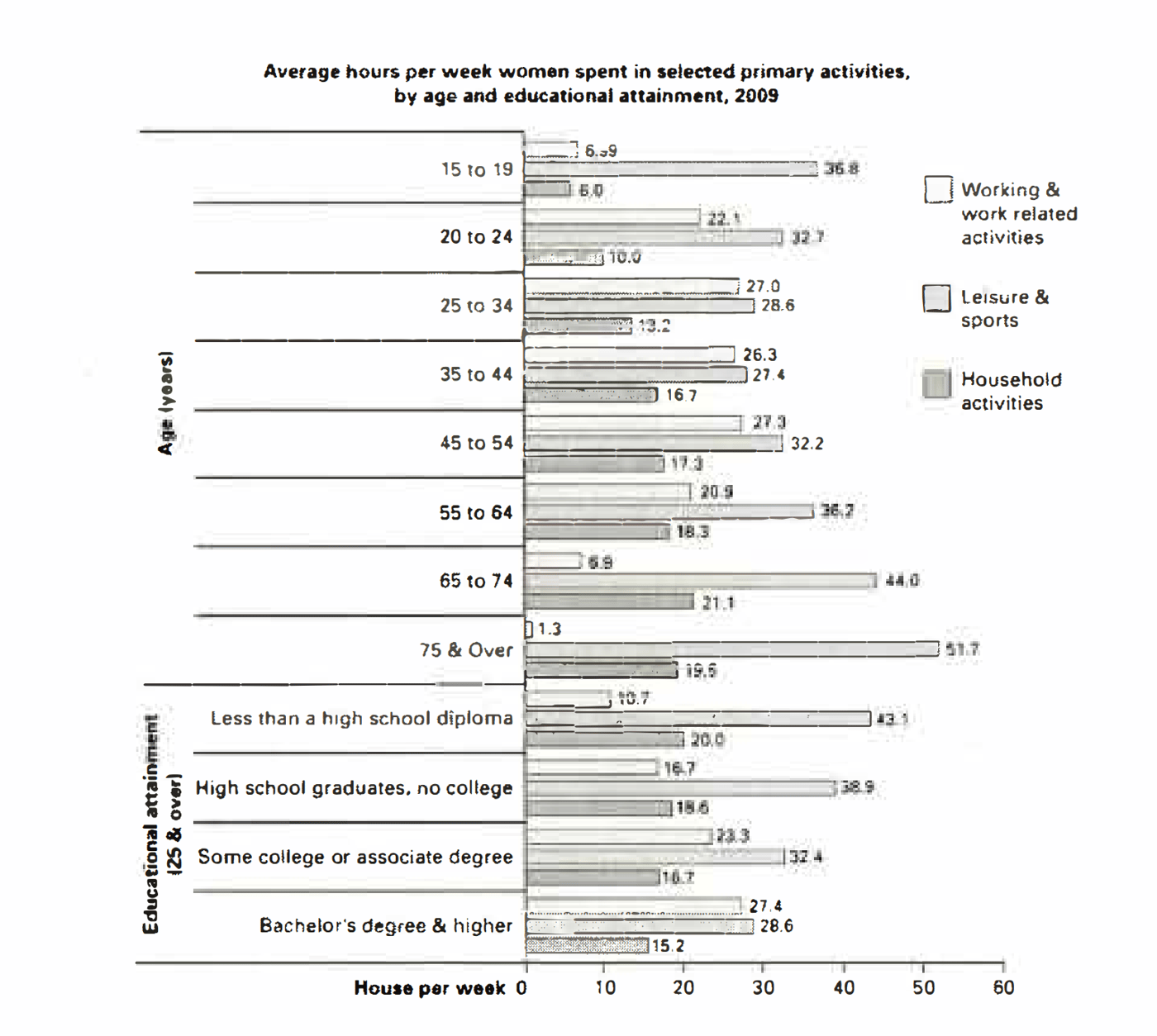
The bar chart below shows the average number of hours that women in various age groups and women with varying levels of education spend on primary activities each week.
Summarise the information by selecting and reporting the main features, and make comparisons where relevant.
Average hours per week women spent in selected primary activities, by age and educational attainment, 2009
Student answer (Band 4.5)
The given bar chart depcits the given information regarding average number of women in different age groups and women with different levels of education spend hours om primary activities.
overall, it is crystal clear that maximam women from 75&over spent most of hours on leisure&sports and women with bachelors degree& higher education spent less hours on household work.
Its is commonly seen than teenagers spent only 6 hours in week on household work and spent six ime more time on leisure&sports 36 hours.
wher
AI examiner evaluation
| Criterion | Band |
|---|---|
| Task Achievement / Task Response | 4.0 |
| Coherence and Cohesion | 4.0 |
| Lexical Resource | 5.0 |
| Grammatical Range and Accuracy | 4.5 |
| Overall | 4.5 |
Task Achievement / Task Response: Band 4.0
You identify the chart’s subject and give two relevant observations: women aged 75 and over spend the most time on leisure and sports, while those with a bachelor’s degree or higher spend the least time on household activities. The teenager comparison is also broadly accurate: about 6 hours on household activities versus roughly 37 on leisure. However, the response reports only a small fraction of the chart and gives no meaningful comparison of working hours, the other age groups, or educational levels. The overview is therefore very limited, and the final fragment leaves the report incomplete. The response is also 66 words below the required minimum. To improve, provide a clear overview and select several key figures and trends from both sections of the chart.
Coherence and Cohesion: Band 4.0
There is a basic attempt to organise the response: an opening sentence is followed by an overview and then a specific comparison about teenagers. This gives the reader a small amount of progression. However, the report is too brief to develop a coherent account of the chart, and the final word, “wher”, makes the ending appear unfinished. The transition from the overview to the example is abrupt, while the relationship between the two chart categories—age and education—is not explained. Use separate paragraphs for the overview and the main comparisons, and connect selected figures with clear links such as “by contrast” or “whereas”. A complete sequence of points would make the information easier to follow.
Lexical Resource: Band 5.0
You use some relevant chart vocabulary, including “age groups”, “leisure&sports”, “household work” and “bachelors degree”. These choices show that you can identify the main activity categories and make a simple comparison. However, the range is limited and some phrases are imprecise or awkward, such as “average number of women … spend hours” and “most of hours”. Spelling and word-form errors, including “depcits”, “maximam” and “ime”, also make the writing less clear. Aim for accurate, natural expressions such as “the average number of hours women spent” and “spent the most time”. Use the chart’s category labels consistently, especially “working and work-related activities” and “household activities”.
Grammatical Range and Accuracy: Band 4.5
The response attempts simple sentence forms and one comparison, as in “teenagers spent only 6 hours … and spent six ime more time on leisure&sports”. However, grammatical control is weak: the opening sentence has an unclear structure, and “women … spend hours” does not form a complete, accurate description of what the chart measures. There are also errors in articles, agreement and sentence boundaries, for example “Its is commonly seen than” and the lower-case “overall” after a full stop. The final “wher” is an incomplete fragment. Practise building accurate sentences with a clear subject and verb, such as “Women aged 15–19 spent 6 hours per week on household activities.” Then add comparisons using “while” or “whereas”.
See this exact question answered at other band scores. The same prompt compared across bands.
Browse more IELTS Writing model answers or get your own writing scored by the same AI examiner.