Band 5.0 IELTS Writing Task 1 Model Answer
Overall Band Score: 5.0 · IELTS Momentum Workout · 2026-11-27
IELTS Writing Task 1 question
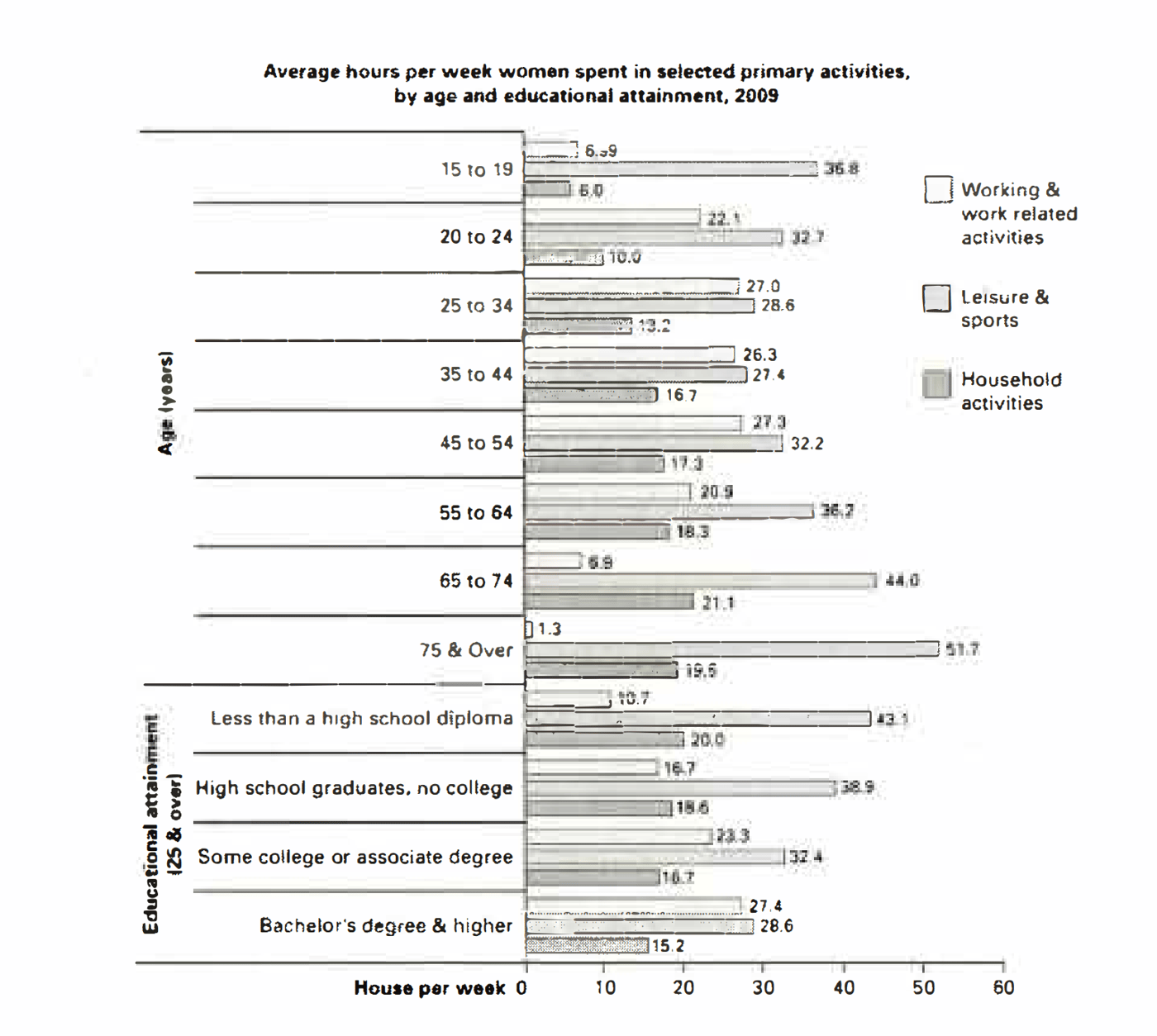
The bar chart below shows the average number of hours that women in various age groups and women with varying levels of education spend on primary activities each week.
Summarise the information by selecting and reporting the main features, and make comparisons where relevant.
Average hours per week women spent in selected primary activities, by age and educational attainment, 2009
Student answer (Band 5.0)
The bar chart below show us the average number of hours that woman in various age groups with varying levels education spend on activities each week
And we see that's most women in age 15ti 24 spend there time in sport with less tile in house activities and work
While women in the age 25-54 are spend more time in working comparing to younger people but still have more time for sport
While we see women in the age between 55-74 do more house activities the the other with to luch hour for work and still have lot of time for sport
In older people over 75 they almost dont do working at all and they r the most hour time for sport and they keep doing household activities
And if we compared between people aver ther education level we see that the educated people who studies in college they have more time for work and sport almost the same but the less educated who don't have bachelor degree r more in to sport and the don work less but the all so household
AI examiner evaluation
| Criterion | Band |
|---|---|
| Task Achievement / Task Response | 5.0 |
| Coherence and Cohesion | 5.0 |
| Lexical Resource | 4.5 |
| Grammatical Range and Accuracy | 5.0 |
| Overall | 5.0 |
Task Achievement / Task Response: Band 5.0
You identify several relevant broad patterns: leisure is prominent among younger and older women, work peaks among many middle-aged groups, and women over 75 spend very little time working. However, the overview is incomplete and some comparisons are inaccurate. For example, women aged 55–64 spend 18.3 hours on household activities, but this is not more than the 65–74 group’s 21.1 hours. The education comparison is also unclear: work rises with educational attainment, while leisure and household time generally fall, but the response suggests less-educated women work less without clearly reporting the overall pattern. Select the main trends accurately and support them with a few figures to make the summary more complete.
Coherence and Cohesion: Band 5.0
The response follows a broadly sensible order, moving from age groups to educational attainment, and linking phrases such as “While” and “if we compared” show an attempt to connect ideas. However, it is presented as one continuous sequence rather than clearly organised paragraphs, and the repeated “While” openings make the progression feel repetitive. Some references are difficult to follow, particularly “the other” and “they” in the discussion of household activities and education. Group the age trends into one paragraph and the education trends into another, with a concise overview first. Use clear comparisons and refer explicitly to the relevant groups so readers can follow each point without having to infer its meaning.
Lexical Resource: Band 4.5
You use some task-relevant vocabulary, including “average number of hours,” “age groups,” “sport,” “house activities,” and “educated,” so the general topic is recognisable. However, the range is limited and several expressions are imprecise or unnatural, such as “do more house activities,” “more in to sport,” and “the most hour time for sport.” Spelling and informal forms—including “dont,” “r,” and “there” for “their”—also make the writing less clear and less appropriate for an academic report. Use the chart’s categories consistently, such as “leisure and sports,” “household activities,” and “work-related activities,” and choose precise verbs such as “spend” or “record.”
Grammatical Range and Accuracy: Band 5.0
You attempt to connect ideas in longer sentences, for example with “While women in the age 25-54…” and “if we compared…,” but these structures are often faulty. Errors include subject–verb agreement in “The bar chart below show,” missing or incorrect articles and prepositions in “women in the age,” and verb-form problems in “are spend” and “if we compared.” Sentence boundaries and punctuation are also largely absent, making several clauses run together. These frequent errors sometimes make relationships between ideas difficult to understand, although the reader can usually identify the broad topic. Practise accurate simple sentences first, then combine them with correctly formed clauses and use full stops to separate the main comparisons.
See this exact question answered at other band scores. The same prompt compared across bands.
Browse more IELTS Writing model answers or get your own writing scored by the same AI examiner.