Band 5.5 IELTS Writing Task 1 Model Answer
Overall Band Score: 5.5 · IELTS Momentum Workout · 2026-11-28
IELTS Writing Task 1 question
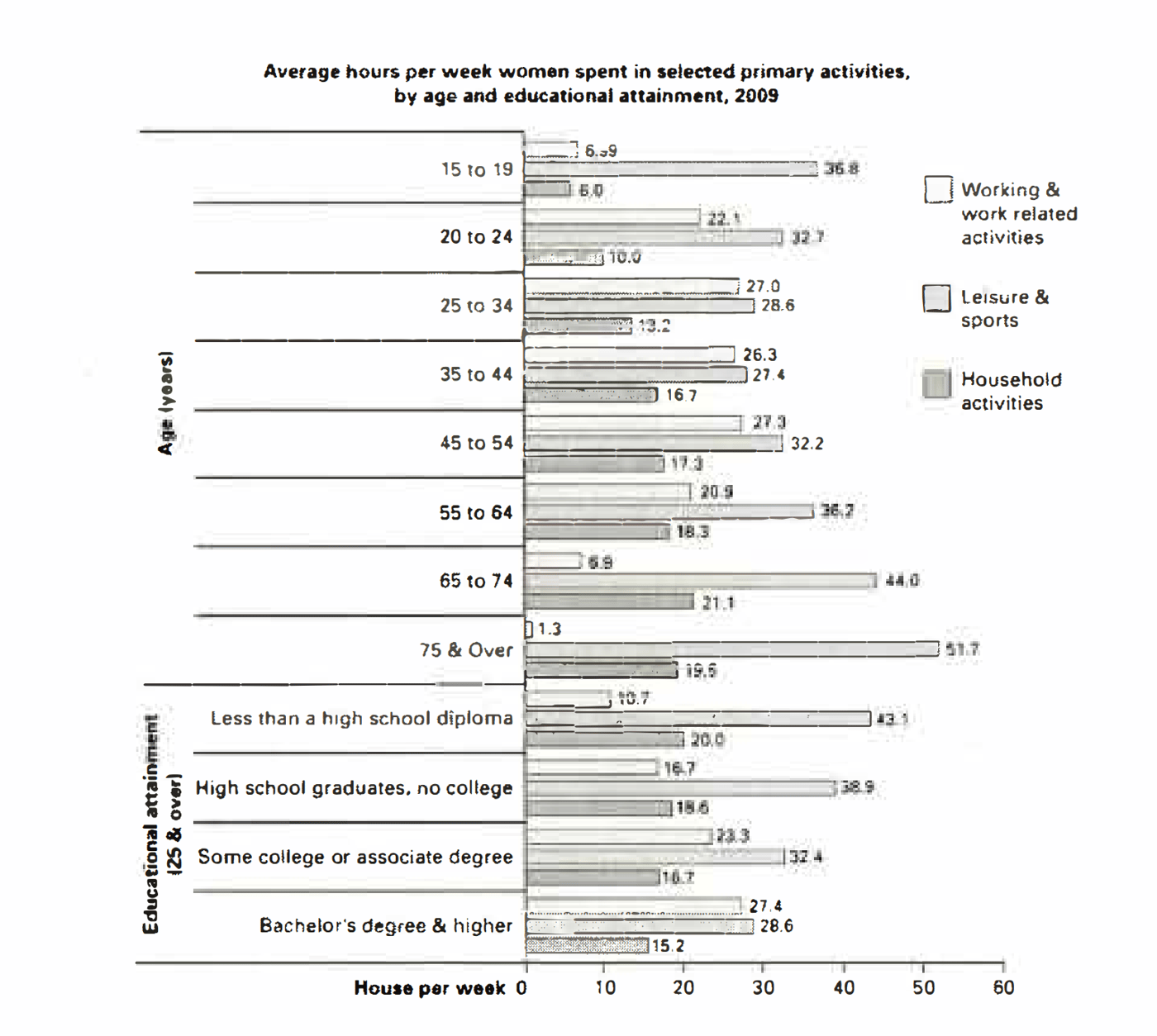
The bar chart below shows the average number of hours that women in various age groups and women with varying levels of education spend on primary activities each week.
Summarise the information by selecting and reporting the main features, and make comparisons where relevant.
Average hours per week women spent in selected primary activities, by age and educational attainment, 2009
Student answer (Band 5.5)
the chart illustrates the time by hour spent weekly by women from different age groups and education levels across activities in 2009.
Overall, women from different educational backgrounds spent almost close hours between 15.2 to 18.6 hours per week doing household activities. Whereas working and work related activities hours increased relatively by the increase of the level of the education. the higher the level goes, the more hours are higher too. Leading up to 27.4 hours for bachelor's degree and higher. As for leisure and sports, it marks the feature that is the highest in terms of spending time on it among all categories of women regardless of their age or literacy. An important note is that, women of youner and older age groups tended to spend their time much more on leisure and sports.
The more wome grew up, the more their hourly use on work time goes up until it it reaches 27.3 for 45-54 age group. It then downgrades until it reaches 1.3 hours per week for 75 and over.
Household activities are another feature that women started increasing their time on it the more they grew up. Going from 6.0 for the group between 15 to 19 until it reaches 21.1 for the group of 65-74 then it drops slightly to 19.5 for the category of 75 and over
AI examiner evaluation
| Criterion | Band |
|---|---|
| Task Achievement / Task Response | 5.5 |
| Coherence and Cohesion | 5.5 |
| Lexical Resource | 5.5 |
| Grammatical Range and Accuracy | 5.0 |
| Overall | 5.5 |
Task Achievement / Task Response: Band 5.5
You identify several relevant overall patterns: leisure is prominent, work rises with education, and household time generally increases with age. You also include useful figures, such as 27.4 hours for women with a bachelor’s degree or higher and 21.1 hours for the 65–74 age group. However, coverage is partial: the age-group work trend is described inaccurately when you say it rises until 45–54; it peaks at 27.0 in both 25–34 and 45–54, after reaching 26.3 for 35–44. The overview also incorrectly suggests household hours are close across education levels, which range from 15.2 to 20.0. Develop the education comparisons more accurately and report the main patterns across both sets of categories.
Coherence and Cohesion: Band 5.5
The response has a recognisable introduction, overview and detail paragraphs, and it generally groups information by age or educational attainment. This gives the reader some organisation. However, progression is uneven: the overview moves between education, leisure and age without a clear hierarchy, and the age details discuss work and household activities but omit leisure comparisons. Linking is sometimes awkward or repetitive, particularly the repeated “the more… the more…” construction. The sentence beginning “Whereas working…” is also left as a fragment, interrupting the flow. Use one paragraph for the overview and separate, clearly ordered paragraphs for age and education, with comparisons that connect each detail to the main trends.
Lexical Resource: Band 5.5
You use relevant chart vocabulary, including “educational backgrounds,” “household activities,” “leisure and sports,” and “increased,” so the topic is usually clear. There is also some attempt to vary expression. However, several word choices and collocations are inaccurate or unnatural, such as “almost close hours,” “marks the feature,” “hourly use on work time,” and “downgrades.” These choices make some comparisons harder to interpret and limit precision. Spelling errors such as “youner” and “wome” are noticeable. Aim for standard data-reporting language and check spelling; precise verbs such as “rose,” “declined,” and “accounted for” will communicate trends more clearly.
Grammatical Range and Accuracy: Band 5.0
You attempt both simple statements and longer comparative structures, including “The more women grew up, the more their hourly use on work time goes up,” but complex sentences are often not controlled successfully. The opening “Whereas working and work related activities hours increased…” is a fragment, while “the higher the level goes, the more hours are higher too” has faulty comparative structure. There are also tense and agreement inconsistencies, for example “women started increasing their time on it” and “it then downgrades,” alongside repeated wording in “until it it reaches.” These errors sometimes make relationships unclear. Build shorter, complete sentences first, then practise accurate comparative clauses and consistent past-tense reporting.
See this exact question answered at other band scores. The same prompt compared across bands.
Browse more IELTS Writing model answers or get your own writing scored by the same AI examiner.