Band 4.5 IELTS Writing Task 1 Model Answer
Overall Band Score: 4.5 · IELTS Momentum Workout · 2026-11-07
IELTS Writing Task 1 question
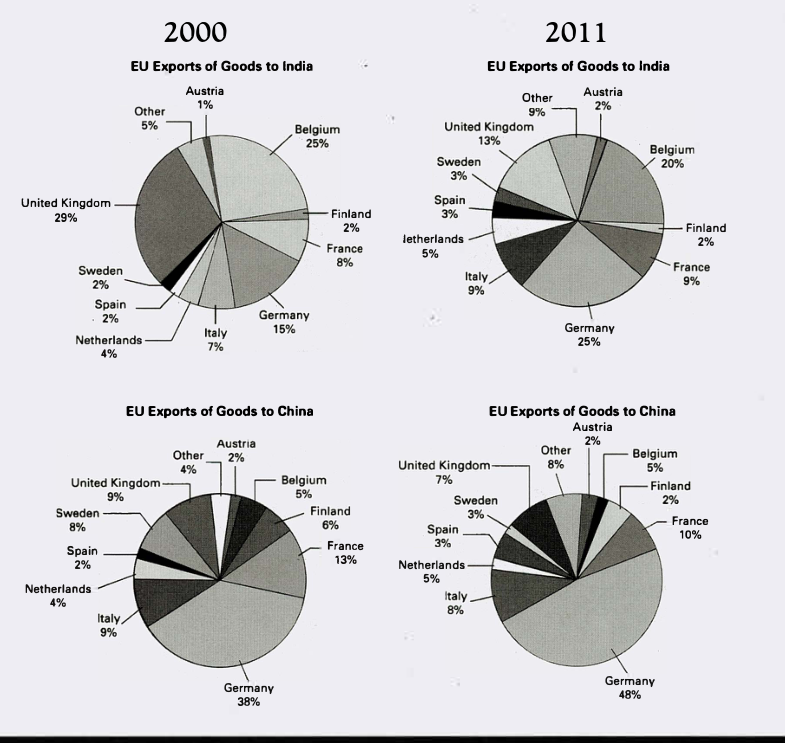
The pie charts below show exports from various EU countries to India and China in 2000 and 2011.
Summarise the information by selecting and reporting the main features, and make comparisons where relevant.
EU Exports of Goods to India and China in 2000 and 2011
Student answer (Band 4.5)
The four pie charts give the camparison oftranfermation goods from. many EU nations to India and China between 2000 and 2011. THe proses is done by two country INDIA and china .pie charts illustrate the percentage of export good of india to china .IN 2000 from India ,belgium remain 25% and in 2011,it slightly down of 20%.on the other hand finland remain same,france changes only 1% in 2011.germany go up n 2011.itally remain only 2% increse,only united kingdom droped in 2011.sweden have minar change in percntage between 2000and 2011.notherland only 1% go up in 2011.other nations incresed 4 % in 2011.austria only 1% increse in 2011. From china ,belgiam remain same between 2000 and 2011,finland france, Italy,sweden and United Kingdom remin decreesd in 2011. netherland, spain ,Germany and other country increse in 2011.on the other hand austria remain the same in between, 2000 and 2011. in this report some nation were decressed from 2000 and 2011, but only ausrtia remain same both the years.
AI examiner evaluation
| Criterion | Band |
|---|---|
| Task Achievement / Task Response | 4.5 |
| Coherence and Cohesion | 5.0 |
| Lexical Resource | 4.5 |
| Grammatical Range and Accuracy | 4.5 |
| Overall | 4.5 |
Task Achievement / Task Response: Band 4.5
You identify that the charts compare EU exports to India and China in 2000 and 2011, and you report several relevant changes, such as Belgium’s share of exports to India falling from 25% to 20% and Germany’s share to China rising. However, the response does not provide a clear overview of the main patterns. It also contains important inaccuracies: for China, France fell from 13% to 10%, but Finland fell from 6% to 2%; the statement that both decreased is broadly right, while the final claim that only Austria stayed the same is incorrect because Belgium also remained at 5%. Several figures and the leading categories are omitted, and the opening description is unclear. Select the dominant features and support them with accurate comparisons.
Coherence and Cohesion: Band 5.0
There is some basic organisation: the response begins with an introduction, then discusses India and China in separate sections, and uses linking phrases such as “on the other hand.” This gives the reader a rough sense of the two markets being covered. However, progression within each section is difficult to follow because many countries are listed in quick succession without grouping or a consistent comparison pattern. The concluding sentence repeats a general point rather than summarising the main trends, and some transitions do not clearly connect the ideas. Use clear paragraphs and organise details around the largest shares, notable rises and falls, then the smaller changes. This would make the comparisons easier to track.
Lexical Resource: Band 4.5
The response attempts relevant chart vocabulary, including “percentage,” “remain,” “drop,” “increased” and “decreased,” so the reader can recognise that you are describing changes in shares. However, the range is basic and repetitive, and frequent spelling and word-choice errors strain understanding: “camparison,” “tranfermation,” “proses,” and “minar change” are examples. Some expressions are also unsuitable or unclear, such as “The proses is done by two country” and “export good of india to china.” Use precise terms such as “share of EU exports,” “accounted for,” “rose,” and “declined,” and check spelling carefully. Avoid repeating “remain” when a more exact verb can describe whether a figure was unchanged or changed.
Grammatical Range and Accuracy: Band 4.5
You make attempts to form longer sentences and use time references, for example, “in 2011” and “between 2000 and 2011.” However, the range of sentence structures is very limited, and frequent errors in sentence formation, tense, agreement and punctuation sometimes distort meaning. “The proses is done by two country INDIA and china” does not form a clear grammatical description, while “germany go up n 2011” lacks correct verb form and sentence punctuation. Several clauses are joined without clear boundaries, making the country-by-country account hard to read. Practise accurate simple comparison patterns first, such as “Germany’s share rose from 15% to 25%,” then combine them with correctly formed contrast clauses.
See this exact question answered at other band scores. The same prompt compared across bands.
Browse more IELTS Writing model answers or get your own writing scored by the same AI examiner.