Band 5.0 IELTS Writing Task 1 Model Answer
Overall Band Score: 5.0 · IELTS Momentum Workout · 2026-11-09
IELTS Writing Task 1 question
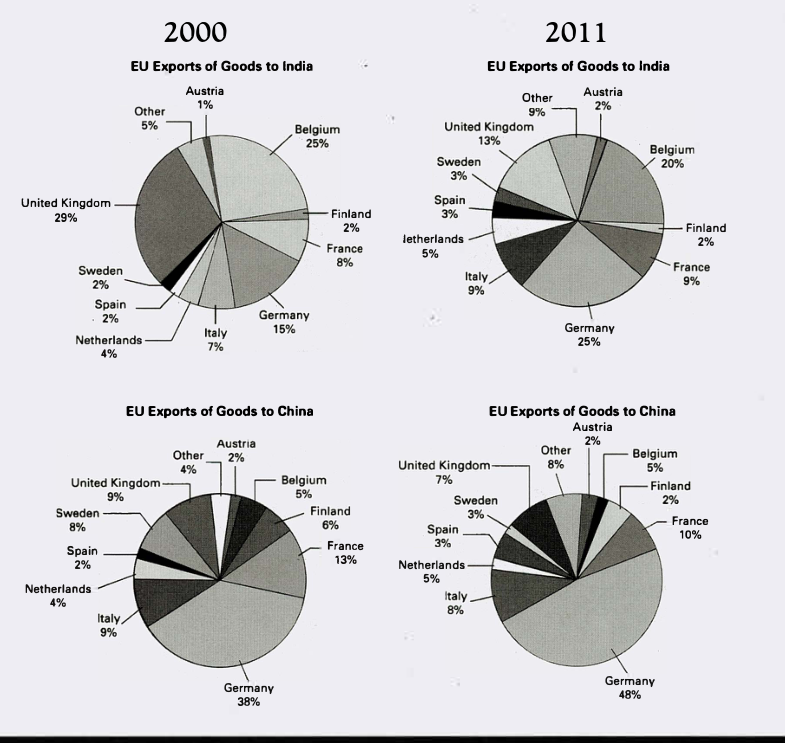
The pie charts below show exports from various EU countries to India and China in 2000 and 2011.
Summarise the information by selecting and reporting the main features, and make comparisons where relevant.
EU Exports of Goods to India and China in 2000 and 2011
Student answer (Band 5.0)
EU Exports of Goods to India and China in 2000 and 2011
In 2000, Exports of Goods to India, But today we talk about only United Kingdom only that have 29%. On the other side to China its market share only 9%. Now If we see 2011, United Kingdom have 13% market share of exports goods industry in India and to China 7% only.
If we notice overall and ranking top market share in India then few country name should mentioned, that is in 2000 top market share under Belgium that is 25%, and second position is Germany that is 15%. In 2011, Belgium decrease market share 25% to 20%, and on the other hand germany is increasing that is massive 15% to 25%, 10% growing after 11 years!
At a same time in China, Germany have 38% in 2000, but after 11 years german too increase 10% that is 48%
AI examiner evaluation
| Criterion | Band |
|---|---|
| Task Achievement / Task Response | 4.5 |
| Coherence and Cohesion | 5.5 |
| Lexical Resource | 5.0 |
| Grammatical Range and Accuracy | 5.0 |
| Overall | 5.0 |
Task Achievement / Task Response: Band 4.5
The response identifies several relevant leading figures: the UK’s share of exports to India fell from 29% to 13%, Belgium’s share there declined from 25% to 20%, and Germany’s share rose in both markets. These comparisons are mostly accurate, and the China figures for Germany are correctly reported. However, the account is incomplete: it gives no clear overall summary of the main contrasts between the two destinations and omits other notable changes, such as Germany becoming the largest supplier to India and its already dominant share in China increasing. The final sentence is also unfinished, and the response is 11 words below the required minimum. Develop a concise overview and cover the most important patterns to address the task more fully.
Coherence and Cohesion: Band 5.5
There is some organisation: the response first compares the UK’s figures, then discusses leading exporters to India, and finally turns to Germany’s share in China. Phrases such as “On the other side” and “At a same time” attempt to connect these points. However, the progression is not fully clear, and the opening sentence is difficult to follow because it shifts abruptly from India to China. The paragraphing does not provide a clear overview followed by organised details, while “Now If we see” and “If we notice overall” make the links feel repetitive and conversational. Group the information by destination or by the most important trends, and use a clear overview to guide the reader.
Lexical Resource: Band 5.0
The response uses some task-relevant terms, including “market share,” “top,” “second position,” and “increase,” so the reader can identify the intended comparisons. However, the vocabulary is limited and several phrases are unnatural or imprecise, such as “exports goods industry,” “top market share under Belgium,” and “Germany is increasing.” These choices sometimes make the meaning harder to follow. There is also repetition of “market share” and “increase,” and “massive” is too informal for a data summary. Use precise reporting language such as “accounted for,” “ranked first,” “rose,” and “declined,” and vary the wording while keeping it formal and factual.
Grammatical Range and Accuracy: Band 5.0
The response attempts both simple statements and comparisons, and the reader can generally recover the intended figures. However, the range of sentence structures is limited, and errors occur frequently enough to make some sentences difficult to process. For example, “United Kingdom have 13%” has subject–verb agreement and article problems, while “Germany have 38% in 2000, but after 11 years german too increase 10%” contains errors in agreement, tense, and sentence construction. Capitalisation and punctuation are also inconsistent, as in “Now If” and the unfinished final sentence. Practise complete comparative sentences with consistent past-tense verbs, for example, “Germany’s share rose from 38% to 48%.”
See this exact question answered at other band scores. The same prompt compared across bands.
Browse more IELTS Writing model answers or get your own writing scored by the same AI examiner.