Band 6.0 IELTS Writing Task 1 Model Answer
Overall Band Score: 6.0 · IELTS Momentum Workout · 2026-11-09
IELTS Writing Task 1 question
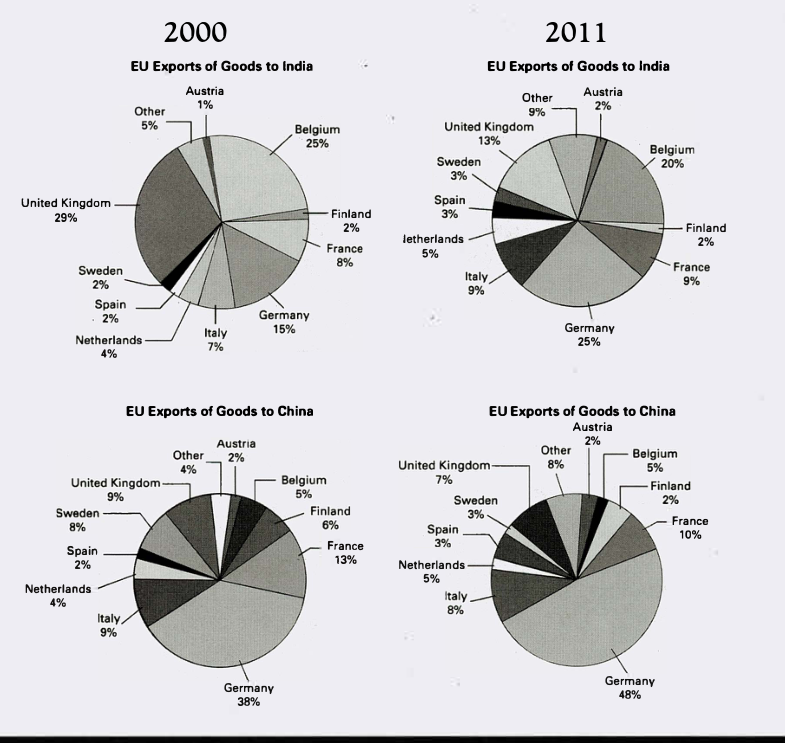
The pie charts below show exports from various EU countries to India and China in 2000 and 2011.
Summarise the information by selecting and reporting the main features, and make comparisons where relevant.
EU Exports of Goods to India and China in 2000 and 2011
Student answer (Band 6.0)
The given pie charts illustrates the exports from different EU countries to India and China in the year 2000 and 2011.
Overall, it can be seen that change in export of Germany and United Kingdom is the most noticeable feature in the pie chart of India. While in the pie chart of China the main trend is Germany, which was recorded the highest in receiving export from China.
Looking at the details, United Kingdom recorded the highest figure in 2000, at 29%, followed by Belgium at 25% and Germany at 15%. However, in 2011, Germany rose sharply at 25%, Belgium decreased to 20% and United kingdom lost the lead, recorded for 13%. Nevertheless, France, Finland, Austria, Italy, Netherlands, Spain, Sweden and other were accounted for slight fluctuations in percentage. This details are for the EU exports of goods to India.
Turning to remaining details, Germany was constantly high in export percentage in the year 2000 and 2011, nearly at 38% and 48%.
AI examiner evaluation
| Criterion | Band |
|---|---|
| Task Achievement / Task Response | 6.0 |
| Coherence and Cohesion | 6.5 |
| Lexical Resource | 6.0 |
| Grammatical Range and Accuracy | 5.5 |
| Overall | 6.0 |
Task Achievement / Task Response: Band 6.0
You identify relevant headline features for both destinations: the UK led exports to India in 2000, Germany became the largest contributor there by 2011, and Germany had the biggest share for China in both years. The India figures you give are accurate, as are the Chinese figures of 38% and 48%. However, the overview is incomplete: it does not clearly compare the overall patterns between the two markets, and the China section stops after mentioning Germany. Important changes such as France’s decline in China and the UK’s fall there are omitted. The statement that the remaining Indian countries showed “slight fluctuations” is also vague. Develop the China comparison and select a few more significant changes to make the summary more complete.
Coherence and Cohesion: Band 6.5
The response has a clear overall arrangement: an introduction, an overview, and separate paragraphs for India and China. Phrases such as “Looking at the details” and “Turning to remaining details” help signal the shift between sections, and the main points are generally easy to follow. This organisation is effective, though the final paragraph is very brief and leaves the China discussion underdeveloped, so the progression feels uneven. Some linking is also mechanical, particularly “However” and “Nevertheless,” which do not always express a precise relationship between the figures. Extend the China paragraph and use more specific comparisons to connect changes across the two years; this would make the progression more sustained and cohesive.
Lexical Resource: Band 6.0
You use an adequate range of task-related vocabulary, including “recorded the highest figure,” “rose sharply,” “decreased,” and “lost the lead.” These choices communicate the main movements, and the reader can understand the comparisons. Some phrasing is imprecise or unnatural, however: “highest in receiving export from China” reverses the relationship, while “accounted for slight fluctuations in percentage” is an awkward way to describe small changes in shares. “Constantly high” is also less precise than a term describing Germany’s leading share in both years. Aim for accurate collocations and concise language for proportions and rankings, and avoid repeating general words such as “details” when a more specific reference to the data is available.
Grammatical Range and Accuracy: Band 5.5
You attempt a mix of simple and complex forms, including the contrast in “However, in 2011…” and the overview sentence beginning “While…”. Meaning is usually clear, but some errors in agreement, articles, and sentence construction remain. For example, “The given pie charts illustrates” should use a plural verb, and “change in export … is” needs a plural or more carefully framed subject. The sentence beginning “While in the pie chart of China…” is a fragment because the subordinate clause is not completed independently. There are also inconsistent capitalisation and tense choices, as in “United kingdom” and “Germany rose sharply.” Check subject–verb agreement and ensure each sentence has a complete main clause; these revisions would improve accuracy while retaining structural variety.
See this exact question answered at other band scores. The same prompt compared across bands.
Browse more IELTS Writing model answers or get your own writing scored by the same AI examiner.