Band 5.5 IELTS Writing Task 1 Model Answer
Overall Band Score: 5.5 · IELTS Momentum Workout · 2026-11-11
IELTS Writing Task 1 question
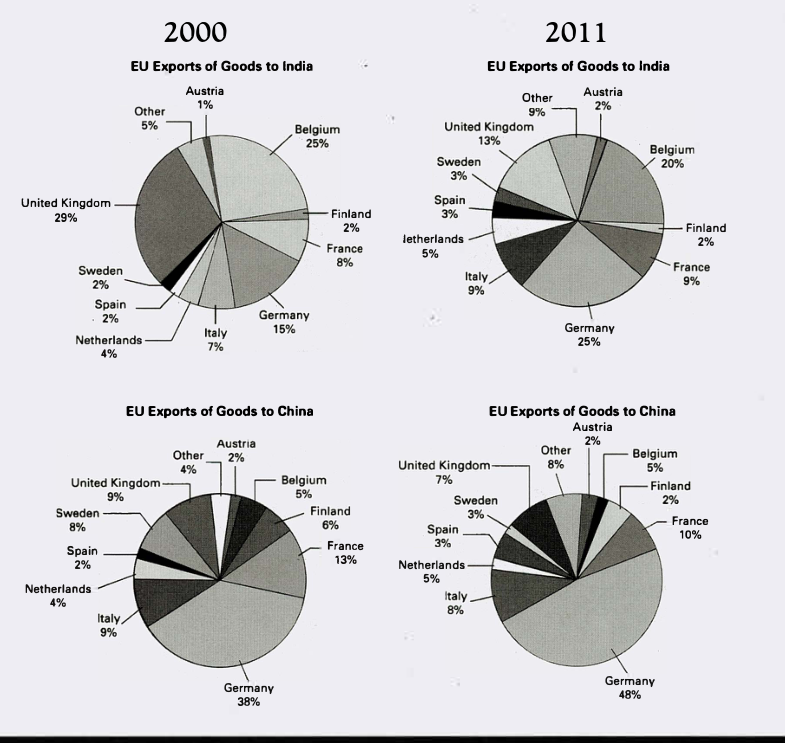
The pie charts below show exports from various EU countries to India and China in 2000 and 2011.
Summarise the information by selecting and reporting the main features, and make comparisons where relevant.
EU Exports of Goods to India and China in 2000 and 2011
Student answer (Band 5.5)
The pie charts compare the share of goods that have been exported to india and china in 2000 and 2011 from various european countries. In 2000, the largest share of goods that have been exported to india was by Belgium and United Kingdom, they both had the highest proportions, at 25% and 29%. Germany ranked third, with 15%.
On the other hand, Germany was the largest exporter to china, at 38%. followed by france, at 13% and rest were those countries who exported their goods less as compared with these two countries.
In 2011, Germany and Belgium were the main EU exporters to India, accounting for 25% and 20% respectively. In contrast, Germany's dominance in the chinese market was far greater, at 48%, up from 37% in 2000. Most other countries exported smaller shares to china in 2011 than in 2000 for example France(from 13% to 10%) and Sweden (from 8% to 3%).
AI examiner evaluation
| Criterion | Band |
|---|---|
| Task Achievement / Task Response | 5.0 |
| Coherence and Cohesion | 6.0 |
| Lexical Resource | 6.0 |
| Grammatical Range and Accuracy | 5.5 |
| Overall | 5.5 |
Task Achievement / Task Response: Band 5.0
You identify the main contrast: the UK and Belgium had the largest shares of exports to India in 2000, while Germany led exports to China and became more dominant by 2011. You also support some points with figures, including Germany’s 25% share in India and the fall in France’s share of exports to China. However, the response is under the required 150 words (145 words; eight words copied from the prompt are excluded), and coverage is incomplete: there is no clear overview of the main changes across both markets, and several important trends are omitted. For example, the UK’s share to India fell from 29% to 13%, while Germany’s share to China rose from 38% to 48%; the stated starting figure of 37% is inaccurate. Develop a fuller overview and select key comparisons.
Coherence and Cohesion: Band 6.0
The response is arranged in a generally logical sequence: it first describes the 2000 figures, then moves to 2011, with separate attention to India and China. Linking phrases such as “On the other hand” and “In contrast” help signal comparisons, and the reader can follow the main points. However, the organisation is not fully effective because there is no distinct overview, and the final paragraph combines India’s 2011 figures with China’s changes without a clear, systematic comparison. Some links are also awkward, such as “followed by France … and rest were those countries,” which leaves the relationship between the figures unclear. Group the information by market or year, and use clearer references to guide the reader through the comparisons.
Lexical Resource: Band 6.0
You use an adequate range of task-related vocabulary, including “share,” “proportions,” “ranked third,” “accounting for,” and “dominance.” These choices allow you to describe rankings and changes, and the meaning is generally clear. Some phrasing is repetitive or imprecise, however: “goods that have been exported” is repeated, while “exported their goods less” is an awkward way to describe smaller shares. “The rest were those countries” is also vague, and “share of goods” could be expressed more precisely as a share of exports. Aim for concise, natural collocations and vary the language used to report proportions and changes. Check capitalisation of country names, particularly “India,” “China,” and “Germany,” as spelling and presentation also affect lexical control.
Grammatical Range and Accuracy: Band 5.5
You attempt both simple and more complex sentence forms, including the comparison “Most other countries exported smaller shares to China in 2011 than in 2000” and the participle phrase “accounting for 25% and 20% respectively.” The main message remains understandable, but some errors reduce accuracy. In “Belgium and United Kingdom, they both had,” the sentence has an unnecessary repeated subject and needs an article before “United Kingdom.” The opening phrase “goods that have been exported” uses a present perfect form where a past-time description is more suitable. There are also punctuation and sentence-boundary problems, such as beginning “followed by France” as a fragment and placing a full stop before lowercase “followed.” Use past simple consistently for the chart years and proofread sentence boundaries.
See this exact question answered at other band scores. The same prompt compared across bands.
Browse more IELTS Writing model answers or get your own writing scored by the same AI examiner.