Band 4.5 IELTS Writing Task 1 Model Answer
Overall Band Score: 4.5 · IELTS Momentum Workout · 2026-11-12
IELTS Writing Task 1 question
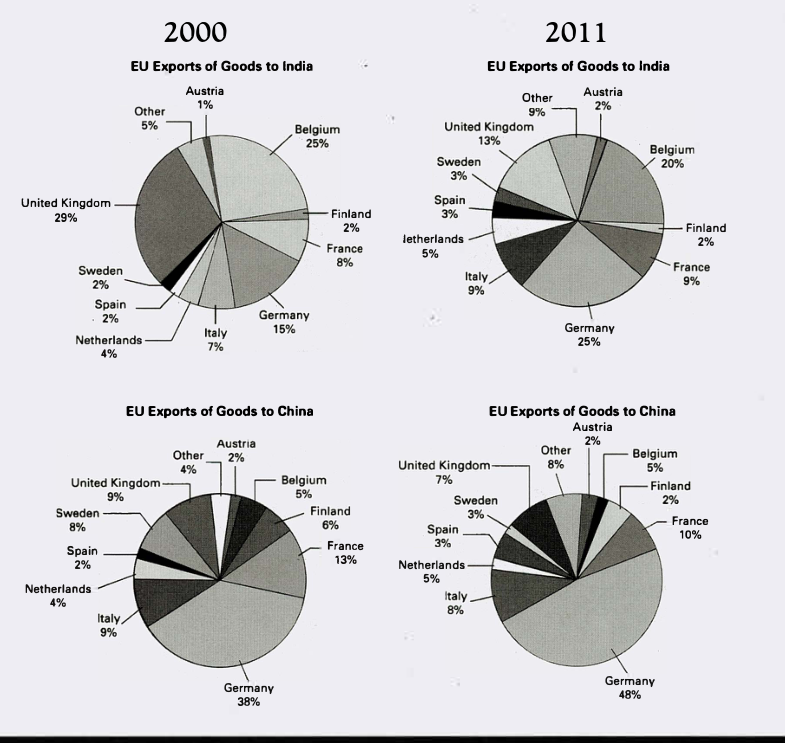
The pie charts below show exports from various EU countries to India and China in 2000 and 2011.
Summarise the information by selecting and reporting the main features, and make comparisons where relevant.
EU Exports of Goods to India and China in 2000 and 2011
Student answer (Band 4.5)
The given pie chart illustrates the exports from different EU countries to India and China in previous 11 years from 2000 to 2011.
In the year 2000 India most things export from united kingdom who was 29% and second from belgium whos was 29% and lowest expotrs from Austria that only 1%,spain 2%,Finland 2%.and in the 2011 year the point of united kingdom was decreased and reach on only 13% and belgium was also decreased which is 20%,germany has increased his rate of importing to india which is now 25% finland is same in both years just 2% to import to india.
china import goods from EU in 2000 highest things from Germany which is accurated 38% and the lowest
AI examiner evaluation
| Criterion | Band |
|---|---|
| Task Achievement / Task Response | 3.5 |
| Coherence and Cohesion | 4.5 |
| Lexical Resource | 5.0 |
| Grammatical Range and Accuracy | 4.5 |
| Overall | 4.5 |
Task Achievement / Task Response: Band 3.5
You identify the two destinations and report several relevant figures, including the UK’s 29% share of exports to India in 2000 and Germany’s rise from 15% to 25% in 2011. However, the response is incomplete: the statement that Belgium was second in India in 2000 gives 29%, when the chart shows 25%, and the discussion of China stops after noting Germany’s 38% share in 2000. There is no overview of the main patterns, such as Germany’s dominance in exports to China and its growing share, or the UK’s decline in India. The response also contains only 120 words, below the required 150. Cover both years and destinations, select the key comparisons, and finish the summary.
Coherence and Cohesion: Band 4.5
The response has a basic sequence: it introduces the charts, discusses India, and then begins the China section. This gives the reader some sense of the intended organisation. However, the progression is weakened by long, loosely connected sentences and abrupt transitions. For example, the India details are joined with repeated “and” clauses, while the final phrase, “and the lowest,” leaves the China comparison unfinished. Use separate paragraphs for India and China, and group figures by the main changes rather than listing them in sequence. Clear linking phrases such as “By contrast” or “In 2011” would help show how the figures relate.
Lexical Resource: Band 5.0
You use some relevant chart vocabulary, including “exports,” “decreased,” “increased,” and “lowest,” so the topic is generally recognisable. However, the range is limited and several word choices or forms make the meaning awkward, such as “most things export,” “the point … was decreased,” and “Germany has increased his rate of importing.” “Importing” also describes the wrong perspective here: the chart shows EU exports to the countries. Spelling and capitalisation errors, including “expotrs,” “united kingdom,” and “belgium,” further reduce accuracy. Build a small set of precise terms for shares and changes, such as “accounted for,” “rose,” and “fell,” and check country names carefully.
Grammatical Range and Accuracy: Band 4.5
The response attempts to report comparisons using past and present forms, but sentence structures are mostly simple or joined into long strings, and errors frequently affect clarity. Examples include “who was 29%,” “which is 20%,” and “Germany has increased his rate,” where relative clauses, tense, and pronoun agreement are not controlled. Missing punctuation also makes the first long sentence difficult to follow. Aim for short, complete sentences with a clear subject and verb, for example, “The UK accounted for 29% of exports to India in 2000. Its share fell to 13% by 2011.” Practise consistent past-tense reporting and use full stops to separate comparisons.
See this exact question answered at other band scores. The same prompt compared across bands.
Browse more IELTS Writing model answers or get your own writing scored by the same AI examiner.