Band 6.0 IELTS Writing Task 1 Model Answer
Overall Band Score: 6.0 · IELTS Momentum Workout · 2026-11-13
IELTS Writing Task 1 question
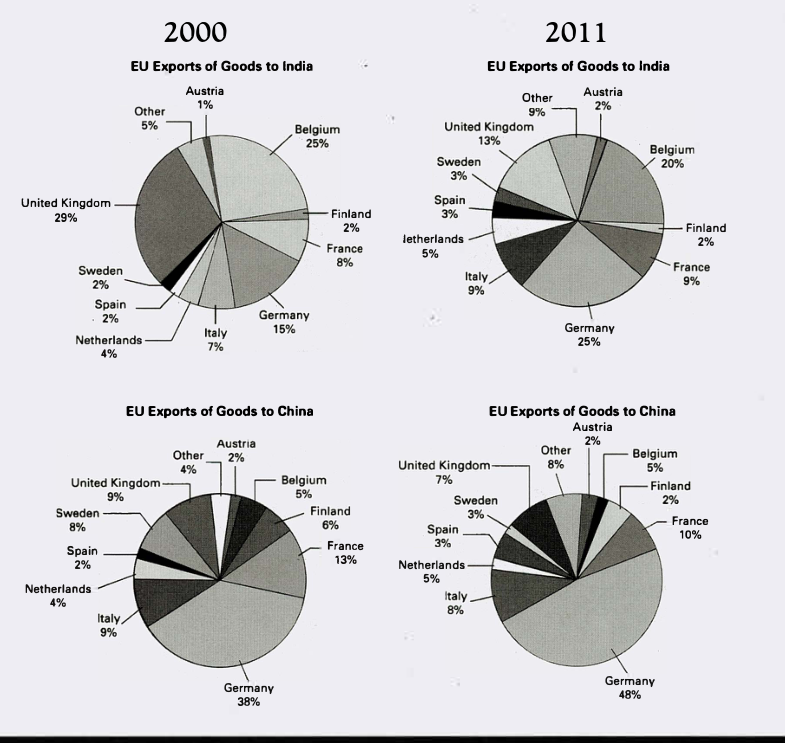
The pie charts below show exports from various EU countries to India and China in 2000 and 2011.
Summarise the information by selecting and reporting the main features, and make comparisons where relevant.
EU Exports of Goods to India and China in 2000 and 2011
Student answer (Band 6.0)
The given pie charts illustrate the proportions of goods exported to india and china in 2000 and 2011 from different european countries.
Overall, Germany became the dominant EU exporter in china, while in the India united kingdom exported significant percentage of goods in the year of 2000 and again Germany dominates in 2011 of exportation of good in India and Austria exported least precentage of goods in both countries in these two years.
In India, the united kingdom held the largest share in 2000 at 29%, followed closely by belgium 25% and germany 15%, while Austria held the least of 1% of share and three countries Finland, Sweden, and Spain held 2% of share. Firthermore, Germany held the largest proportion of 25% in 2011 and same as year of 2000 Austria and Finland participate with 2%.
In China, Germany held the largest proportion in exportation of goods with 38% in 2000 and 48% in 2011, while all of the other countries held single figure share in both years. Furthermore, Austria again offered just 2% which is least share in both years in china.
AI examiner evaluation
| Criterion | Band |
|---|---|
| Task Achievement / Task Response | 6.0 |
| Coherence and Cohesion | 6.0 |
| Lexical Resource | 6.0 |
| Grammatical Range and Accuracy | 5.5 |
| Overall | 6.0 |
Task Achievement / Task Response: Band 6.0
You identify the main pattern that Germany was the largest exporter to China in both years and became the leading exporter to India by 2011. Several figures are accurate, including the UK’s 29% share in India in 2000 and Germany’s rise from 38% to 48% in China. However, the overview is not fully precise: Austria was not the smallest exporter in both years and destinations, since Finland also had 2% in India in 2011 and several countries shared the lowest figure in China. The statement that all other countries had single-figure shares in China is also inaccurate for 2000, when France had 13%. More comparison of changes across the two years would make the report more complete.
Coherence and Cohesion: Band 6.0
The response has a clear overall structure: an introduction, an overview, and separate paragraphs for India and China. This makes the two destinations easy to follow, and linking expressions such as “Overall,” “while,” and “Furthermore” help connect points. However, some connections are mechanical or unclear. In the overview, “while in the India united kingdom…” creates a confusing transition, and “again Germany dominates” does not clearly distinguish the 2011 India pattern from the China pattern. The country-by-country details are also selective without a consistent comparison of changes between years. To improve progression, organise each destination around its leading exporters and the most notable rises or falls, using clear references to the relevant year.
Lexical Resource: Band 6.0
You use a suitable range of task-related vocabulary, including “proportions,” “largest share,” “dominant,” and “held the largest proportion.” These expressions communicate the main comparisons, and the meaning is generally clear. However, some word choices and collocations are inaccurate or repetitive: “participate with 2%” is not natural for describing export shares, and “offered just 2%” is less precise than language such as “accounted for 2%.” There are also spelling and capitalisation errors, including “Firthermore,” “precentage,” and lower-case country names such as “india” and “germany.” Use a consistent set of precise reporting verbs and check spelling and proper nouns carefully to make the description more polished.
Grammatical Range and Accuracy: Band 5.5
You attempt both simple and complex sentences, including comparisons joined with “while,” and most of the intended meaning can be understood. However, some grammatical errors remain, particularly in sentence construction and articles. For example, “in the India united kingdom exported significant percentage” lacks a clear grammatical structure and needs articles and punctuation; “Austria held the least of 1% of share” also has an awkward construction. In “Germany held the largest proportion … with 38% in 2000 and 48% in 2011,” the sentence is understandable, but the phrasing would be clearer with “accounting for.” Aim to produce more consistently controlled sentences, especially in the overview, and check article use, sentence boundaries, and agreement.
See this exact question answered at other band scores. The same prompt compared across bands.
Browse more IELTS Writing model answers or get your own writing scored by the same AI examiner.