Band 5.5 IELTS Writing Task 1 Model Answer
Overall Band Score: 5.5 · IELTS Momentum Workout · 2026-11-16
IELTS Writing Task 1 question
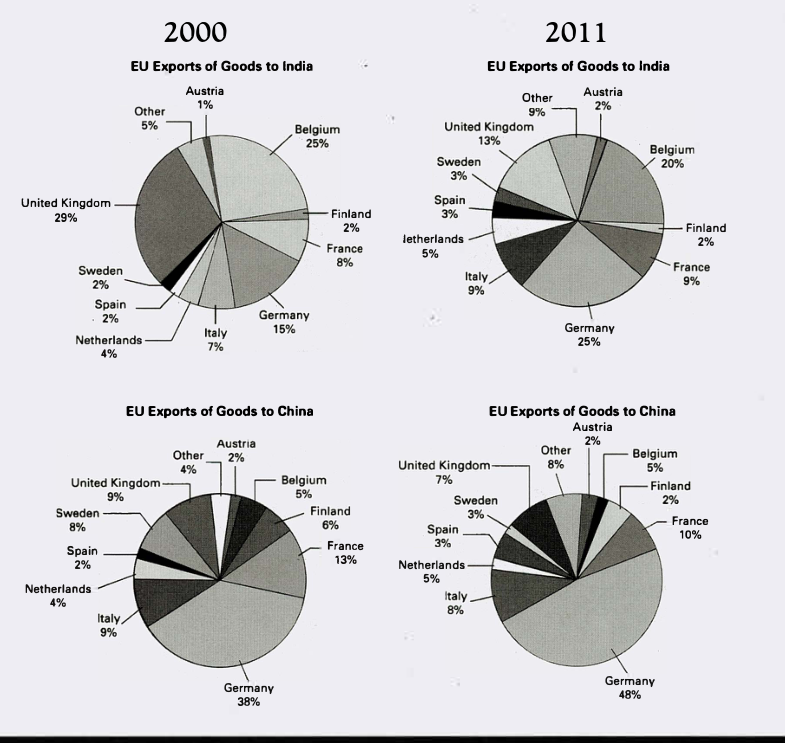
The pie charts below show exports from various EU countries to India and China in 2000 and 2011.
Summarise the information by selecting and reporting the main features, and make comparisons where relevant.
EU Exports of Goods to India and China in 2000 and 2011
Student answer (Band 5.5)
The pie chart illustrate the exportation of goods from different European countries to India and China between 2000 and 2011.
I India Belgium has raimin the highest number of goods exportation between 25% and 20%( 2000 and 2011) respectively, however in 2000 United Kingdom has about 29% but slightly decreased in to 13% in 2011, the list supply comes from Australia 1% and 2% (2000 and 2011).
In China Germany has the largest goods exportation with 38% and slightly increased by 10 percent between 2000 and 2011 respectively, however in 2000 Sweden has 8% within the year 2011 it decreases to 3% making it the lowest country in exporting goods to China
AI examiner evaluation
| Criterion | Band |
|---|---|
| Task Achievement / Task Response | 4.5 |
| Coherence and Cohesion | 6.0 |
| Lexical Resource | 5.5 |
| Grammatical Range and Accuracy | 5.0 |
| Overall | 5.5 |
Task Achievement / Task Response: Band 4.5
You identify some important features, including Belgium and the UK as major exporters to India in 2000 and Germany’s leading share of exports to China. However, the response covers only a small part of the charts and gives no clear overall summary comparing the two destinations. There is also a factual error: the smallest Indian share is Austria’s 1% in 2000, not “Australia”; in 2011 Austria is 2%, so it is not the lowest. The China figures for Germany are broadly right, but “increased by 10 percent” should be expressed as a rise from 38% to 48%, or 10 percentage points. The response is 112 words, below the required 150, which contributes to the limited coverage. Include a concise overview and more key comparisons across both years.
Coherence and Cohesion: Band 6.0
The response has a basic sequence: it first discusses India and then China, which gives the reader a simple way to follow the information. You also use contrast markers such as “however” and time references such as “in 2000” and “in 2011.” However, the ideas are packed into two long paragraphs, and the first begins with the unclear phrase “I India.” Some links are awkward or repetitive, and the final sentence combines a change in Sweden’s share with a claim about the lowest exporter without making the comparison fully clear. Organise the response into a short introduction, an overview, and focused detail paragraphs. Use linking phrases selectively and make each comparison explicit.
Lexical Resource: Band 5.5
You use some relevant chart vocabulary, including “largest,” “decreased,” “increased,” and “exporting goods,” so the reader can recognise the topic and several trends. However, word choice and spelling are often inaccurate or unnatural: “exportation” is repeated where “exports” or “share of exports” would be more suitable, while “raimin” and “list supply” are unclear. “Australia” is also the wrong country name for the chart’s Austria. These errors sometimes make the intended meaning difficult to follow. Build a small set of accurate terms for describing proportions and changes, and check country names carefully. Prefer precise phrases such as “accounted for 25%” and “fell to 13%” over repeated general wording.
Grammatical Range and Accuracy: Band 5.0
You attempt to connect ideas in longer sentences, for example with “however,” and you use past-tense forms to describe the chart. Nevertheless, the range of sentence structures is limited, and errors in agreement, articles, and sentence construction are frequent enough to affect clarity. For instance, “The pie chart illustrate” needs a plural verb agreement correction, and “in 2000 United Kingdom has” mixes an article omission with an unsuitable tense. The sentence beginning “In China Germany has” also lacks clear punctuation and structure. Practise writing short, complete comparison sentences first, then combine them accurately using clauses such as “whereas” or “while.” Check verb tense and articles before submitting.
See this exact question answered at other band scores. The same prompt compared across bands.
Browse more IELTS Writing model answers or get your own writing scored by the same AI examiner.