Band 6.0 IELTS Writing Task 1 Model Answer
Overall Band Score: 6.0 · IELTS Momentum Workout · 2026-11-17
IELTS Writing Task 1 question
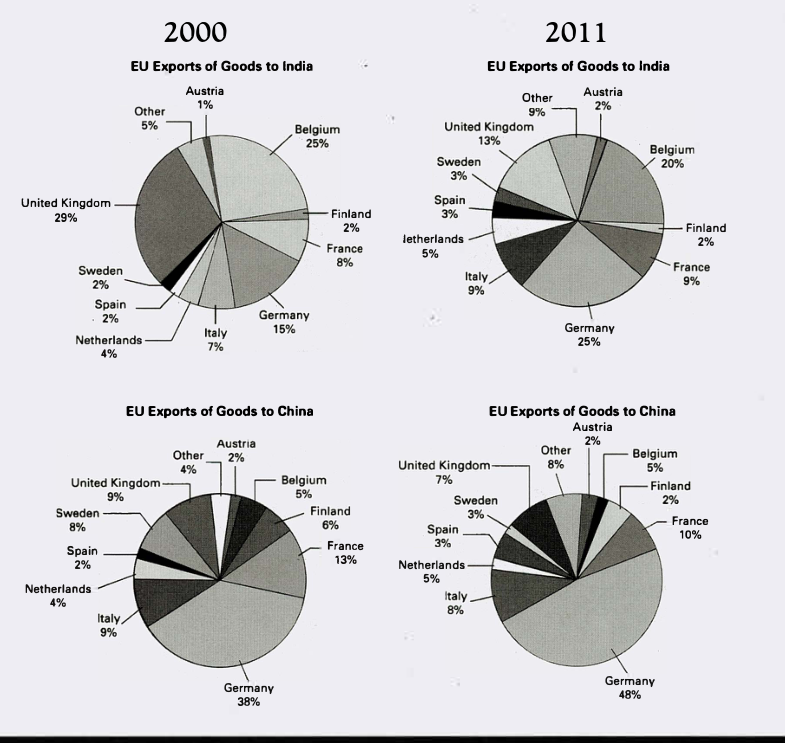
The pie charts below show exports from various EU countries to India and China in 2000 and 2011.
Summarise the information by selecting and reporting the main features, and make comparisons where relevant.
EU Exports of Goods to India and China in 2000 and 2011
Student answer (Band 6.0)
The pie charts illustrate information about the export of India and China from European countries in 2000 and 2011.
Overall, many European countries export to India (except Finland and Belgium) increased while United Kingdom and germany trade surged more. Moreover, Exports with China for Italy, Finland, France and United Kingdom experience a declined whereas Germany's trade surged drastically.
Looking at the detail, Sweden 2%, Spain 2%, Netherlands 4%, Italy 7%, France 8% and Austria 1% trade with india grew for just 1% to 2% from 2000 to 2011. However the major increase was for Germany from 15% to 25% and other's share also boosted from 5% to 9%. In addition, United Kingdom trade declined to 13% from 29% and Belgium's share dropped to 20% from 25%.
Moving toward the China's trade information, smaller contributors saw only modest growth. specifically the share of Spain(2%) and Netherlands(4%) grew by 1%, whereas many smaller contributors saw a decline in their trade as Italy dropped to 8 % form 9%, United Kingdom share decrease to 7% form 9%, France's share shrank to 10% form 13% and Sweden declined to 3% from 8% same for Finland as it change from 6% to 2%. The major surge was for the Germany as it trade rose form 38% to 48%, along with Belgium remain constant at 5%.
AI examiner evaluation
| Criterion | Band |
|---|---|
| Task Achievement / Task Response | 6.5 |
| Coherence and Cohesion | 6.5 |
| Lexical Resource | 6.0 |
| Grammatical Range and Accuracy | 5.5 |
| Overall | 6.0 |
Task Achievement / Task Response: Band 6.5
You identify the main contrasts and provide an overview: India’s UK share fell while Germany’s rose, and Germany remained dominant in exports to China. Most figures you cite are accurate, including the India changes for Germany, the UK and Belgium, and China’s German increase from 38% to 48%. However, the overview is not fully reliable: it says Germany’s trade “surged more” without clearly distinguishing the two destinations, and claims that exports to India increased for “many” countries while excluding Belgium and Finland, although the UK also declined. Some details are unclear or incomplete, such as the India sentence listing several starting shares without consistently giving their 2011 values. A clearer, more precise overview and fuller reporting of the key shifts would strengthen the response.
Coherence and Cohesion: Band 6.5
The response has a recognisable structure: an introduction, an overview, and separate paragraphs for India and China. This makes the two destinations easy to distinguish, and phrases such as “Looking at the detail” and “Moving toward” signal progression. However, some links are mechanical or imprecise, and the overview’s claims do not align neatly with the details that follow. The India paragraph’s long list of countries and percentages is difficult to process because the comparisons are compressed into one sentence. In the China paragraph, “smaller contributors” is repeated, and the sequence shifts between increases and declines without a consistently clear grouping. Organise each paragraph around the largest changes first, then group smaller movements, using clearer references to the years.
Lexical Resource: Band 6.0
You use a reasonable range of task-related vocabulary, including “share,” “contributors,” “declined,” “dropped,” and “surged,” and the meaning is generally understandable. There are also attempts at more formal reporting language, such as “the major increase” and “the major surge.” However, several word choices and collocations are inaccurate or awkward: “export of India and China from European countries” does not clearly express exports to those destinations, while “trade surged more” and “smaller contributors saw only modest growth” are imprecise. Repetition of “share” and “trade” also limits flexibility. Choose standard chart language such as “accounted for,” “rose,” “fell,” and “the proportion of EU exports,” and check spelling and word forms, including “Germany” and “others.”
Grammatical Range and Accuracy: Band 5.5
You attempt both simple and more complex sentences, including contrast clauses beginning with “whereas” and “whereas many smaller contributors…”. The overall meaning can usually be followed, but some errors in sentence structure, agreement, tense and punctuation reduce accuracy. For example, “many European countries export to India … increased” mixes verb forms, and “Germany’s trade surged more” lacks a clear grammatical comparison. In “the Germany as it trade rose,” the article and possessive construction are incorrect; “Belgium remain constant” also has a subject–verb agreement error. Several sentences are overloaded with figures and lack punctuation that would clarify the comparisons. Use consistent past-tense reporting, check subject–verb agreement, and divide long lists into shorter, controlled sentences.
See this exact question answered at other band scores. The same prompt compared across bands.
Browse more IELTS Writing model answers or get your own writing scored by the same AI examiner.